

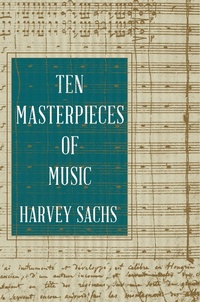
Ten Masterpieces of Music
Description

Some pieces of music survive. Most fall into oblivion. What gives the ten masterpieces selected for this book their exceptional vitality?
In this penetrating volume, Harvey Sachs, acclaimed biographer and historian of classical music, takes readers into the hearts of ten extraordinary works of classical music in ten different genres, showing both the curious novice and the seasoned listener how to recognize, appreciate, and engage with these masterpieces on a historical and compositional level.
Far from what is often thought, classical music is neither dead nor dying. As a genre, it is constantly evolving, its pieces passing through countless permutations and combinations yet always retaining that essential élan vital, or life force. The works collected here, composed in the years between 1784 and 1966, are a testament to this fact. As Sachs skillfully demonstrates, they have endured not because they were exceptionally well-made or interesting but because they were created by composers—Mozart and Beethoven; Schubert, Schumann, Berlioz, Verdi, and Brahms; Sibelius, Prokofiev, and Stravinsky—who had a particular genius for drawing music out of their deepest wellsprings. "Through music,” Sachs writes, "they universalized the intimate.”
In describing how music actually sounds, Ten Masterpieces of Music seems to do the impossible, animating the process of composing as well as the coming together of disparate scales and melodies, trills and harmonies. It tells us, too, how particular compositions came to be, often revealing that the pieces we now consider "classic” were never intended to be so. In poignant, exquisite prose, Sachs shows how Mozart, a former child prodigy under constant pressure to produce new music, hastily penned Piano Concerto No. 17 in G major, one of his finest piano concertos, for a teenage student, and likewise demonstrates how Goethe's Faust, Part One, became a springboard for the musical imagination of the French composer Berlioz.
As Sachs explains, these pieces are not presented as candidates for a new "Top Ten.” They represent neither the most well-known nor the most often-performed works of each composer. Instead, they were chosen precisely because he had something profound to say about them, about their composers, about how each piece fits into its composer's life, and about how each of these lives can be contextualized by time and place. In fact, Sachs encourages readers to form their own favorites, and teaches them how to discern special characteristics that will enhance their own listening experiences.
With Ten Masterpieces of Music, it becomes evident that Sachs has lived with these pieces for a veritable lifetime. His often-soaring descriptions of the works and the dramatic lives of the men who composed them bring a heightened dimension to the musical perceptions of all listeners, communicating both the sheer improbability of a work becoming a classic and why certain pieces—these ten among them—survive the perilous test of time.
More details
Other editions
Additional editions
Person
Content
- Intro
- Title
- Contents
- Preface
- Part I. 1789: Before and After
- 1. "Il catalogo è questo"
- Wolfgang Amadeus Mozart: Concerto No. 17 in G Major for Piano and Orchestra, K. 453 (1784)
- 2. His Imperial Highness's Sore Finger
- Ludwig van Beethoven: Trio in B-flat Major for Piano, Violin, and Cello, Op. 97, "Archduke" (1811)
- Part II. The Romantic Century
- 3. A Quartet That's About Nothing
- Franz Schubert: String Quartet No. 15 in G Major, Op. posth. 161, D. 887 (1826)
- 4. In the Wondrously Disturbing Month of May
- Robert Schumann: Dichterliebe (Poet's Love), Op. 48 (1840)
- 5. A Monument Reimagined
- Hector Berlioz: La Damnation de Faust: Légende dramatique, Op. 24 (1846)
- 6. The Crown, the Cross, and the Cruelty of Love
- Giuseppe Verdi: Don Carlo (1867)
- 7. Almost a Tale of Joy
- Johannes Brahms: String Quintet No. 2 in G Major, Op. 111 (1890)
- Part III. The Age of Uncertainty
- 8. Europe, a Prophecy?
- Jean Sibelius: Symphony No. 4 in A Minor, Op. 63 (1911)
- 9. Creative Suffering
- Sergei Prokofiev: Piano Sonata No. 8 in B-flat Major, Op. 84 (1944)
- 10. An Ice-Cold Question Mark
- Igor Stravinsky: Requiem Canticles for Contralto and Bass Soli, Chorus, and Orchestra (1966)
- Acknowledgments
- Notes
- Some Recordings
- Bibliography
- Index
- Other Books by Harvey Sachs
- Copyright
