

The Development Dictionary
A Guide to Knowledge as Power
2nd Edition
Published on 26. November 2009
353 pages
978-1-84813-381-5 (ISBN)
Description

In this classic collection, some of the world's most eminent critics of development review the key concepts of the development discourse.
Each essay examines one concept from a historical and anthropological point of view, highlights its particular bias, and exposes its historical obsolescence and intellectual sterility. The authors argue that a bidding farewell to the whole Eurocentric development idea is urgently needed, in order to liberate people's minds in both North and South for bold responses to the environmental and ethical challenges now confronting humanity.
The combined result forms a must-read invitation to experts, grassroots movements and students of development to recognize the tainted glasses they put on whenever they participate in the development discourse.
Each essay examines one concept from a historical and anthropological point of view, highlights its particular bias, and exposes its historical obsolescence and intellectual sterility. The authors argue that a bidding farewell to the whole Eurocentric development idea is urgently needed, in order to liberate people's minds in both North and South for bold responses to the environmental and ethical challenges now confronting humanity.
The combined result forms a must-read invitation to experts, grassroots movements and students of development to recognize the tainted glasses they put on whenever they participate in the development discourse.
Reviews / Votes
Short, pithy and well reasoned... There is something in each chapter to challenge, even assault, our dearest, most tightly held assumptions. * Praise for the First Edition, Bulletin of Science, Technology and Society * The Development Dictionary questions the whole basis for twentieth century development through a series of brilliantly written essays by leading writers from around the world. * Praise for the First Edition, Resurgence * Unique...the book is a scream of pain from the receiving end of a process experienced as cultural genocide. * Praise for the First Edition, The Guardian *More details
Series
Edition
2nd New edition
Language
English
Place of publication
London
United Kingdom
Publishing group
Bloomsbury Publishing PLC
Target group
College/higher education
Professional and scholarly
Edition type
New edition
ISBN-13
978-1-84813-381-5 (9781848133815)
Copyright in bibliographic data and cover images is held by Nielsen Book Services Limited or by the publishers or by their respective licensors: all rights reserved.
Schweitzer Classification
Other editions
New editions
E-Book
09/2019
3rd Edition
Zed Books Ltd
€25.49
Available for download
Additional editions
Book
11/2009
2nd Edition
Zed Books Ltd
€48.46
Article exhausted; check for reprint
Person
Wolfgang Sachs is an author and research director at the Wuppertal Institute for Climate, Environment and Energy, in Germany. He has been chair of the board of Greenpeace Germany, a member of the Intergovernmental Panel on Climate Change, and is a member of the Club of Rome. Amongst the various appointments he has held are co-editor of the Society for International Development's journal Development; visiting professor of science, technology and society at Pennsylvania State University and fellow at the Institute for Cultural Studies in Essen. He regularly teaches at Schumacher College and as Honorary Professor at the University of Kassel.
Wolfgang Sachs's first English book, For Love of the Automobile: Looking Back into the History of Our Desires, was published by the University of California Press in 1992. Several of his works have been published by Zed Books. They include the immensely influential Development Dictionary: A Guide to Knowledge as Power (edited, 1992), which has since been translated into numerous languages; Global Ecology: A New Arena of Political Conflict (edited, 1993); Greening the North: A Post-Industrial Blueprint for Ecology and Equity (co-authored with Reinhard Loske and Manfred Linz, 1998); Planet Dialectics: Explorations in Environment and Development (1999) and (with T. Santarius et al) Fair Future: Resource Conflicts, Security, and Global Justice (2007).
Wolfgang Sachs's first English book, For Love of the Automobile: Looking Back into the History of Our Desires, was published by the University of California Press in 1992. Several of his works have been published by Zed Books. They include the immensely influential Development Dictionary: A Guide to Knowledge as Power (edited, 1992), which has since been translated into numerous languages; Global Ecology: A New Arena of Political Conflict (edited, 1993); Greening the North: A Post-Industrial Blueprint for Ecology and Equity (co-authored with Reinhard Loske and Manfred Linz, 1998); Planet Dialectics: Explorations in Environment and Development (1999) and (with T. Santarius et al) Fair Future: Resource Conflicts, Security, and Global Justice (2007).
Content
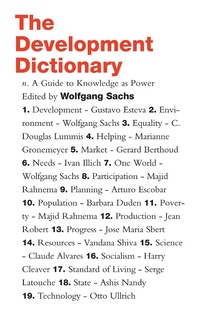
Introduction - Wolfgang Sachs
1. Development - Gustavo Esteva
2. Environment - Wolfgang Sachs
3. Equality - C. Douglas Lummis
4. Helping - Marianne Gronemeyer
5. Market - Gerard Berthoud
6. Needs - Ivan Illich
7. One World - Wolfgang Sachs
8. Participation - Majid Rahnema
9. Planning - Arturo Escobar
10. Population - Barbara Duden
11. Poverty - Majid Rahnema
12. Production - Jean Robert
13. Progress - Jose Maria Sbert
14. Resources - Vandana Shiva
15. Science - Claude Alvares
16. Socialism - Harry Cleaver
17. Standard of Living - Serge Latouche
18. State - Ashis Nandy
19. Technology - Otto Ullrich
1. Development - Gustavo Esteva
2. Environment - Wolfgang Sachs
3. Equality - C. Douglas Lummis
4. Helping - Marianne Gronemeyer
5. Market - Gerard Berthoud
6. Needs - Ivan Illich
7. One World - Wolfgang Sachs
8. Participation - Majid Rahnema
9. Planning - Arturo Escobar
10. Population - Barbara Duden
11. Poverty - Majid Rahnema
12. Production - Jean Robert
13. Progress - Jose Maria Sbert
14. Resources - Vandana Shiva
15. Science - Claude Alvares
16. Socialism - Harry Cleaver
17. Standard of Living - Serge Latouche
18. State - Ashis Nandy
19. Technology - Otto Ullrich
