

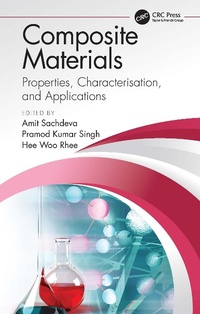
Composite Materials
Properties, Characterisation, and Applications
1st Edition
Published on 11. February 2021
280 pages
978-1-000-32800-4 (ISBN)
Description

Composite Materials: Properties, Characterisation, and Applications provides an in-depth description of the synthesis, properties, and various characterisation techniques used for the study of composite materials.
Covers applications and simulation tests of these advanced materials
Presents real-world examples for demonstration
Discusses surface, thermal, and electrical characterisation techniques
Covers composites for use as sensors
Aimed at industry professionals and researchers, this book offers readers thorough knowledge of the fundamentals as well as advanced level techniques involved in composite material characterisation, development, and applications.
Covers applications and simulation tests of these advanced materials
Presents real-world examples for demonstration
Discusses surface, thermal, and electrical characterisation techniques
Covers composites for use as sensors
Aimed at industry professionals and researchers, this book offers readers thorough knowledge of the fundamentals as well as advanced level techniques involved in composite material characterisation, development, and applications.
More details
Edition
1. Auflage
Language
English
Place of publication
London
United Kingdom
Publishing group
Taylor & Francis Ltd
Target group
Professional and scholarly
Illustrations
10 Tables, black and white; 50 Illustrations, black and white
ISBN-13
978-1-000-32800-4 (9781000328004)
Copyright in bibliographic data and cover images is held by Nielsen Book Services Limited or by the publishers or by their respective licensors: all rights reserved.
Schweitzer Classification
Other editions
New editions
E-Book
08/2022
4th Edition
CRC Press
€69.99
Available for download
Additional editions
Amit Sachdeva | Pramod Kumar Singh | Hee Woo Rhee
Composite Materials
Properties, Characterisation, and Applications
Book
10/2024
1st Edition
CRC Press
€70.40
Shipment within 15-20 days
Amit Sachdeva | Pramod Kumar Singh | Hee Woo Rhee
Composite Materials
Properties, Characterisation, and Applications
Book
02/2021
1st Edition
CRC Press
€186.40
Shipment within 15-20 days
Composite Materials
Properties, Characterisation, and Applications
Book
02/2021
CRC Press
Unfortunately, price unknown
Available (delivery time upon request)
Persons
Dr. Amit Sachdeva is Associate Professor at Lovely Professional University, Jalandhar. Punjab, India. He has teaching experience of more than 7 years and his field of specialisation is Material Technology. Dr. Sachdeva has authored around 20 technical research papers in SCI, Scopus, indexed quality journals and National/International Conferences. Dr. Sachdeva is also editorial member of various scientific indexed journals and is lifetime member of IAENG and IFERP. Dr. Sachdeva has received Young Scientist Award from University of Malaya, at ICFPAM 2019. He has participated in around 15 international conferences and have also been part of organising committee in 6 international conferences. Dr. Sachdeva also coordinates all the FDPs along with academia-industry interface at Lovely Professional University.
Prof. (Dr.) Pramod Kumar Singh got Ph.D. degree from Banaras Hindu University, India and is currently working as a Professor at the Department of Physics, School of Basic Sciences and Research, at Sharda University. As a postdoctoral fellow, Dr. Singh has spent six years abroad visiting South Korea, Norway and Turkey. Dr. Singh has published more than 150 International Journals (since January 2020) and five book chapters. He is currently associated as an editorial board member of 5 International Journals. His area of research includes Polymer Electrolyte, Nanoporous materials for energy devices, Dye sensitized solar cell, and Supercapacitors.
Prof. Hee-Woo Rhee got his Ph.D. degree from the University of Connecticut, US, and is currently working as a Professor at the Department of Chemical and Biomolecular Engineering at Sogang University in Seoul, Korea. Prof. Rhee has wide research experience and he is additionally appointed as the Director at Samsung Display Research Center in South Korea.
Prof. Rhee has published more than 250 International Journals (since January 2020) and twelve book chapters. He is currently associated as an editorial board member of many International Journals. His area of research includes Polymer Electrolyte, Nanoporous materials for energy devices, Dye sensitized solar cell, and Fuel Cell.
Prof. (Dr.) Pramod Kumar Singh got Ph.D. degree from Banaras Hindu University, India and is currently working as a Professor at the Department of Physics, School of Basic Sciences and Research, at Sharda University. As a postdoctoral fellow, Dr. Singh has spent six years abroad visiting South Korea, Norway and Turkey. Dr. Singh has published more than 150 International Journals (since January 2020) and five book chapters. He is currently associated as an editorial board member of 5 International Journals. His area of research includes Polymer Electrolyte, Nanoporous materials for energy devices, Dye sensitized solar cell, and Supercapacitors.
Prof. Hee-Woo Rhee got his Ph.D. degree from the University of Connecticut, US, and is currently working as a Professor at the Department of Chemical and Biomolecular Engineering at Sogang University in Seoul, Korea. Prof. Rhee has wide research experience and he is additionally appointed as the Director at Samsung Display Research Center in South Korea.
Prof. Rhee has published more than 250 International Journals (since January 2020) and twelve book chapters. He is currently associated as an editorial board member of many International Journals. His area of research includes Polymer Electrolyte, Nanoporous materials for energy devices, Dye sensitized solar cell, and Fuel Cell.
Content
Chapter 1 Introduction to Composite Materials
Chapter 2 Biocomposites and Nanocomposites
Chapter 3 Properties of Composite Materials
Chapter 4 Synthesis of a Hybrid Self-Cleaning Coating System for Glass
Chapter 5 Experimental and Characterization Techniques
Chapter 6 Electrical Characterization of Electro-Ceramics
Chapter 7 Thermal Characterization of Composites
Chapter 8 Mechanical Characterization Techniques for Composite Materials
Chapter 9 Humidity Sensor Based on Alum-Fly Ash Composite
Chapter 10 Applications of Graphene-Based Composite Materials
Chapter 11 Low Power Ge-Si0.7Ge0.3 nJLTFET and pJLTFET Designand Characterization in Sub-20 nm Technology Node
Chapter 12 Influence of Moisture Uptake on Mechanical Properties of Natural Fiber-Reinforced Polymer Composites
Chapter 13 Exploring the Potential of Nanotechnology in Agriculture: Current Research and Future Prospects
Chapter 14 Nanostructuring of Materials by Severe Deformation Processes
Chapter 2 Biocomposites and Nanocomposites
Chapter 3 Properties of Composite Materials
Chapter 4 Synthesis of a Hybrid Self-Cleaning Coating System for Glass
Chapter 5 Experimental and Characterization Techniques
Chapter 6 Electrical Characterization of Electro-Ceramics
Chapter 7 Thermal Characterization of Composites
Chapter 8 Mechanical Characterization Techniques for Composite Materials
Chapter 9 Humidity Sensor Based on Alum-Fly Ash Composite
Chapter 10 Applications of Graphene-Based Composite Materials
Chapter 11 Low Power Ge-Si0.7Ge0.3 nJLTFET and pJLTFET Designand Characterization in Sub-20 nm Technology Node
Chapter 12 Influence of Moisture Uptake on Mechanical Properties of Natural Fiber-Reinforced Polymer Composites
Chapter 13 Exploring the Potential of Nanotechnology in Agriculture: Current Research and Future Prospects
Chapter 14 Nanostructuring of Materials by Severe Deformation Processes
