

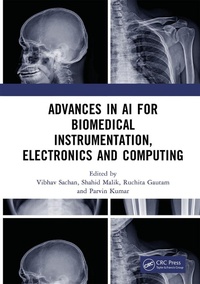
Advances in AI for Biomedical Instrumentation, Electronics and Computing
Proceedings of the 5th International Conference on Advances in AI for Biomedical Instrumentation, Electronics and Computing (ICABEC - 2023), 22-23 December 2023, India
1st Edition
Published on 13. June 2024
632 pages
978-1-040-11859-7 (ISBN)
Description

This book contains the proceedings of 5th International Conference on Advances in AI for Biomedical Instrumentation, Electronics and Computing (ICABEC - 2023), which provided an international forum for the exchange of ideas among researchers, students, academicians, and practitioners.
It presents original research papers on subjects of AI, Biomedical, Communications & Computing Systems. Some interesting topics it covers are enhancing air quality prediction using machine learning, optimization of leakage power consumption using hybrid techniques, multi-robot path planning in complex industrial dynamic environment, enhancing prediction accuracy of earthquake using machine learning algorithms and advanced machine learning models for accurate cancer diagnostics.
Containing work presented by a diverse range of researchers, this book will be of interest to students and researchers in the fields of Electronics and Communication Engineering, Computer Science Engineering, Information Technology, Electrical Engineering, Electronics and Instrumentation Engineering, Computer applications and all interdisciplinary streams of Engineering Sciences.
It presents original research papers on subjects of AI, Biomedical, Communications & Computing Systems. Some interesting topics it covers are enhancing air quality prediction using machine learning, optimization of leakage power consumption using hybrid techniques, multi-robot path planning in complex industrial dynamic environment, enhancing prediction accuracy of earthquake using machine learning algorithms and advanced machine learning models for accurate cancer diagnostics.
Containing work presented by a diverse range of researchers, this book will be of interest to students and researchers in the fields of Electronics and Communication Engineering, Computer Science Engineering, Information Technology, Electrical Engineering, Electronics and Instrumentation Engineering, Computer applications and all interdisciplinary streams of Engineering Sciences.
More details
Edition
1. Auflage
Language
English
Place of publication
London
United Kingdom
Publishing group
Taylor & Francis Ltd
Target group
College/higher education
Professional and scholarly
ISBN-13
978-1-040-11859-7 (9781040118597)
Copyright in bibliographic data and cover images is held by Nielsen Book Services Limited or by the publishers or by their respective licensors: all rights reserved.
Schweitzer Classification
Other editions
Additional editions
Vibhav Sachan | Shahid Malik | Ruchita Gautam
Advances in AI for Biomedical Instrumentation, Electronics and Computing
Proceedings of the 5th International Conference on Advances in AI for Biomedical Instrumentation, Electronics and Computing (ICABEC - 2023), 22-23 December 2023, India
Book
06/2024
1st Edition
CRC Press
€186.30
Shipment within 10-20 days
Persons
Prof. (Dr.) Vibhav Sachan is the Professor, Dean (Research & Development) & Head of Department of Electronics & Communication Engineering Department at KIET Group of Institutions, Ghaziabad, Uttar Pradesh. He completed his B.Tech. with distinction in 2001, M.Tech. with distinction in 2006 and Ph.D. in 2014. Dr. Sachan started his career as Lecturer of Electronics & Communication Engineering at KIET Group of Institutions, Ghaziabad, Uttar Pradesh in August 2001. During his academic career of 23 years, Dr. Sachan has taught various subjects at UG/PG levels and has authored 40 books, edited 04 conference proceedings and written 08 chapters in different books. He has published 50 papers in reputed International journals, 8 papers in National journals and 60 papers in proceedings of International / National Conferences. He is on the editorial board of different International & National journals. He is the recipient of merit Scholarship throughout education. Dr. Sachan has also received Dr. CV Raman Award, Dronacharya Award & Letters of Appreciation for his contributions as Additional Head of Department and Coordinator of Administrative Assignments by the Director General of KIET Group of Institutions, Ghaziabad and Director of KIET Group of Institutions, Ghaziabad respectively. He has Granted/Published Eight patents. He has completed four government-sponsored research projects. One Paper published in Nature Journal. He is guiding 04 Ph.D. students. His current research interests are in the field of Wireless Sensor Networks, communications and Signal processing.
Dr. Shahid Malik is working as an Assistant Professor in Centre for Sensors, Instrumentation and Cyber-Physical Systems Engineering (SeNSE), IIT Delhi India. Shahid Malik was born in Rajasthan, India, in 1992. He received his Ph.D. degree from IIT Bombay. He obtained his Master's degree from Jamia Millia Islamia University, New Delhi, India, with a specialization in control and instrumentation systems in 2014. He worked as the Guest Faculty Member at the Malaviya National Institute of Technology at Jaipur (MNIT-Jaipur), Jaipur, India, in 2014 and associated with Central Electronics Engineering Research Institute (CSIR-CEERI), Pilani, India, from 2014 to 2015. He worked as a research associate at Department of Electrical and Electronics Engineering, Imperial College London. He has also been associated with Tufts University, Boston, MA, USA, and BCN-MedTECH, UPF, Barcelona, Spain as a Visiting Scholar. His research interests include Electronic Instrumentation and Sensors Systems, Embedded Sensing Systems for Industrial and Biomedical Applications, Mixed Signal Conditioning Circuits and Sensor Interface Circuits, and Wearable and Injectable Embedded Sensing Systems. He has also received Research projects from Technology Innovation Hub, IIT (ISM Dhanbad) and SERB Govt. of India.
Dr Ruchita Gautam, Associate Dean (Research & Development) & Addl. Head of Department of Electronics & Communication Engineering at KIET Group of Institutions, Ghaziabad, Uttar Pradesh. She has obtained her Bachelor's degree in Electronics and Communication Engineering from Rajasthan University in 2005. Then she obtained her Master's degree in Digital Communication from Rajasthan Technical University in 2009 and completed her Ph.D. from Banasthali Vidhyapith, Rajasthan in 2017. Her current research interests are Solar Cells, Microwaves and Antennas. She has total work experience of 18+ years.
Dr. Parvin Kumar is Professor (ECE), Overall NIRF Coordinator (Institute Level) and Assistant Dean (R&D) at KIET Group of Institutions, Delhi-NCR, Ghaziabad, India-201206. He has received his Ph.D. degree from State Goverenment Dr. A.P.J. Abdul Kalam Technical University, Lucknow (Uttar Pradesh), India and Master of Technology (with honours) degree & Bachelor of Technology (with honours) degree in Electronics and Communication Engineering from Kurkshetra University Kurukshetra, Kurukshetra. During his academic career of 15 years, he has taught various subjects at UG/PG levels. He as Incharge of Sapce Technologies, CoE, KIET signed MoU with SAC, ISRO, Ahmadabad. He has Granted/Published fifteen patents. He has published more than 75 research papers in various International Journals. He has completed four government-sponsored projects. He is guiding 2 Ph.D. students of Delhi Technological University, Delhi and 1 Ph.D. student of SRM University as Joint Supervisor. He has also guided 10 M.Tech scholars and more than 300 B.Tech students. He Qualified International Certificate: Certified LabVIEW Associate Developer (CLAD) Certification and NI Faculty Trainer. He joined KIET Group of Institutions, Delhi-NCR, Ghaziabad, Uttar Pradesh, India, in 2011, working in areas of Wireless & Mobile Communication, Biomedical Signal Processing, Space Technologies. His research interest includes 6G, 5G, radio over fiber systems, design and analysis of Biomedical Industry Product design, design and analysis of payloads for Nano-Satellite. He is also a reviewer of many journals and a member of the technical program committees of different conferences. Along with being a good academics background, he has also handled no. of administrative assignments successfully and made exemplary contributions through his dedicated, committed and innovative approach with high integrity.
Dr. Shahid Malik is working as an Assistant Professor in Centre for Sensors, Instrumentation and Cyber-Physical Systems Engineering (SeNSE), IIT Delhi India. Shahid Malik was born in Rajasthan, India, in 1992. He received his Ph.D. degree from IIT Bombay. He obtained his Master's degree from Jamia Millia Islamia University, New Delhi, India, with a specialization in control and instrumentation systems in 2014. He worked as the Guest Faculty Member at the Malaviya National Institute of Technology at Jaipur (MNIT-Jaipur), Jaipur, India, in 2014 and associated with Central Electronics Engineering Research Institute (CSIR-CEERI), Pilani, India, from 2014 to 2015. He worked as a research associate at Department of Electrical and Electronics Engineering, Imperial College London. He has also been associated with Tufts University, Boston, MA, USA, and BCN-MedTECH, UPF, Barcelona, Spain as a Visiting Scholar. His research interests include Electronic Instrumentation and Sensors Systems, Embedded Sensing Systems for Industrial and Biomedical Applications, Mixed Signal Conditioning Circuits and Sensor Interface Circuits, and Wearable and Injectable Embedded Sensing Systems. He has also received Research projects from Technology Innovation Hub, IIT (ISM Dhanbad) and SERB Govt. of India.
Dr Ruchita Gautam, Associate Dean (Research & Development) & Addl. Head of Department of Electronics & Communication Engineering at KIET Group of Institutions, Ghaziabad, Uttar Pradesh. She has obtained her Bachelor's degree in Electronics and Communication Engineering from Rajasthan University in 2005. Then she obtained her Master's degree in Digital Communication from Rajasthan Technical University in 2009 and completed her Ph.D. from Banasthali Vidhyapith, Rajasthan in 2017. Her current research interests are Solar Cells, Microwaves and Antennas. She has total work experience of 18+ years.
Dr. Parvin Kumar is Professor (ECE), Overall NIRF Coordinator (Institute Level) and Assistant Dean (R&D) at KIET Group of Institutions, Delhi-NCR, Ghaziabad, India-201206. He has received his Ph.D. degree from State Goverenment Dr. A.P.J. Abdul Kalam Technical University, Lucknow (Uttar Pradesh), India and Master of Technology (with honours) degree & Bachelor of Technology (with honours) degree in Electronics and Communication Engineering from Kurkshetra University Kurukshetra, Kurukshetra. During his academic career of 15 years, he has taught various subjects at UG/PG levels. He as Incharge of Sapce Technologies, CoE, KIET signed MoU with SAC, ISRO, Ahmadabad. He has Granted/Published fifteen patents. He has published more than 75 research papers in various International Journals. He has completed four government-sponsored projects. He is guiding 2 Ph.D. students of Delhi Technological University, Delhi and 1 Ph.D. student of SRM University as Joint Supervisor. He has also guided 10 M.Tech scholars and more than 300 B.Tech students. He Qualified International Certificate: Certified LabVIEW Associate Developer (CLAD) Certification and NI Faculty Trainer. He joined KIET Group of Institutions, Delhi-NCR, Ghaziabad, Uttar Pradesh, India, in 2011, working in areas of Wireless & Mobile Communication, Biomedical Signal Processing, Space Technologies. His research interest includes 6G, 5G, radio over fiber systems, design and analysis of Biomedical Industry Product design, design and analysis of payloads for Nano-Satellite. He is also a reviewer of many journals and a member of the technical program committees of different conferences. Along with being a good academics background, he has also handled no. of administrative assignments successfully and made exemplary contributions through his dedicated, committed and innovative approach with high integrity.
Content
Category
1 AI Based Biomedical Instrumentation
1
Signal Processing and Image Analysis for Biomedical Instrumentation
Topics
related to processing and analyzing medical signals and images using AI, such as ECG, EEG, MRI, and
CT scans
2
Wearable and Implantable Medical Devices and Systems
Focus
on the design, development, and application of AI in wearable and implantable medical devices, such
as smart sensors, pacemakers, and artificial limbs
3
Intelligent Medical Robotics and Automation
This
track explore the use of AI and machine learning in medical robotics and automation, including robotic
surgery, drug delivery, and patient monitoring
4
Human Machine Interfaces and Brain Computer Interfaces
This
track cover the development and application of AI based human machine and brain computer interfaces
in healthcare
Category
2 Applications of AI and ML for Electronics and Signal Processing
6
Machine Learning and Data Analytics for Biomedical Applications
This
track cover the application of AI and machine learning in biomedical data analysis and decision making,
such as disease diagnosis, prognosis, and treatment planning
7
Big Data and Cloud Computing for Biomedical Applications
This
track could focus on the use of AI and cloud computing in handling and analyzing large scale biomedical
data, such as genomics, proteomics, and electronic health records
8
Healthcare Information Systems and Electronic Health Records
explore
the use of AI and machine learning in managing and analyzing electronic health records and
healthcare information systems, including clinical decision support systems and disease registries
Category
3 Generalized Tracks for Space Technologies, Electronics Engineering, and Image
Processing
9
Space based Medical Technologies and Satellite Program
This
track cover the use of AI and machine learning in designing and developing medical technologies for
space applications, such as remote diagnosis and Health Monitoring, Space based Medical Technologies
10
Electronic Circuits and devices for Biomedical Applications
This
track explore the application of electronic engineering principles, circuits and techniques in biomedical
research and healthcare
11
Image Processing for Biomedical Applications
This
track focus on the use of image processing techniques in biomedical research and healthcare, including
medical image analysis and computer aided diagnosis
12
Drug Discovery and Development
This
track includes the development of various drug discoveries for medical applications
1 AI Based Biomedical Instrumentation
1
Signal Processing and Image Analysis for Biomedical Instrumentation
Topics
related to processing and analyzing medical signals and images using AI, such as ECG, EEG, MRI, and
CT scans
2
Wearable and Implantable Medical Devices and Systems
Focus
on the design, development, and application of AI in wearable and implantable medical devices, such
as smart sensors, pacemakers, and artificial limbs
3
Intelligent Medical Robotics and Automation
This
track explore the use of AI and machine learning in medical robotics and automation, including robotic
surgery, drug delivery, and patient monitoring
4
Human Machine Interfaces and Brain Computer Interfaces
This
track cover the development and application of AI based human machine and brain computer interfaces
in healthcare
Category
2 Applications of AI and ML for Electronics and Signal Processing
6
Machine Learning and Data Analytics for Biomedical Applications
This
track cover the application of AI and machine learning in biomedical data analysis and decision making,
such as disease diagnosis, prognosis, and treatment planning
7
Big Data and Cloud Computing for Biomedical Applications
This
track could focus on the use of AI and cloud computing in handling and analyzing large scale biomedical
data, such as genomics, proteomics, and electronic health records
8
Healthcare Information Systems and Electronic Health Records
explore
the use of AI and machine learning in managing and analyzing electronic health records and
healthcare information systems, including clinical decision support systems and disease registries
Category
3 Generalized Tracks for Space Technologies, Electronics Engineering, and Image
Processing
9
Space based Medical Technologies and Satellite Program
This
track cover the use of AI and machine learning in designing and developing medical technologies for
space applications, such as remote diagnosis and Health Monitoring, Space based Medical Technologies
10
Electronic Circuits and devices for Biomedical Applications
This
track explore the application of electronic engineering principles, circuits and techniques in biomedical
research and healthcare
11
Image Processing for Biomedical Applications
This
track focus on the use of image processing techniques in biomedical research and healthcare, including
medical image analysis and computer aided diagnosis
12
Drug Discovery and Development
This
track includes the development of various drug discoveries for medical applications
