

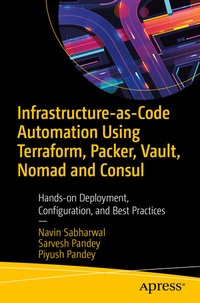
Infrastructure-as-Code Automation Using Terraform, Packer, Vault, Nomad and Consul
Description

Discover the methodologies and best practices for getting started with HashiCorp tools, including Terraform, Vault, and Packer. The book begins with an introduction to the infrastructure-as-code concept while establishing the need for automation and management technologies. You'll go over hands-on deployment, configuration, and best practices for Terraform, Packer, Vault, Nomad, and Consul. You'll then delve deeper into developing automation code using Terraform for automating AWS/Azure/GCP public cloud tasks; advanced topics include leveraging Vault for secrets management and Packer for image management.
Along the way you will also look at Nomad and Consul for managing application orchestration along with network interconnectivity. In each chapter you will cover automated infrastructure and application deployment on the VM/container base ecosystem. The book provides sample code and best-practice guidance for developers and architects to look at infrastructure-as-code adoptionfrom a holistic viewpoint.All the code presented in the book is available in the form of scripts, which allow you to try out the examples and extend them in interesting ways.
What You Will Learn
- Get an overview of the architecture of Terraform, Vault, Packer, Nomad, and Consul
- Follow hands-on steps for enabling Terraform, Vault, Packer, Nomad, and Consul
- Automate various services on the public cloud, including AWS, Azure, and GCP
Who This Book Is For
Developers, architects, and administrators who want to learn about infrastructure-as-code automation.
More details
Other editions
Additional editions
Persons
Navin Sabharwal is an innovator, thought leader, author, and consultant in the areas of AI, machine learning, cloud computing, big data analytics, and software product development. He is responsible for IP development and service delivery in the areas of AI and machine learning, automation products, GCP, cloud computing, public cloud AWS, and Microsoft Azure. Navin has created niche award-winning products and solutions and has filed numerous patents in diverse fields such as IT services, assessment engines, ranking algorithms, capacity planning engines, and knowledge management.
Sarvesh Pandey is an innovator and thought leader in the area of hybrid cloud lifecycle automation covering technologies such as cloud management automation, and infrastructure-as-code and runbook automation with overall 15 years of IT experience. He currently works as associate director and practice head for cloud management automation in the HCL DRYiCE practice focusing on planning, designing, and managing multiple infrastructure automation projects of strategic importance to the cloud journey and the IAC framework. He possesses excellent experience of working with highly engineered systems which require deep understanding of cutting-edge technology and their key drivers in multiple markets.Piyush is a solution architect for automation, DevOps, and cloud services with overall ten years of IT experience. Piyush is currently working as a deputy general manager at HCL DRYiCE practice focusing on creating solutions catering to cloud adoption (including cloud landing zone, migration, and operations), automation, orchestration, and cloud lifecycle management.
