

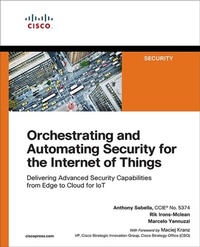
Orchestrating and Automating Security for the Internet of Things
Delivering Advanced Security Capabilities from Edge to Cloud for IoT
1st Edition
Published on 4. June 2018
1008 pages
978-0-13-475691-2 (ISBN)
Description

Master powerful techniques and approaches for securing IoT systems of all kinds-current and emerging
Internet of Things (IoT) technology adoption is accelerating, but IoT presents complex new security challenges. Fortunately, IoT standards and standardized architectures are emerging to help technical professionals systematically harden their IoT environments. In Orchestrating and Automating Security for the Internet of Things, three Cisco experts show how to safeguard current and future IoT systems by delivering security through new NFV and SDN architectures and related IoT security standards.
The authors first review the current state of IoT networks and architectures, identifying key security risks associated with nonstandardized early deployments and showing how early adopters have attempted to respond. Next, they introduce more mature architectures built around NFV and SDN. You'll discover why these lend themselves well to IoT and IoT security, and master advanced approaches for protecting them. Finally, the authors preview future approaches to improving IoT security and present real-world use case examples.
This is an indispensable resource for all technical and security professionals, business security and risk managers, and consultants who are responsible for systems that incorporate or utilize IoT devices, or expect to be responsible for them.
? Understand the challenges involved in securing current IoT networks and architectures
? Master IoT security fundamentals, standards, and modern best practices
? Systematically plan for IoT security
? Leverage Software-Defined Networking (SDN) and Network Function Virtualization (NFV) to harden IoT networks
? Deploy the advanced IoT platform, and use MANO to manage and orchestrate virtualized network functions
? Implement platform security services including identity, authentication, authorization, and accounting
? Detect threats and protect data in IoT environments
? Secure IoT in the context of remote access and VPNs
? Safeguard the IoT platform itself
? Explore use cases ranging from smart cities and advanced energy systems to the connected car
? Preview evolving concepts that will shape the future of IoT security
Internet of Things (IoT) technology adoption is accelerating, but IoT presents complex new security challenges. Fortunately, IoT standards and standardized architectures are emerging to help technical professionals systematically harden their IoT environments. In Orchestrating and Automating Security for the Internet of Things, three Cisco experts show how to safeguard current and future IoT systems by delivering security through new NFV and SDN architectures and related IoT security standards.
The authors first review the current state of IoT networks and architectures, identifying key security risks associated with nonstandardized early deployments and showing how early adopters have attempted to respond. Next, they introduce more mature architectures built around NFV and SDN. You'll discover why these lend themselves well to IoT and IoT security, and master advanced approaches for protecting them. Finally, the authors preview future approaches to improving IoT security and present real-world use case examples.
This is an indispensable resource for all technical and security professionals, business security and risk managers, and consultants who are responsible for systems that incorporate or utilize IoT devices, or expect to be responsible for them.
? Understand the challenges involved in securing current IoT networks and architectures
? Master IoT security fundamentals, standards, and modern best practices
? Systematically plan for IoT security
? Leverage Software-Defined Networking (SDN) and Network Function Virtualization (NFV) to harden IoT networks
? Deploy the advanced IoT platform, and use MANO to manage and orchestrate virtualized network functions
? Implement platform security services including identity, authentication, authorization, and accounting
? Detect threats and protect data in IoT environments
? Secure IoT in the context of remote access and VPNs
? Safeguard the IoT platform itself
? Explore use cases ranging from smart cities and advanced energy systems to the connected car
? Preview evolving concepts that will shape the future of IoT security
All prices
More details
Edition
1. Auflage
Language
English
Place of publication
Indianapolis
United States
Publishing group
Pearson Education (US)
Target group
Professional and scholarly
File size
49,33 MB
ISBN-13
978-0-13-475691-2 (9780134756912)
Copyright in bibliographic data and cover images is held by Nielsen Book Services Limited or by the publishers or by their respective licensors: all rights reserved.
Schweitzer Classification
Other editions
Additional editions
Anthony Sabella | Marcelo Yannuzzi | Rik Irons-Mclean
Orchestrating and Automating Security for the Internet of Things
Delivering Advanced Security Capabilities from Edge to Cloud for IoT
Book
08/2018
Cisco Press
€74.50
Shipment within 3-4 weeks
Persons
Anthony Sabella, CCIE No. 5374, is the lead cybersecurity architect for the Enterprise Chief Technology Office at Cisco and has worked at Cisco for eight years. Anthony leads innovative work streams on methods to break free from manual tasks by applying the latest virtualization and orchestration techniques to cybersecurity. He combines this with machine learning concepts and the ingestion of intelligence feeds, to design effective solutions that can self-manage and self-heal. Anthony applies these concepts across a variety of use cases, including financial institutions, healthcare, energy, and manufacturing (examples included in this book).
Before joining Cisco, Anthony worked as principal engineer for a global service provider for 13 years, where he created cybersecurity solutions for enterprise customers. Anthony was also the cofounder and CTO for a technology consulting firm responsible for designing cybersecurity solutions for both commercial and enterprise customers. Anthony's expertise has resulted in speaking engagements at major conferences around the world for both Cisco and its major partners. Anthony holds a master's degree in computer science and an active CCIE, and he is a contributing member in the IEEE Cyber Security community.
Rik Irons-Mclean is the Industry Principal for Oil & Gas at Cisco. Rik has worked at Cisco for 11 years and has had lead roles in IoT/IIoT, communications and security for power utilities and process control industries, and energy management and optimization. He has led technical global teams in taking new products to market in all theaters, specializing in driving new technology adoption in both established and emerging markets. Before joining Cisco, he worked for a Cisco service provider partner for eight years, where he focused on converged solutions.
Rik has represented Cisco in a number of industry and standards bodies, including Open Process Automation, IEC 61850 for industrial communications, and IEC 62351 for industrial security. Additionally, he elected the U.K. lead for Cigre SC D2 for communications and security in the power industry. Rik has written for a number of industry publications and authored whitepapers on such topics as industrial cybersecurity, IoT security, distributed industrial control systems, next-generation operational field telecoms, fog computing, and digital IoT fabric architectures.
Rik holds a bachelor of science degree and a master of business administration degree, focused on international leadership. He is currently studying for a doctorate in cybersecurity.
Marcelo Yannuzzi is a principal engineer at the Chief Strategy Office in Cisco. Marcelo leads strategic innovation in the areas of IoT, security, and novel architectures fusing cloud and fog computing. He has led flagship innovations across different industry verticals, some of which are outlined in this book. Marcelo also provides strategic advisory on new business opportunities and technologies for Cisco and start-ups.
Before joining Cisco, Marcelo was the head of the Advanced Network Architectures Lab at the Department of Computer Architecture in a Barcelona university. He was the cofounder and CTO of a start-up for which Cisco was its first customer. Marcelo is the author of more than 100 peer-reviewed publications, including top journals and conferences in the areas of IoT, fog computing, security, NFV, software-defined systems (SDX), multilayer network management and control, sensor networks, and mobility. Marcelo has led several European research projects and contracts in the industry, and his research was funded multiple times by Cisco. He is a frequent speaker and invited panelist at major conferences and forums. He held previous positions as an assistant professor at the physics department in a university's school of engineering.
Marcelo holds a bachelor's degree in electrical engineering and both a master of science degree and a Ph.D. in computer science.
Before joining Cisco, Anthony worked as principal engineer for a global service provider for 13 years, where he created cybersecurity solutions for enterprise customers. Anthony was also the cofounder and CTO for a technology consulting firm responsible for designing cybersecurity solutions for both commercial and enterprise customers. Anthony's expertise has resulted in speaking engagements at major conferences around the world for both Cisco and its major partners. Anthony holds a master's degree in computer science and an active CCIE, and he is a contributing member in the IEEE Cyber Security community.
Rik Irons-Mclean is the Industry Principal for Oil & Gas at Cisco. Rik has worked at Cisco for 11 years and has had lead roles in IoT/IIoT, communications and security for power utilities and process control industries, and energy management and optimization. He has led technical global teams in taking new products to market in all theaters, specializing in driving new technology adoption in both established and emerging markets. Before joining Cisco, he worked for a Cisco service provider partner for eight years, where he focused on converged solutions.
Rik has represented Cisco in a number of industry and standards bodies, including Open Process Automation, IEC 61850 for industrial communications, and IEC 62351 for industrial security. Additionally, he elected the U.K. lead for Cigre SC D2 for communications and security in the power industry. Rik has written for a number of industry publications and authored whitepapers on such topics as industrial cybersecurity, IoT security, distributed industrial control systems, next-generation operational field telecoms, fog computing, and digital IoT fabric architectures.
Rik holds a bachelor of science degree and a master of business administration degree, focused on international leadership. He is currently studying for a doctorate in cybersecurity.
Marcelo Yannuzzi is a principal engineer at the Chief Strategy Office in Cisco. Marcelo leads strategic innovation in the areas of IoT, security, and novel architectures fusing cloud and fog computing. He has led flagship innovations across different industry verticals, some of which are outlined in this book. Marcelo also provides strategic advisory on new business opportunities and technologies for Cisco and start-ups.
Before joining Cisco, Marcelo was the head of the Advanced Network Architectures Lab at the Department of Computer Architecture in a Barcelona university. He was the cofounder and CTO of a start-up for which Cisco was its first customer. Marcelo is the author of more than 100 peer-reviewed publications, including top journals and conferences in the areas of IoT, fog computing, security, NFV, software-defined systems (SDX), multilayer network management and control, sensor networks, and mobility. Marcelo has led several European research projects and contracts in the industry, and his research was funded multiple times by Cisco. He is a frequent speaker and invited panelist at major conferences and forums. He held previous positions as an assistant professor at the physics department in a university's school of engineering.
Marcelo holds a bachelor's degree in electrical engineering and both a master of science degree and a Ph.D. in computer science.
Content
Chapter 1 Evolution of the Internet of Things (IoT)
Chapter 2 Planning for IoT Security
Chapter 3 IoT Security Fundamentals
Chapter 4 IoT and Security Standards and Best Practices
Chapter 5 Current IoT Architecture Design and Challenges
Chapter 6 Evolution and Benefits of SDX and NFV Technologies and Their Impact on IoT
Chapter 7 Securing SDN and NFV Environments
Chapter 8 The Advanced IoT Platform and MANO
Chapter 9 Identity, Authentication, Authorization, and Accounting
Chapter 10 Threat Defense
Chapter 11 Data Protection in IoT
Chapter 12 Remote Access and Virtual Private Networks (VPN)
Chapter 13 Securing the Platform Itself
Chapter 14 Smart Cities
Chapter 15 Industrial Environments: Oil and Gas
Chapter 16 The Connected Car
Chapter 17 Evolving Concepts That Will Shape the Security Service Future
Chapter 2 Planning for IoT Security
Chapter 3 IoT Security Fundamentals
Chapter 4 IoT and Security Standards and Best Practices
Chapter 5 Current IoT Architecture Design and Challenges
Chapter 6 Evolution and Benefits of SDX and NFV Technologies and Their Impact on IoT
Chapter 7 Securing SDN and NFV Environments
Chapter 8 The Advanced IoT Platform and MANO
Chapter 9 Identity, Authentication, Authorization, and Accounting
Chapter 10 Threat Defense
Chapter 11 Data Protection in IoT
Chapter 12 Remote Access and Virtual Private Networks (VPN)
Chapter 13 Securing the Platform Itself
Chapter 14 Smart Cities
Chapter 15 Industrial Environments: Oil and Gas
Chapter 16 The Connected Car
Chapter 17 Evolving Concepts That Will Shape the Security Service Future
