

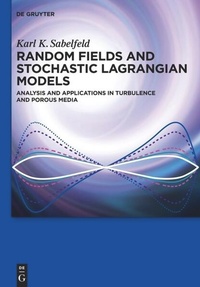
Random Fields and Stochastic Lagrangian Models
Description

The book presents advanced stochastic models and simulation methods for random flows and transport of particles by turbulent velocity fields and flows in porous media. Two main classes of models are constructed: (1) turbulent flows are modeled as synthetic random fields which have certain statistics and features mimicing those of turbulent fluid in the regime of interest, and (2) the models are constructed in the form of stochastic differential equations for stochastic Lagrangian trajectories of particles carried by turbulent flows.
The book is written for mathematicians, physicists, and engineers studying processes associated with probabilistic interpretation, researchers in applied and computational mathematics, in environmental and engineering sciences dealing with turbulent transport and flows in porous media, as well as nucleation, coagulation, and chemical reaction analysis under fluctuation conditions. It can be of interest for students and post-graduates studying numerical methods for solving stochastic boundary value problems of mathematical physics and dispersion of particles by turbulent flows and flows in porous media.
More details
Other editions
Additional editions

Persons
Content
2 - 1 Introduction [Seite 17]
2.1 - 1.1 Why random fields? [Seite 17]
2.2 - 1.2 Some examples [Seite 19]
2.3 - 1.3 Fundamental concepts [Seite 24]
2.3.1 - 1.3.1 Random functions in a broad sense [Seite 25]
2.3.2 - 1.3.2 Gaussian random vectors [Seite 29]
2.3.3 - 1.3.3 Gaussian random functions [Seite 30]
2.3.4 - 1.3.4 Random fields [Seite 32]
2.3.5 - 1.3.5 Stochastic measures and integrals [Seite 33]
2.3.6 - 1.3.6 Integral representation of random functions [Seite 35]
2.3.7 - 1.3.7 Random trajectories [Seite 37]
2.3.8 - 1.3.8 Stochastic differential, Ito integrals [Seite 38]
2.3.9 - 1.3.9 Brownian motion [Seite 38]
2.3.10 - 1.3.10 Multidimensional diffusion and Fokker-Planck equation [Seite 41]
2.3.11 - 1.3.11 Central limit theorem and convergence of a Poisson process to a Gaussian process [Seite 42]
3 - 2 Stochastic simulation of vector Gaussian random fields [Seite 45]
3.1 - 2.1 Introduction [Seite 45]
3.2 - 2.2 Discrete expansions related to the spectral representations of Gaussian random fields [Seite 46]
3.2.1 - 2.2.1 Spectral representations [Seite 46]
3.2.2 - 2.2.2 Series expansions [Seite 47]
3.2.3 - 2.2.3 Expansion with an even complex orthonormal system [Seite 47]
3.2.4 - 2.2.4 Expansion with a real orthonormal system [Seite 48]
3.2.5 - 2.2.5 Complex valued orthogonal expansions [Seite 49]
3.3 - 2.3 Wavelet expansions [Seite 49]
3.3.1 - 2.3.1 Fourier wavelet expansions [Seite 50]
3.3.2 - 2.3.2 Wavelet expansion [Seite 51]
3.3.3 - 2.3.3 Moving averages [Seite 52]
3.4 - 2.4 Randomized spectral models [Seite 53]
3.4.1 - 2.4.1 Randomized spectral models defined through stochastic integrals [Seite 53]
3.4.2 - 2.4.2 Stratified RSM for homogeneous random fields [Seite 55]
3.5 - 2.5 Fourier wavelet models [Seite 55]
3.5.1 - 2.5.1 Meyer wavelet functions [Seite 56]
3.5.2 - 2.5.2 Evaluation of the coefficients and Fm. and Fm. [Seite 56]
3.5.3 - 2.5.3 Cut-off parameters [Seite 58]
3.5.4 - 2.5.4 Choice of parameters [Seite 59]
3.6 - 2.6 Fourier wavelet models of homogeneous random fields based on randomization of plane wave decomposition [Seite 63]
3.6.1 - 2.6.1 Plane wave decomposition of homogeneous random fields [Seite 63]
3.6.2 - 2.6.2 Decomposition with fixed nodes [Seite 66]
3.6.3 - 2.6.3 Decomposition with randomly distributed nodes [Seite 68]
3.6.4 - 2.6.4 Some examples [Seite 70]
3.6.5 - 2.6.5 Flow in a porous media in the first order approximation [Seite 72]
3.6.6 - 2.6.6 Fourier wavelet models of Gaussian random fields [Seite 73]
3.7 - 2.7 Comparison of Fourier wavelet and randomized spectral models [Seite 74]
3.7.1 - 2.7.1 Some technical details of RSM [Seite 74]
3.7.2 - 2.7.2 Some technical details of FWM [Seite 76]
3.7.3 - 2.7.3 Ensemble averaging [Seite 78]
3.7.4 - 2.7.4 Space averaging [Seite 78]
3.8 - 2.8 Conclusions [Seite 79]
3.9 - 2.9 Appendices [Seite 81]
3.9.1 - 2.9.1 Appendix A. Positive definiteness of the matrix B [Seite 81]
3.9.2 - 2.9.2 Appendix B. Proof of Proposition 2.1 [Seite 81]
4 - 3 Stochastic Lagrangian models of turbulent flows: Relative dispersion of a pair of fluid particles [Seite 86]
4.1 - 3.1 Introduction [Seite 86]
4.2 - 3.2 Criticism of 2-particle models [Seite 89]
4.3 - 3.3 The quasi-1-dimensional Lagrangian model of relative dispersion [Seite 93]
4.3.1 - 3.3.1 Quasi-1-dimensional analog of formula (2.14a) [Seite 94]
4.3.2 - 3.3.2 Models with a finite-order consistency [Seite 96]
4.3.3 - 3.3.3 Explicit form of the model (3.26, 3.27) [Seite 99]
4.3.4 - 3.3.4 Example [Seite 104]
4.4 - 3.4 A 3-dimensional model of relative dispersion [Seite 106]
4.5 - 3.5 Lagrangian models consistent with the Eulerian statistics [Seite 108]
4.5.1 - 3.5.1 Diffusion approximation [Seite 108]
4.5.2 - 3.5.2 Relation to the well-mixed condition [Seite 110]
4.5.3 - 3.5.3 A choice of the coefficients ai and bij [Seite 111]
4.6 - 3.6 Conclusions [Seite 113]
5 - 4 A new Lagrangian model of 2-particle relative turbulent dispersion [Seite 114]
5.1 - 4.1 Introduction [Seite 114]
5.2 - 4.2 An examination of Durbin's nonlinear model [Seite 114]
5.3 - 4.3 Mathematical formulation of a new model [Seite 116]
5.4 - 4.4 A qualitative analysis of the problem (4.14) for symmetric £(r) [Seite 118]
5.4.1 - 4.4.1 Analysis of the problem (4.14) in the deterministic case [Seite 118]
5.4.2 - 4.4.2 Analysis of the problem (4.14) for stochastic £(r) [Seite 119]
5.5 - 4.5 Qualitative analysis of the problem (4.14) in the general case [Seite 124]
6 - 5 The combined Eulerian-Lagrangian model [Seite 129]
6.1 - 5.1 Introduction [Seite 129]
6.2 - 5.2 2-particle models [Seite 133]
6.2.1 - 5.2.1 Eulerian stochastic models of high-Reynolds-number pseudoturbulence [Seite 133]
6.3 - 5.3 A new 2-particle Eulerian-Lagrangian stochastic model [Seite 136]
6.3.1 - 5.3.1 Formulation of 2-particle Eulerian-Lagrangian model [Seite 136]
6.3.2 - 5.3.2 Models for the p.d.f. of the Eulerian relative velocity [Seite 139]
6.4 - 5.4 Appendix [Seite 141]
7 - 6 Stochastic Lagrangian models for 2-particle relative dispersion in high-Reynolds-number turbulence [Seite 145]
7.1 - 6.1 Introduction [Seite 145]
7.2 - 6.2 Preliminaries [Seite 146]
7.3 - 6.3 A closure of the quasi-1-dimensional model of relative dispersion [Seite 147]
7.4 - 6.4 Choice of the model (6.1) for isotropic turbulence [Seite 148]
7.5 - 6.5 The model of relative dispersion of two particles in a locally isotropic turbulence [Seite 151]
7.5.1 - 6.5.1 Specification of the model [Seite 151]
7.5.2 - 6.5.2 Numerical analysis of the Q1D-model (6.30) [Seite 153]
7.6 - 6.6 Model of the relative dispersion in intermittent locally isotropic turbulence [Seite 155]
7.7 - 6.7 Conclusions [Seite 157]
8 - 7 Stochastic Lagrangian models for 2-particle motion in turbulent flows. Numerical results [Seite 158]
8.1 - 7.1 Introduction [Seite 158]
8.2 - 7.2 Classical pseudoturbulence model [Seite 159]
8.2.1 - 7.2.1 Randomized model of classical pseudoturbulence [Seite 159]
8.2.2 - 7.2.2 Mean square separation of two particles in classical pseudoturbulence [Seite 162]
8.3 - 7.3 Calculations by the combined Eulerian-Lagrangian stochastic model [Seite 165]
8.3.1 - 7.3.1 Mean square separation of two particles [Seite 165]
8.3.2 - 7.3.2 Thomson's "two-to-one" reduction principle [Seite 168]
8.3.3 - 7.3.3 Concentration fluctuations [Seite 170]
8.4 - 7.4 Technical remarks [Seite 172]
8.5 - 7.5 Conclusion [Seite 174]
9 - 8 The 1-particle stochastic Lagrangian model for turbulent dispersion in horizontally homogeneous turbulence [Seite 175]
9.1 - 8.1 Introduction [Seite 175]
9.2 - 8.2 Choice of the coefficients in the Ito equation [Seite 178]
9.3 - 8.3 2D stochastic model with Gaussian p.d.f [Seite 180]
9.4 - 8.4 Numerical experiments [Seite 183]
10 - 9 Direct and adjoint Monte Carlo for the footprint problem [Seite 187]
10.1 - 9.1 Introduction [Seite 187]
10.2 - 9.2 Formulation of the problem [Seite 188]
10.3 - 9.3 Stochastic Lagrangian algorithm [Seite 189]
10.3.1 - 9.3.1 Direct Monte Carlo algorithm [Seite 190]
10.3.2 - 9.3.2 Adjoint algorithm [Seite 192]
10.4 - 9.4 Impenetrable boundary [Seite 194]
10.5 - 9.5 Reacting species [Seite 196]
10.6 - 9.6 Numerical simulations [Seite 199]
10.7 - 9.7 Conclusion [Seite 203]
10.8 - 9.8 Appendices [Seite 204]
10.8.1 - 9.8.1 Appendix A. Flux representation [Seite 204]
10.8.2 - 9.8.2 Appendix B. Probabilistic representation [Seite 204]
10.8.3 - 9.8.3 Appendix C. Forward and backward trajectory estimators [Seite 205]
11 - 10 Lagrangian stochastic models for turbulent dispersion in an atmospheric boundary layer [Seite 209]
11.1 - 10.1 Introduction [Seite 209]
11.2 - 10.2 Neutrally stratified boundary layer [Seite 213]
11.2.1 - 10.2.1 General case of Eulerian p.d.f [Seite 213]
11.2.2 - 10.2.2 Gaussian p.d.f [Seite 216]
11.3 - 10.3 Comparison with other models and measurements [Seite 217]
11.3.1 - 10.3.1 Comparison with measurements in an ideally-neutral surface layer (INSL) [Seite 217]
11.3.2 - 10.3.2 Comparison with the wind tunnel experiment by Raupach and Legg (1983) [Seite 220]
11.4 - 10.4 Convective case [Seite 223]
11.5 - 10.5 Boundary conditions [Seite 227]
11.6 - 10.6 Conclusion [Seite 228]
11.7 - 10.7 Appendices [Seite 229]
11.7.1 - 10.7.1 Appendix A. Derivation of the coefficients in the Gaussian case [Seite 229]
11.7.2 - 10.7.2 Appendix B. Relation to other models [Seite 231]
12 - 11 Analysis of the relative dispersion of two particles by Lagrangian stochastic models and DNS methods [Seite 234]
12.1 - 11.1 Introduction [Seite 234]
12.2 - 11.2 Basic assumptions [Seite 236]
12.2.1 - 11.2.1 Markov assumption [Seite 237]
12.2.2 - 11.2.2 Consistency with the second Kolmogorov similarity hypothesis [Seite 237]
12.2.3 - 11.2.3 Thomson's well-mixed condition [Seite 238]
12.3 - 11.3 Well-mixed Lagrangian stochastic models [Seite 238]
12.3.1 - 11.3.1 Quadratic-form models [Seite 239]
12.3.2 - 11.3.2 Quasi-1-dimensional models [Seite 240]
13 - 11.3.3 3-dimensional extension of Q1D models [Seite 241]
13.1 - 11.4 Stochastic Lagrangian models based on the moments approximation method [Seite 242]
13.1.1 - 11.4.1 Moments approximation conditions [Seite 242]
13.1.2 - 11.4.2 Realizability of LS models based on the moments approximation method [Seite 243]
13.2 - 11.5 Comparison of different models of relative dispersion for the inertial subrange of a fully developed turbulence [Seite 245]
13.2.1 - 11.5.1 Q1D quadratic-form model of Borgas and Yeung [Seite 245]
13.2.2 - 11.5.2 Comparison of different models in the inertial subrange [Seite 247]
13.3 - 11.6 Comparison of different Q1D models of relative dispersion for modestly large Reynolds number turbulence (Re? ? 240) [Seite 248]
13.3.1 - 11.6.1 Parametrization of Eulerian statistics [Seite 248]
13.3.2 - 11.6.2 Bi-Gaussian p.d.f [Seite 250]
13.3.3 - 11.6.3 Q1D quadratic-form model [Seite 252]
14 - 12 Evaluation of mean concentration and fluxes in turbulent flows by Lagrangian stochastic models [Seite 254]
14.1 - 12.1 Introduction [Seite 254]
14.2 - 12.2 Formulation of the problem [Seite 255]
14.3 - 12.3 Monte Carlo estimators for the mean concentration and fluxes [Seite 259]
14.3.1 - 12.3.1 Forward estimator [Seite 260]
14.3.2 - 12.3.2 Modified forward estimators in case of horizontally homogeneous turbulence [Seite 261]
14.3.3 - 12.3.3 Backward estimator [Seite 266]
14.4 - 12.4 Application to the footprint problem [Seite 267]
14.5 - 12.5 Conclusion [Seite 269]
14.6 - 12.6 Appendices [Seite 269]
14.6.1 - 12.6.1 Appendix A. Representation of concentration in Lagrangian description [Seite 269]
14.6.2 - 12.6.2 Appendix B. Relation between forward and backward transition density functions [Seite 271]
14.6.3 - 12.6.3 Appendix C. Derivation of the relation between the forward and backward densities [Seite 271]
15 - 13 Stochastic Lagrangian footprint calculations over a surface with an abrupt change of roughness height [Seite 274]
15.1 - 13.1 Introduction [Seite 274]
15.2 - 13.2 The governing equations [Seite 275]
15.2.1 - 13.2.1 Evaluation of footprint functions [Seite 276]
15.3 - 13.3 Results [Seite 279]
15.3.1 - 13.3.1 Footprint functions of concentration and flux [Seite 279]
15.4 - 13.4 Discussion and conclusions [Seite 292]
15.5 - 13.5 Appendices [Seite 293]
15.5.1 - 13.5.1 Appendix A. Dimensionless mean-flow equations [Seite 293]
15.5.2 - 13.5.2 Appendix B. Lagrangian stochastic trajectory model [Seite 294]
16 - 14 Stochastic flow simulation in 3D porous media [Seite 296]
16.1 - 14.1 Introduction [Seite 296]
16.2 - 14.2 Formulation of the problem [Seite 299]
16.3 - 14.3 Direct numerical simulation method: DSM-SOR [Seite 300]
16.4 - 14.4 Randomized spectral model (RSM) [Seite 302]
16.5 - 14.5 Testing the simulation procedure [Seite 304]
16.6 - 14.6 Evaluation of Eulerian and Lagrangian statistical characteristics by the DNS-SOR method [Seite 308]
16.6.1 - 14.6.1 Eulerian statistical characteristics [Seite 308]
16.6.2 - 14.6.2 Lagrangian statistical characteristics [Seite 310]
16.7 - 14.7 Conclusions and discussion [Seite 314]
17 - 15 A Lagrangian stochastic model for the transport in statistically homogeneous porous media [Seite 316]
17.1 - 15.1 Introduction [Seite 316]
17.2 - 15.2 Direct simulation method [Seite 317]
17.2.1 - 15.2.1 Random flow model [Seite 317]
17.2.2 - 15.2.2 Numerical simulation [Seite 319]
17.2.3 - 15.2.3 Evaluation of Eulerian characteristics [Seite 322]
17.2.4 - 15.2.4 Evaluation of Lagrangian characteristics [Seite 326]
17.3 - 15.3 Construction of the Langevin-type model [Seite 330]
17.3.1 - 15.3.1 Introduction [Seite 330]
17.3.2 - 15.3.2 Langevin model for an isotropic porous medium [Seite 332]
17.3.3 - 15.3.3 Expressions of the drift terms [Seite 335]
17.4 - 15.4 Numerical results and comparison against the DSM [Seite 337]
17.5 - 15.5 Conclusions [Seite 337]
18 - 16 Coagulation of aerosol particles in intermittent turbulent flows [Seite 342]
18.1 - 16.1 Introduction [Seite 342]
18.2 - 16.2 Analysis of the fluctuations in the size spectrum [Seite 345]
18.3 - 16.3 Models of the energy dissipation rate [Seite 348]
18.3.1 - 16.3.1 The model by Pope and Chen (P&Ch) [Seite 348]
18.3.2 - 16.3.2 The model by Borgas and Sawford (B&S) [Seite 350]
18.4 - 16.4 Monte Carlo simulation for the Smoluchowski equation in a stochastic coagulation regime [Seite 351]
18.4.1 - 16.4.1 The total number of clusters and the mean cluster size [Seite 353]
18.4.2 - 16.4.2 The functions N3(t) and N10(t) [Seite 355]
18.4.3 - 16.4.3 The size spectrum N [Seite 356]
18.4.4 - 16.4.4 Comparative analysis for two different models of the energy dissipation rate [Seite 357]
18.5 - 16.5 The case of a coagulation coefficient with no dependence on the cluster size [Seite 358]
18.6 - 16.6 Simulation of coagulation processes in turbulent coagulation regime [Seite 359]
18.7 - 16.7 Conclusion [Seite 361]
18.8 - 16.8 Appendix. Derivation of the coagulation coefficient [Seite 362]
19 - 17 Stokes flows under random boundary velocity excitations [Seite 365]
19.1 - 17.1 Introduction [Seite 365]
19.2 - 17.2 Exterior Stokes problem [Seite 368]
19.2.1 - 17.2.1 Poisson formula in polar coordinates [Seite 369]
19.3 - 17.3 K-L expansion of velocity [Seite 372]
19.3.1 - 17.3.1 White noise excitations [Seite 372]
19.3.2 - 17.3.2 General case of homogeneous excitations [Seite 377]
19.4 - 17.4 Correlation function of the pressure [Seite 382]
19.4.1 - 17.4.1 White noise excitations [Seite 382]
19.4.2 - 17.4.2 Homogeneous random boundary excitations [Seite 384]
19.4.3 - 17.4.3 Vorticity and stress tensor [Seite 384]
19.5 - 17.5 Interior Stokes problem [Seite 388]
19.6 - 17.6 Numerical results [Seite 390]
20 - Bibliography [Seite 397]
21 - Index [Seite 413]
