

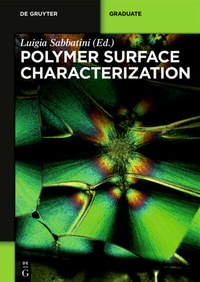
Polymer Surface Characterization
Description

Polymer Surface Characterization provides a comprehensive approach to the surface analysis of polymers of technological interest by means of modern analytical techniques. Basic principles, operative conditions, applications, performance, and limiting features are supplied, together with current advances in instrumental apparatus. Each chapter is devoted to one technique and is self-consistent; the end-of-chapter references would allow the reader a quick access to more detailed information.
After an introductory chapter, techniques that can interrogate the very shallow depth of a polymer surface, spanning from the top few angstroms in secondary ions mass spectrometry to 2-10 nm in X-ray photoelectron spectroscopy are discussed, followed by Fourier transform infrared spectroscopy and chapters on characterization by scanning probe microscopy, electron microscopies, wettability and spectroscopic ellipsometry.
More details
Other editions
New editions
Additional editions
Persons
Content
- Intro
- Contents
- Preface
- Contributing authors
- 1 Introductory remarks on polymers and polymer surfaces
- 1.1 Why polymers?
- 1.1.1 Generality
- 1.1.2 Synthesis
- 1.1.3 Classification and nomenclature
- 1.1.4 Morphology and properties
- 1.2 Why to investigate a polymer surface?
- 1.2.1 Nature and dynamics of polymer surfaces
- 1.2.1.1 Vibrational dynamics of macromolecules
- 1.2.1.2 Changes in thermodynamic properties on the surface
- 1.2.1.3 Rotation of functional groups on polymer backbones in response to different environmental conditions
- 1.2.1.4 Surface interdiffusion or segregation of copolymers or polymer blends
- 1.2.2 Surface modification of polymers
- 1.2.2.1 Improvement of wettability
- 1.2.2.2 Improvement of porosity or roughening
- 1.2.2.3 Improvement of adhesion
- 1.2.2.4 Interaction of polymer with biological environment: Biocompatibility
- 1.2.2.5 Improvement of conductivity
- 1.2.3 Possibility of predicting polymer performances by surface characterization techniques
- References
- 2 Investigation of polymer surfaces by time-of-flight secondary ion mass spectrometry
- 2.1 Introduction
- 2.1.1 Analysis of surfaces
- 2.1.2 The SIMS process: A detailed approach of theory and instruments
- 2.1.2.1 Sputter process and SSIMS approach
- 2.1.2.2 Mass analyzer systems
- 2.1.2.3 Ion sources and primary ions
- 2.1.2.4 Surface ionization ion guns
- 2.1.2.5 Duoplasmatron and gas ion sources
- 2.1.2.6 Liquid metal ion guns
- 2.1.2.7 Gas cluster ion sources
- 2.1.2.8 High-resolution ion images obtained from cluster LMIG sources
- 2.2 TOF-SIMS investigations of polymer materials
- 2.2.1 General remarks
- 2.2.2 Polymers
- 2.2.2.1 Polydimethylsiloxane
- 2.2.2.2 Polystyrene
- 2.2.2.3 Polyacrylates
- 2.2.2.4 Fluorinated polymers
- 2.2.2.5 Poly(ethyleneterephthalate)
- 2.2.2.6 Polyethylene glycol
- 2.2.2.7 Spectra libraries and G-SIMS approach
- 2.2.2.8 Multivariate analysis and principal component analysis
- 2.2.3 Polymer additives
- 2.2.4 Copolymers
- 2.2.5 Multicomponent polymers (polymer blends)
- 2.2.6 Plasma modification and deposition
- 2.2.7 Other applications
- References
- 3 Polymer surface chemistry: Characterization by XPS
- 3.1 Introduction
- 3.2 Photoelectron spectroscopy: A brief historyª
- 3.2.1 Basic principles
- 3.2.2 Spectroscopic and X-ray notations
- 3.3 Instrumentation
- 3.3.1 Vacuum system
- 3.3.2 X-ray sources
- 3.3.2.1 Dual Mg/Al anode X-ray tube
- 3.3.2.2 Monochromatic source
- 3.3.2.3 Synchrotron radiation source
- 3.3.3 Energy analyzers
- 3.3.4 Detectors
- 3.3.5 Charge compensation
- 3.3.6 Small-area XPS: imaging and mapping
- 3.3.7 Ambient-pressure photoelectron spectroscopy
- 3.4 Chemical information from XPS
- 3.5 Chemical shift and its significance in the analysis of polymers
- 3.6 Chemical derivatization techniques in conjunction with XPS
- 3.7 Polymers surface segregation
- 3.8 Polymers physical treatments/grafting
- 3.9 Polymers aging
- References
- 4 Attenuated total reflection-Fourier transform infrared spectroscopy: A powerful tool for investigating polymer surfaces and interfaces
- 4.1 Principles of Fourier transform infrared spectroscopy
- 4.2 Theory of attenuated total reflection FTIR spectroscopy
- 4.2.1 Propagation of IR radiation through a planar interface between two isotropic media
- 4.2.2 Propagation of IR radiation through stratified media
- 4.2.3 Penetration depth and effective thickness
- 4.2.3.1 Penetration depth in ATR/FTIR spectroscopic analysis of polymers
- 4.2.4 Transmission FTIR vs ATR/FTIR spectroscopy
- 4.3 Experimental methods in ATR/FTIR spectroscopy
- 4.3.1 Internal reflection elements
- 4.3.2 Internal reflection attachments
- 4.3.3 Metal underlayer ATR/FTIR spectroscopy
- 4.3.3.1 Effect of metal underlayer on penetration depth in ATR/FTIR spectroscopic analysis of polymers
- 4.4 Potentials and limitations of ATR/FTIR spectroscopy
- 4.5 Applications of ATR/FTIR spectroscopy
- 4.5.1 ATR/FTIR spectroscopy in polymer science
- 4.5.2 In situ ATR/FTIR spectroscopy of tribochemical phenomena
- Acknowledgments
- References
- 5 Scanning probe microscopy of polymers
- 5.1 Introduction
- 5.2 Sample preparation
- 5.3 Phase imaging
- 5.3.1 Background on phase imaging
- 5.3.2 Applications of phase imaging to polymer materials
- 5.4 Multifrequency imaging
- 5.5 Nanorheological mapping
- 5.6 Thermal/spectroscopic measurements
- 5.7 Environmental measurements
- 5.8 Conclusions
- References
- 6 Polymer surface morphology: Characterization by electron microscopies
- 6.1 Introduction
- 6.2 Scanning electron microscopy
- 6.2.1 SEM: Principles
- 6.2.1.1 Microscope and image formation
- 6.2.1.2 Interaction of the electron beam with the specimen
- 6.2.2 SEM: Classical modes
- 6.2.2.1 SE imaging
- 6.2.2.2 BSE imaging
- 6.2.2.3 EDX spectra
- 6.2.2.4 STEM imaging
- 6.2.3 SEM: Modern trends
- 6.2.3.1 Variable-pressure SEM
- 6.2.3.2 Variable-temperature SEM
- 6.2.3.3 Low-voltage SEM
- 6.2.3.4 Multidimensional SEM
- 6.2.4 SEM: Further possibilities
- 6.2.4.1 Spectroscopic methods
- 6.2.4.2 Methods connected with crystal structure of samples
- 6.2.4.3 Methods using sample-specific interactions with electron beam
- 6.3 Transmission electron microscopy
- 6.4 Sample preparation
- 6.4.1 Overview of polymer materials
- 6.4.2 Specific features of polymer materials
- 6.4.2.1 Charging and electron-beam damage
- 6.4.2.2 Skin-core effect
- 6.4.2.3 Low contrast between components
- 6.4.3 Preparation techniques for polymer materials
- 6.4.3.1 Direct observation of polymer surface
- 6.4.3.2 Fracturing
- 6.4.3.3 Etching
- 6.4.3.4 Cutting and staining
- 6.4.3.5 Special techniques
- 6.5 Applications
- 6.5.1 Homopolymers
- 6.5.2 Copolymers
- 6.5.3 Polymer blends
- 6.5.4 Polymer composites
- 6.5.5 Special applications
- 6.5.5.1 Low-voltage SEM in polymer science
- 6.5.5.2 Wet specimens in polymer science
- 6.5.5.3 Further applications
- Acknowledgments
- References
- 7 Wettability: Significance and measurement
- 7.1 Introduction
- 7.2 CA and surface energy
- 7.2.1 Surface energy evaluation
- 7.2.1.1 Critical surface energy method
- 7.2.1.2 Multicomponent approaches
- 7.2.1.3 Particular cases: High-energy surfaces and granular materials
- 7.2.2 Considerations on surface energy evaluation
- 7.3 CA hysteresis
- 7.4 Measurement methods for CA
- 7.4.1 Direct measurement by optical goniometry
- 7.4.2 Force tensiometry
- 7.4.3 Approach comparison
- 7.5 Application of CA measurement
- 7.5.1 From hydrophobic to water- and oil-repellent materials
- 7.5.2 Hydrophilic to super-hydrophilic materials
- 7.5.3 Hydrophobic recovery of hydrophilic surfaces
- 7.5.4 CA on porous surfaces
- 7.5.5 Acid-base characterization of polymeric surfaces
- References
- 8 Advances of spectroscopic ellipsometry in the analysis of thin polymer films-polymer interfaces
- 8.1 Introduction
- 8.1.1 Basics of ellipsometry
- 8.2 New ellipsometric methods, techniques, and aspects
- 8.2.1 Optical dispersion
- 8.2.2 In situ setups
- 8.2.2.1 Liquid cells for measurements in solution
- 8.2.2.2 Coupling ellipsometry with quartz crystal microbalance
- 8.2.2.3 Total internal reflection ellipsometry
- 8.2.3 In-line monitoring
- 8.2.3.1 Monitoring processes in a vacuum chamber
- 8.2.3.2 R2R fabrication processes
- 8.2.4 Micropatterned films
- 8.2.4.1 VIS imaging ellipsometry
- 8.2.4.2 Microfocus-mapping IR ellipsometry
- 8.3 Selected architectures of polymer films, blends, and composites
- 8.3.1 Polymer blends and cross-linked polymer films
- 8.3.2 Tg in thin polymer films of different architectures: Confinement effects
- 8.3.3 Polymer-NP composites
- 8.3.4 Polymers in nanostructured surfaces
- 8.4 Polymer layers absorbing in the VIS spectral range
- 8.4.1 Chemical modification with dye molecules
- 8.4.2 Semiconducting polymers and blends for OPV and OLED
- 8.5 Swelling and adsorption processes: Proteins and stimuli-responsive polymers
- 8.5.1 Swelling of stimuli-responsive polymer layers
- 8.5.2 Protein adsorption at soft polymer surfaces
- References
- Index
