

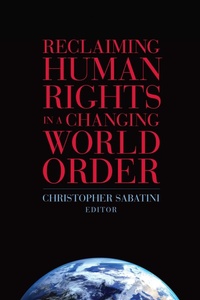
Reclaiming Human Rights in a Changing World Order
1st Edition
Published on 7. October 2022
410 pages
978-0-8157-3976-0 (ISBN)
Description

Human rights - and the international institutions that strive to protect them - are under increasing attack from powerful actors on the global stage, from recent political trends even within established democracies and from new technologies. Together, these threats have undermined what had been a fragile international consensus as recently as two decades ago about the importance of concerted international action to protect human rights and punish those who abuse them.
China, Russia, and other nondemocratic regimes have become increasingly bold in acting as if agreed-upon international human rights standards no longer exist, or at least do not apply to them. More broadly, domestic political movements based on nationalism, religion, and populism are challenging human rights norms on nearly every continent. And new technologies - including autonomous weapons systems and relentless digital surveillance - have given national leaders new ways to control or even abuse their citizens with impunity.
This book examines these new challenges to international and regional human rights in Africa, Europe, Latin America, and the Middle East. It is the result of a year of workshops with human rights activists and young leaders from around the world, with chapters written by a diverse group of leading scholars. Beyond describing the challenges to human rights, the book offers targeted, practical recommendations for national and multilateral policymakers, activists, and scholars for concrete actions to protect human rights as well as improve public understanding of why doing so is essential.
Reclaiming Human Rights in a Changing World Order will interest scholars of international relations and human rights law, domestic and international activists involved in human rights - indeed, anyone wanting to understand the implications for the liberal international order of the new geopolitical competition, modern technology, and political and social movements.
China, Russia, and other nondemocratic regimes have become increasingly bold in acting as if agreed-upon international human rights standards no longer exist, or at least do not apply to them. More broadly, domestic political movements based on nationalism, religion, and populism are challenging human rights norms on nearly every continent. And new technologies - including autonomous weapons systems and relentless digital surveillance - have given national leaders new ways to control or even abuse their citizens with impunity.
This book examines these new challenges to international and regional human rights in Africa, Europe, Latin America, and the Middle East. It is the result of a year of workshops with human rights activists and young leaders from around the world, with chapters written by a diverse group of leading scholars. Beyond describing the challenges to human rights, the book offers targeted, practical recommendations for national and multilateral policymakers, activists, and scholars for concrete actions to protect human rights as well as improve public understanding of why doing so is essential.
Reclaiming Human Rights in a Changing World Order will interest scholars of international relations and human rights law, domestic and international activists involved in human rights - indeed, anyone wanting to understand the implications for the liberal international order of the new geopolitical competition, modern technology, and political and social movements.
More details
Series
Edition
1. Auflage
Language
English
Place of publication
New York
United States
Publishing group
Bloomsbury Publishing Plc
ISBN-13
978-0-8157-3976-0 (9780815739760)
DOI
10.5771/9780815739760
Copyright in bibliographic data and cover images is held by Nielsen Book Services Limited or by the publishers or by their respective licensors: all rights reserved.
Schweitzer Classification
Other editions
Additional editions
Christopher Sabatini
Reclaiming Human Rights in a Changing World Order
Book
10/2022
Brookings Institution
€126.40
Shipment within 10-20 days
Christopher Sabatini
Reclaiming Human Rights in a Changing World Order
Book
10/2022
Brookings Institution
€61.80
Shipment within 10-20 days
Person
Christopher Sabatini issenior fellow for Latin America at Chatham House. He is also on the advisory board of Americas Watch.
Content
- Cover
- Title Page
- Copyright
- Contents
- Foreword
- Acknowledgments
- Acronyms and Abbreviations
- Introduction
- Part I. Geopolitics
- One. Human Rights: From Evolution to Devolution?
- Two. Positioning Human Rights in China-U.S. Relations
- Three. Crossing the "Redline": Engaging Russia in the Multilateral Order
- Four. Same Blueprint, New Norms: Regional Organizations, Illiberalism, and the Rise of Contested Global Governance
- Five. Human Rights, Pandemics, and the Infrastructure of Human Rights Institutions
- Part II. Domestic Politics and International Human Rights Policies
- Six. Protecting Human Rights from Exclusionary Populism
- Seven. Evangelicals and Human Rights
- Part III. New Technologies and Human Rights
- Eight. Technical Standards and Human Rights: The Case of New IP
- Nine. Autonomous Weapon Systems: Accountability Gaps and Racial Oppression
- Part IV. Regional Human Rights Systems
- Ten. Populism and the Protection of Human Rights in Europe: The Challenge from Within
- Eleven. Polishing the Crown Jewel of the Western Hemisphere: The Inter-American Commission on Human Rights
- Twelve. Caught between Geopolitics, Democratic Regression, and the "Sovereign Backlash": The African Human Rights System
- Thirteen. Human Rights and Geopolitics in the Middle East, North Africa, and Afghanistan
- Conclusions: Reforming, Rebuilding, Modernizing the International Human Rights System
- Contributors
- Index
- Back Cover
