

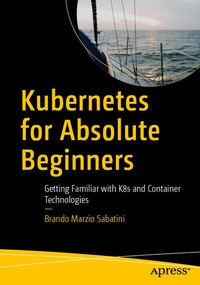
Kubernetes for Absolute Beginners
Description

Learn modern application deployment practices using containers and gain the foundational knowledge and practical skills that can be applied in real-world scenarios This book aims to make Kubernetes and container technologies easier to understand for those new to cloud computing and containerization.
Aided by clear explanations, pictures, and diagrams, you'll start by reviewing the basics of container technologies, how Kubernetes works, how to deploy applications, and how networking works within this open-source system. Then, guided by a step-by-step approach to learning complex topics, the book explains why containers and Kubernetes are important in modern software development and shows you how these technologies are changing the way we build and run software.
Featuring shorter chapters that break down difficult concepts, Kubernetes for Absolute Beginners is your starting point for understanding the future of software infrastructure and how this important system will help super-charge your career.
You Will:
- Understand the basics of Kubernetes, including its architecture and core components, and how it manages containerized applications
- Acquire hands-on skills in deploying, managing, and scaling applications using Docker and Kubernetes
- Explore advanced topics such as networking, security, storage solutions, and resource management in Kubernetes
- Use YAML files, ConfigMaps, and Secrets for configuration management
This Book Is For
IT professionals and developers who are new to Kubernetes and container technologies.
More details
Other editions
Additional editions
Person
Brando Marzio Sabatini is an IT enthusiast driven by a passion for innovation, experimentation, and systematic improvement. His fascination with technology began in childhood, fueling a lifelong curiosity and eagerness to explore new devices and systems. With over 10 years of experience in the IT industry, Brando's career began as an IT specialist at one of the world's leading French retailers in Italy, his foundational professional role. He then expanded his expertise in Germany, serving as a technical engineer at a company specializing in hybrid cloud solutions, data services, and data storage and afterwards as a contractor for an intergovernmental organization for the team called Unified Meteorological Archive Facility as a Data Centre Operator. His international experience continued with a position as Senior Associate Technical Support in Southeast Asia's oil and gas industry. Currently, he works at CERN as a Computing Infrastructure Engineer in the sysadmin team.
Content
Chapter 1: Introduction to Kubernetes and Containers.- Chapter 2: Getting Started with Docker.- Chapter 3: Understanding Kubernetes Basics.- Chapter 4: Kubernetes Architecture.- Chapter 5: Core Kubernetes Components.- Chapter 6: Working With YAML Files.- Chapter 7: Managing PODS in Kubernetes.- Chapter 8: Deployments and Replicasets.- Chapter 9: Advanced Networking in Kubernetes.- Chapter 10: ConfigMaps and Secrets.- Chapter 11: Labels, Selectors, and Annotations.- Chapter 12:Exploring Namespaces.- Chapter 13: Monitoring Health and Performance.- Chapter 14: Stateful vs. Stateless Applications.- Chapter 15: Security in Kubernetes.- Chapter 16: Storage Solutions in Kubernetes.- Chapter 17: Job Management with DaemonSets and Jobs.- Chapter 18: DNS Services in Kubernetes.- Chapter 19: Resource Management.- Chapter 20: Certificates and Encryption.
