

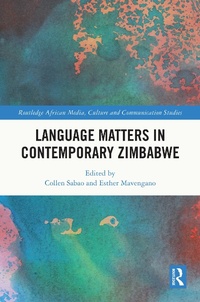
Language Matters in Contemporary Zimbabwe
1st Edition
Published on 17. June 2024
232 pages
978-1-040-03974-8 (ISBN)
Description

Speaking to a broader global preoccupation with the state of languages and language development, this book considers issues surrounding the diverse languages, linguistic communities, and cultures of Zimbabwe.
Reflecting on Shona, Xitsonga, Sotho, Xhosa, Tjwao, Nambya, IsiNdebele, Nyanja, Tshivenda, English and Braille, the book uncovers both the internal and external factors that impact language structures, language use and language ideologies across the country. The book considers how colonial legacies and contemporary language domination and minoritisation have led to language endangerment. It considers the fate of communities whose languages are marginalised and, in the process, poses questions on what can and should be done to preserve Zimbabwean languages. The authors' offerings range across subjects as diverse as music, linguistic innovation, education, human rights, literature, language politics and language policy, in order to build a rich and nuanced picture of language matters in the country.
Coming at a critical moment of increasing mobility, migration, cultural plurality and globalisation, this book will be an important resource for researchers across African literature, linguistics, communication, policy and politics.
Reflecting on Shona, Xitsonga, Sotho, Xhosa, Tjwao, Nambya, IsiNdebele, Nyanja, Tshivenda, English and Braille, the book uncovers both the internal and external factors that impact language structures, language use and language ideologies across the country. The book considers how colonial legacies and contemporary language domination and minoritisation have led to language endangerment. It considers the fate of communities whose languages are marginalised and, in the process, poses questions on what can and should be done to preserve Zimbabwean languages. The authors' offerings range across subjects as diverse as music, linguistic innovation, education, human rights, literature, language politics and language policy, in order to build a rich and nuanced picture of language matters in the country.
Coming at a critical moment of increasing mobility, migration, cultural plurality and globalisation, this book will be an important resource for researchers across African literature, linguistics, communication, policy and politics.
More details
Series
Edition
1. Auflage
Language
English
Place of publication
London
United Kingdom
Publishing group
Taylor & Francis Ltd
Target group
College/higher education
Professional and scholarly
Product notice
Reflowable
Illustrations
5 Tables, black and white
ISBN-13
978-1-040-03974-8 (9781040039748)
Copyright in bibliographic data and cover images is held by Nielsen Book Services Limited or by the publishers or by their respective licensors: all rights reserved.
Schweitzer Classification
Other editions
Additional editions
Collen Sabao | Esther Mavengano
Language Matters in Contemporary Zimbabwe
Book
10/2025
1st Edition
Routledge
€63.70
Shipment within 10-20 days
Collen Sabao | Esther Mavengano
Language Matters in Contemporary Zimbabwe
Book
06/2024
1st Edition
Routledge
€193.90
Shipment within 10-20 days
Persons
Collen Sabao is an Associate Professor of Linguistics, Literature and Communication in the Languages and Literature Department at the University of Namibia. Prof. Sabao's research interests lie in the areas of Phonetics and Phonology, Political Discourse, Media Discourse, Pan Africanism, Afrocentricity, Appraisal Theory, Argumentation, World Literatures and Rhetoric. He has published extensively in these areas, with quite a sizeable number of journal articles and chapters in internationally refereed publications. He also holds a Bachelor of Arts Honours Degree in English and Communication and a Master of Philosophy in Theoretical Linguistics from universities in Zimbabwe, a PhD in African Languages (Applied Linguistics) from Stellenbosch University (South Africa) and a Postgraduate Diploma in Higher Education from the International University of Management (IUM) in Namibia. Currently, he is also reading for a DLitt. et. Phil. in Literature at the University of South Africa (UNISA). He is an American Council of Learned Societies Fellow'14 and an African Humanities Fellow '14. Prof Sabao is also an amateur footballer and an Elder Elect of Records in the House of Nyabhinghi Rastafari.
Esther Mavengano is a lecturer who teaches Linguistics and Literature in the Department of English and Media Studies, Faculty of Arts at Great Zimbabwe University in Masvingo, Zimbabwe. She holds a Ph.D. in Linguistics and Literary Studies obtained from North West University in Mafikeng , South Africa. Her research areas maintain the interface of applied linguistics, sociolinguistis and Anglophone African literary studies. She has interests in language policy and planning, sociolinguistics, language use in media and political discourses, translingual practices in Postcolonial Anglophone African fictional writings, Identity issues in contemporary transnational Anglophone/African literature, religion and gender discourses in African literature, stylistics and language education in emerging contact contexts. She has published in reputable international journals including Cogent Arts and Humanities, African Identities, Literator, Journal of Multicultural Discourses, among others. She is a Research Fellow at the Research Institute for Theology and Religion, College of Human Sciences, UNISA, in South Africa. She was recently awarded an Alexander von Humboldt Postdoctoral Fellow in Germany. She is at (TUD), Technische Universitat Dresden in the Department of English, Faculty of Linguistics, Literature and Cultural Studies, Institute of English and American Studies. She is currently working on her postdoctoral monograph focusing on Language Politics and Linguistic Ideologies in Postcolonial Anglophone African Literature. She has co-edited a number of books including, Zimbabwe in the Post-COVID-19 Era: Reflections, lessons and the Future of Public Health, published by Routledge.
Esther Mavengano is a lecturer who teaches Linguistics and Literature in the Department of English and Media Studies, Faculty of Arts at Great Zimbabwe University in Masvingo, Zimbabwe. She holds a Ph.D. in Linguistics and Literary Studies obtained from North West University in Mafikeng , South Africa. Her research areas maintain the interface of applied linguistics, sociolinguistis and Anglophone African literary studies. She has interests in language policy and planning, sociolinguistics, language use in media and political discourses, translingual practices in Postcolonial Anglophone African fictional writings, Identity issues in contemporary transnational Anglophone/African literature, religion and gender discourses in African literature, stylistics and language education in emerging contact contexts. She has published in reputable international journals including Cogent Arts and Humanities, African Identities, Literator, Journal of Multicultural Discourses, among others. She is a Research Fellow at the Research Institute for Theology and Religion, College of Human Sciences, UNISA, in South Africa. She was recently awarded an Alexander von Humboldt Postdoctoral Fellow in Germany. She is at (TUD), Technische Universitat Dresden in the Department of English, Faculty of Linguistics, Literature and Cultural Studies, Institute of English and American Studies. She is currently working on her postdoctoral monograph focusing on Language Politics and Linguistic Ideologies in Postcolonial Anglophone African Literature. She has co-edited a number of books including, Zimbabwe in the Post-COVID-19 Era: Reflections, lessons and the Future of Public Health, published by Routledge.
Content
1. The Politics of Language and the Linguistic Imperative to Language Matters in Zimbabwe 2. Re-syllabification and morphophonological nativisation of English loans in Chi/Shona 3. Harmonised Shona varieties: Myths, Misconceptions and Truths in the Standardisation and Harmonisation of Shona-Nyai cross-border Varieties 4. Sociolinguistic motivations behind Analogical Creation and Semantic Irregularities in the Zimbabwe's Shona language. 5. Zimbabwean 'kombi' cant: An etymological and sociolinguistic exploration of 'chihwindi' (public transport operators) Shona slang in Zimbabwe 6. The anatomy and soul of the 'dira rizare' social media posts in Zimbabwe 7. Navigating stance-taking at university: An explorative study of first year writing in Zimbabwe. 8. Braille access in institutions of higher and tertiary education in Masvingo, Zimbabwe 9. A model of reversing language shift in Xitsonga speakers in southern Zimbabwe's Mwenezi district 10. The intellectualisation of African languages at institutions of higher learning in Zimbabwe 11. Seclusion through discourse: Begging language in music and chants by the visually impaired in Zimbabwe 12. Linguistic Innovation in Soul Jah Love's Zimdancehall Music 13. The Native Speakerism Ideology and language Utility in South Africa and Zimbabwe: Challenges in Confronting Normative English Monolingualism 14. Politics of Language, Ethnicity and Marginalization: De-Minoritisation of Nambya Language in the Quest for Cultural Identity 15. Zimbabwe and Her Multi- recognised Official Languages: Some Notable Consequences 16. The Semiotics Politics in Chenjerai Hove's novel, Bones: Moving Beyond Colonial Binaries to Envision Pluricentric Perspectives
