

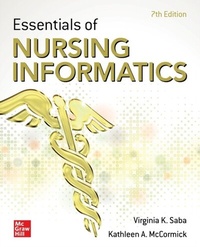
Essentials of Nursing Informatics, 7th Edition
1st Edition
Published on 22. March 2021
896 pages
978-1-260-45679-0 (ISBN)
Available for download
Description

The single best resource for learning how technology can make the nursing experience as rewarding and successful as possibleA Doody's Core Title for 2024 & 2023! Essentials of Nursing Informatics provides the information and insights readers need to manage and process data to improve the quality and outcomes of healthcare. Topics include the use of computers in nursing administration, practice, education, and research, computer systems and information theory, electronic medical records, continuum of care information technology systems, and personal health records, coding, and government, clinical, and private sector system requirements.This revised and updated edition covers the latest changes in technology, administration, policy, and their effects on healthcare informatics in the U.S., with contributing international authors from Canada, South America, Europe, Asia, Australia, and New Zealand. The seventh edition includes section summaries, and each chapter includes sample test questions and answers. This updated seventh edition covers:Nursing Informatics TechnologiesNursing Practice ApplicationsSystem StandardsAdvanced Applications for the 4th Nursing IT RevolutionSystem Life CycleEducational ApplicationsInformatics Theory StandardsResearch ApplicationsPolicies and Quality Measures in Healthcare
More details
Other editions
Additional editions
Virginia Saba | Kathleen McCormick
Essentials of Nursing Informatics
Book
02/2021
7th Edition
McGraw-Hill Education
€162.70
Shipment within 10-20 days
Content
- Cover
- Title Page
- Copyright Page
- Dedication
- Contents
- Contributors
- Foreword
- Preface
- Acknowledgments
- Part 1 - Nursing Informatics Technologies
- 1 Historical Perspectives of Nursing Informatics
- 2 Computer Systems Basics-Hardware
- 3 Advanced Hardware and mHealth
- 4 Computer Systems Basics-Software
- 5 Open Source and Free Software
- 6 Data and Data Processing
- Part 2 - System Standards
- 7 Health Data Standards: Development, Harmonization, and Interoperability
- 8 Standardized Nursing Terminologies
- 9 Human-Computer Interaction
- 10 Trustworthy Systems for Safe and Private Healthcare
- 11 Social Determinants of Health, Electronic Health Records, and Health Outcomes
- Part 3 - System Life Cycle
- 12 System Design Life Cycle: A Framework
- 13 System and Functional Testing
- 14 System Life Cycle Tools
- Part 4 - Informatics Theory Standards
- 15 Healthcare Project Management
- 16 The Practice Specialty of Nursing Informatics
- 17 Foundations of Nursing Informatics
- Part 5 - Policies and Quality Measures in Healthcare
- 18 Establishing Nursing Informatics in Public Policy
- 19 Quality Measurement and the Importance of Nursing Informatics
- 20 Using Six Sigma and Lean for Measuring Quality
- 21 Informatics Applications to Support Rural and Remote Health
- 22 Communication Skills in Health IT, Building Strong Teams for Successful Health IT Outcomes
- 23 Nurse Scheduling and Credentialing Systems
- 24 Mastering Skills that Support Nursing Practice
- Part 6 - Nursing Practice Applications
- 25 Translation of Evidence into Nursing Practice
- 26 Improving Healthcare Quality and Patient Outcomes Through the Integration of Evidence-Based Practice and Informatics
- 27 Nursing Plan of Care Framework for HIT
- 28 Structuring Advanced Practice Knowledge: Curricular, Practice, and Internet Resource Use
- 29 Beyond EMR Implementation: Optimize and Enhance
- 30 Federal Healthcare Sector Nursing Informatics
- 31 Monitoring Interoperability, Device Interface, and Security
- 32 Population Health Informatics
- 33 Informatics Solutions for Emergency Planning and Response
- 34 Health Information Technology: Striving to Improve Patient Safety
- 35 Consumer Patient Engagement and Connectivity in Patients with Chronic Disease in the Community and at Home
- Part 7 - Advanced Applications for the Fourth Nursing IT Revolution
- 36 New Models of Healthcare Delivery and Retailers Producing Big Data
- 37 Artificial Intelligence in Healthcare
- 38 Telehealth: Healthcare Evolution in the Technology Age
- 39 Nursing's Role in Genomics and Information Technology for Precision Health
- 40 Big Data Analysis of Electronic Health Record (EHR) Data
- 41 Nursing Data Science and Quality Clinical Outcomes
- 42 Nursing Informatics Innovations to Improve Quality Patient Care on Many Continents
- 43 Global eHealth and Informatics
- Part 8 - Educational Applications
- 44 Nursing Curriculum Reform and Healthcare Information Technology
- 45 The Evolution of the TIGER Initiative
- 46 Initiation and Management of Accessible, Effective Online Learning
- 47 Social Media Tools in the Connected Age
- 48 A Paradigm Shift in Simulation: Experiential Learning in Virtual Worlds and Future Use of Virtual Reality, Robotics, and Drones
- Part 9 - Research Applications
- 49 Computer Use in Nursing Research
- 50 Information Literacy and Computerized Information Resources
- Appendix Clinical Care Classification (CCC) System: Overview, Applications, and Analyses
- Index

