

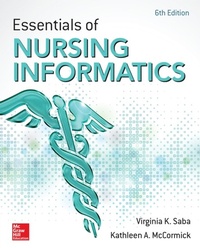
Essentials of Nursing Informatics, 6th Edition
1st Edition
Published on 22. February 2015
1417 pages
978-0-07-182956-4 (ISBN)
Available for download
Description

The classic text on how nurses can use technology to improve patient care -- and every aspect of their job performance, education, and career Written by leaders in nursing informatics, this comprehensive, up-to-date text explores the ever-growing role technology plays in the field of nursing. Offering theoretical background to help you understand how informatics serves many aspects of the profession, Essential of Nursing Informatics also gives you practical help in unlocking computing s benefits -- both now and into the future. Numerous case studies and examples add real-world relevance to the material. An internationally recognized contributor team provides information and insights not found in any other text on essential topics such as the application of computers to nursing administration, education, and research, electronic medical records (EMRs) and personal health records (PHRs), coding, and government, clinical, and private sector system requirements. NEW! A companion Teacher's Edition, which will include chapter summaries with key teaching points, lesson plans, and review questions/answers for classroom use
More details
Other editions
Additional editions
Virginia Saba | Kathleen McCormick
Essentials of Nursing Informatics
Book
05/2015
6th Edition
McGraw-Hill Professional
€75.51
Article exhausted; check different version
Content
- Cover
- Title Page
- Copyright Page
- Contents
- Contributors
- Foreword 1
- Foreword 2
- Preface
- Acknowledgments
- Part 1 - Nursing Informatics Technologies
- 1 Historical Perspectives of Nursing Informatics
- 2 Computer Hardware
- 3 Advanced Hardware and mHealth
- 4 Computer Software
- 5 Open Source and Free Software
- 6 Data and Data Processing
- 7 Health Data Standards: Development, Harmonization, and Interoperability
- 8 Standardized Nursing Terminologies
- 9 Human-Computer Interaction
- 10 Trustworthy Systems for Safe and Private Healthcare
- Part 2 - System Life Cycle
- 11 System Life Cycle: A Framework
- 12 System and Functional Testing
- 13 System Life Cycle Tools
- 14 Healthcare Project Management
- Part 3 - Informatics Theory Standards-Foundations of Nursing Informatics
- 15 The Practice Specialty of Nursing Informatics
- 16 Nursing Informatics and Healthcare Policy
- Part 4 - Nursing Informatics Leadership
- 17 The Role of the Nurse Executive in Information Technology Decision-Making
- 18 Establishing Nursing Informatics in Public Policy
- 19 Communication Skills in Health IT, Building Strong Teams for Successful Health IT Outcomes
- 20 Assessing the Vendors
- 21 Nurse Scheduling and Credentialing Systems
- 22 Informatics and the Healthcare Industry
- Part 5 - Advanced Nursing Informatics in Practice
- 23 Structuring Advanced Practice Knowledge: An Internet Resource for Education and Practice
- 24 Nursing Informatics in Retail Clinics
- 25 Care Delivery Across the Care Continuum: Hospital-Community-Home
- 26 Foundation of a Nursing Plan of Care Standard
- 27 Computerized Provider Order Entry
- 28 Physiological Monitoring and Device Interface
- 29 Health Information Technology: Striving to Improve Patient Safety
- 30 The Role of Technology in the Medication-Use Process
- 31 The Magnet Model
- 32 Public Health Practice Applications
- 33 Informatics Solutions for Emergency Planning and Response
- 34 Federal Healthcare Sector Nursing Informatics
- 35 Consumer/Patient Engagement and eHealth Resources
- Part 6 - Nursing Informatics-Complex Applications
- 36 Healthcare Analytics
- 37 Planning, Design, and Implementation of Information Technology in Complex Healthcare Systems
- 38 The Quality Spectrum in Informatics
- 39 Translation of Evidence into Nursing Practice
- 40 Improving Healthcare Quality and Patient Outcomes Through the Integration of Evidence-Based Practice and Informatics
- 41 Incorporating Evidence: Use of Computer-Based Clinical Decision Support Systems for Health Professionals
- Part 7 - Educational Applications
- 42 Nursing Curriculum Reform and Healthcare Information Technology
- 43 The TIGER Initiative
- 44 Initiation and Management of Accessible, Effective Online Learning
- 45 Social Media in the Connected Age: Impact on Healthcare Education and Practice
- 46 A Paradigm Shift in Simulation: Experiential Learning in Virtual Worlds
- Part 8 - Research Applications
- 47 Computer Use in Nursing Research
- 48 Information Literacy and Computerized Information Resources
- Part 9 - Big Data Initiatives
- 49 Genomics and Information Technology for Personalized Health
- 50 Global eHealth and Informatics
- Part 10 - International Perspectives
- 51 Nursing Informatics in Canada
- 52 Nursing Informatics in Europe
- 53 Pacific Rim Perspectives
- 54 Nursing Informatics in Asia
- 55 Nursing Informatics in South America
- 56 Nursing Informatics in South Africa
- Appendix A Overview of Clinical Care Classification System
- Index

