

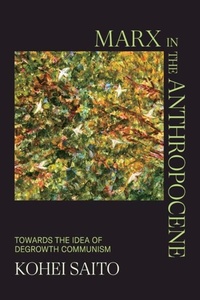
Marx in the Anthropocene
Towards the Idea of Degrowth Communism
Published on 1. February 2023
294 pages
978-1-009-27660-3 (ISBN)
Description

Facing global climate crisis, Karl Marx's ecological critique of capitalism more clearly demonstrates its importance than ever. This book explains why Marx's ecology had to be marginalized and even suppressed by Marxists after his death throughout the twentieth century. Marx's ecological critique of capitalism, however, revives in the Anthropocene against dominant productivism and monism. Investigating new materials published in the complete works of Marx and Engels (Marx-Engels-Gesamtausgabe), Saito offers a wholly novel idea of Marx's alternative to capitalism that should be adequately characterized as degrowth communism. This provocative interpretation of the late Marx sheds new lights on the recent debates on the relationship between society and nature and invites readers to envision a post-capitalist society without repeating the failure of the actually existing socialism of the twentieth century.
Reviews / Votes
'Marx in the Anthropocene is a deeply restorative project, both analytically and politically. Through a detailed examination of Marx's notebooks on the natural sciences, Kohei Saito reminds us why Marx insisted that the relationship between nature and capitalism was fundamentally unsustainable. The book restores to us a forgotten Marx, one who is eager to learn from precapitalist societies, one who is beginning to see destruction in development. Taking his lead from this longneglected Marx, Saito then builds a powerful argument for degrowth communism, a theoretical approach that aims to reorganize the very notion of abundance to fit the common weal, rather than fit an abstract notion of luxury communism. Marx in the Anthropocene reminds us, again, why anticapitalism is the nutrient that must be urgently added to nature'' Tithi Bhattacharya, author of Feminism for the 99%: A Manifesto 'A masterpiece. This is the book we have been waiting for. Saito draws on Marx to deliver a thrilling synthesis of degrowth and ecosocialism. Herein lies the secret to post-capitalist transition. A must-read for every socialist and every environmentalist -it will change both forever' Jason Hickel, author of Less is More: How Degrowth Will Save the World 'After his brilliant essay on Marx's ecology, Kohei Saito shows in his new pathbreaking book how different Marxist thinkers tried to deal with the environmental, challenges, from an anti-capitalist perspective. As in his previous essay, Saito is able to grasp Marxism as thought in movement, and not as a closed system. His courageous appeal for a 'degrowth communism' is a decisive contribution for an ecological Marxism of our times, a communism for the Anthropocene' Michael Loewy, author of Ecosocialism: A Radical Alternative to Capitalist Catastrophe 'the way Saito mobilises Marxist theory to make a plea for 'the abundance of wealth in degrowth communism' ... is as precise as it is gripping' Timothee Parrique, The Conversation 'In this refreshing and highly significant work, Kohei Saito draws on only recently published writings from Marx's later notebooks on science and nature which reveal a less Promethean Marx ... essential reading for all serious Marxists.' John Green, Morning Star 'To bring Red and Green together ... Marx in the Anthropocene directs attention first at environmentalists, then at Marxists, and concludes with a synthesis, making the case for degrowth communism. Throughout the text, the central figure is Marx himself, whom Saito recasts as a deeply ecological thinker and one who argues that destroying the environment is an inherent feature of capitalism. While drawing on familiar texts such as Capital and Critique of the Gotha Program, Saito's most original contribution to the ecological Marx is to uncover what he calls Marx's 'ecological notebooks' - largely compiled after the publication of Capital - documenting his particular attention to the natural sciences, the idea of a steady-state metabolism, and non-Western societies. Saito argues that Marx was on his way to developing a theory towards degrowth communism and away from the more productivist and Promethean Marx that has been the more popular conception of Marx and Marxism.' Los Angeles Review of Books 'Saito's work - both in Marx and the Anthropocene and his earlier book Karl Marx's Ecosocialism ... stands out for its use of a copious collection of notes that Marx took after 1868 from his readings on biology, botany, chemistry, geology, minerology, and other fields of the natural sciences ... Drawing on these newly discovered late works, Saito illuminates a formerly invisible dimension of Marx's thought - and not a moment too soon as our world begins to catch flame ... The days when Marx's ideas were assumed to be incompatible with environmentalism and in need of greening are thankfully past, thanks in no small part to Saito's contributions.' Protean MagazineMore details
Language
English
Place of publication
Cambridge
United Kingdom
Illustrations
Worked examples or Exercises
File size
3,05 MB
ISBN-13
978-1-009-27660-3 (9781009276603)
Copyright in bibliographic data and cover images is held by Nielsen Book Services Limited or by the publishers or by their respective licensors: all rights reserved.
Schweitzer Classification
Other editions
Additional editions
Book
05/2023
Cambridge University Press
€110.50
Shipment within 15-20 days
Book
02/2023
Cambridge University Press
€37.50
Shipment within 15-20 days
Person
Content
Dedication; Acknowledgements; Abbreviations; Introduction; Part I. Marx's Ecological Critique of Capitalism and its Oblivion: 1. Marx's theory of metabolism in the age of global ecological crisis; 2. The intellectual relationship of Marx and Engels revisited from an ecological perspective; 3. Lukacs's theory of metabolism as the foundation of ecosocialist realism; Part II. A Critique of Productive Forces in the Anthropocene; 4. Monism and the non-identity of nature; 5. The revival of utopian socialism and the productive forces of capital; Part III. Towards Degrowth Communism: 6. Marx as a degrowth communist; 7. The abundance of wealth in degrowth communism; Conclusion; References; Index.
