

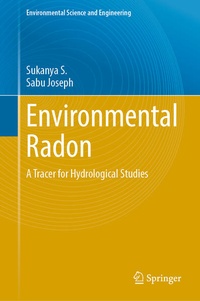
Environmental Radon
A Tracer for Hydrological Studies
1st Edition
Published on 30. May 2023
XII, 184 pages
978-981-99-2672-5 (ISBN)
Description

This book presents state-of-the-art techniques on radon (222Rn) in the environment, including measurement techniques in air, soil and water and its potential applications to various hydrological investigations, especially for water resources development and management. The future directions of its use are also discussed.
As a radon tracer can be used to solve hydrological issues, the highlights of this book are useful for stakeholders to achieve UN Sustainable Development Goal 6, which addresses the sustainability of water resources. The most relevant target audiences are hydrologists, hydrogeologists, geologists, environmental scientists, nuclear physicists, hydraulic engineers and academicians, among others. This book also covers health implications of radon and mitigation strategies, thus creating a valuable resource for health physicists working on environmental radiation safety as well.
As a radon tracer can be used to solve hydrological issues, the highlights of this book are useful for stakeholders to achieve UN Sustainable Development Goal 6, which addresses the sustainability of water resources. The most relevant target audiences are hydrologists, hydrogeologists, geologists, environmental scientists, nuclear physicists, hydraulic engineers and academicians, among others. This book also covers health implications of radon and mitigation strategies, thus creating a valuable resource for health physicists working on environmental radiation safety as well.
More details
Series
Language
English
Place of publication
Singapore
Singapore
Publishing group
Springer Singapore
Target group
Professional and scholarly
Product notice
Reflowable
Illustrations
XII, 184 p. 30 illus., 25 illus. in color.
File size
4,77 MB
ISBN-13
978-981-99-2672-5 (9789819926725)
DOI
10.1007/978-981-99-2672-5
Schweitzer Classification
Other editions
Additional editions
Book
05/2023
Springer
€160.49
Shipment within 3-4 weeks
Persons
Dr. Sukanya S obtained her Ph.D. in environmental sciences in 2022 from the University of Kerala, India. She worked as a research fellow at the Department of Environmental Sciences, University of Kerala, for a major research project funded by the Department of Atomic Energy-Board of Research in Nuclear Sciences (DAE-BRNS, Government of India) between 2016 and 2019, in collaboration with Bhabha Atomic Research Centre (BARC), Mumbai, India. Her Ph.D. work focused on hydrochemistry and environmental isotope hydrology, particularly on hydrological applications of the radon isotope 222Rn. She is also a recipient of a scholarship awarded by the Indo-German Centre for Sustainability (IGCS) under the German Federal Ministry for Education and Research (BMBF) through the German Academic Exchange Service (DAAD) for participating in the Indo-German Students Exchange Program 2015 on "Sustainable Water Management in Rural Landscapes" at the Department of Hydrology and Water Resources Management, Kiel University, Germany. She is a member of international scientific bodies such as the International Association of Hydrological Sciences (IAHS), International Water Resources Association (IWRA) and the Organization for Women in Science for the Developing World (OWSD)-UNESCO.She has published research papers, book chapters published by international publishers like Taylor & Francis, Elsevier and presented papers in various conferences conducted by internationally reputed organizations including the International Commission on Radiological Protection (ICRP 2019, Australia). She is also a reviewer for many international journals with leading publishers.
Dr. Sabu Joseph obtained his Ph.D. in geology in 1997 from the University of Kerala (India). He joined the Department of Environmental Sciences at the same university as a Junior Lecturer in 2001 and now works as a Professor of the department and Director of the School of Earth System Sciences. He teaches remote sensing, environmental geology, environmental chemistry, and environmental impact assessment to post-graduate students. His current research areas include biogeochemistry, hydrogeochemistry and isotope hydrology. He has supervised 12 Ph.D. students and still has 9 candidates pursuing their doctoral degrees under his guidance. He is also a mentor for 4 D. S. Kothari postdoctoral fellowship awardees. He has completed 6 major projects funded by various agencies, including an Indo-Israel international project funded by the University Grants Commission (India), and another by the Board of Research in Nuclear Sciences, India-funded projects. He has published 90+ research papers in various national and international journals and 2 books. He visited many countries as part of research/conference. He is currently the chairman of the board of studies in environmental sciences, member of the Academic Council, and Innovation Council of the University of Kerala. Also serving as expert committee member in various government organizations. He is coordinating the village adoption program of the Dept. of Environmental Sciences. He is an editorial board member and a reviewer for many journals.
Dr. Sabu Joseph obtained his Ph.D. in geology in 1997 from the University of Kerala (India). He joined the Department of Environmental Sciences at the same university as a Junior Lecturer in 2001 and now works as a Professor of the department and Director of the School of Earth System Sciences. He teaches remote sensing, environmental geology, environmental chemistry, and environmental impact assessment to post-graduate students. His current research areas include biogeochemistry, hydrogeochemistry and isotope hydrology. He has supervised 12 Ph.D. students and still has 9 candidates pursuing their doctoral degrees under his guidance. He is also a mentor for 4 D. S. Kothari postdoctoral fellowship awardees. He has completed 6 major projects funded by various agencies, including an Indo-Israel international project funded by the University Grants Commission (India), and another by the Board of Research in Nuclear Sciences, India-funded projects. He has published 90+ research papers in various national and international journals and 2 books. He visited many countries as part of research/conference. He is currently the chairman of the board of studies in environmental sciences, member of the Academic Council, and Innovation Council of the University of Kerala. Also serving as expert committee member in various government organizations. He is coordinating the village adoption program of the Dept. of Environmental Sciences. He is an editorial board member and a reviewer for many journals.
Content
Introduction.- Radon Measurement Techniques.- Radon Distribution in Groundwater and River water.- Radon in Surface water-Groundwater Interaction Studies.- Radon in Hydrograph Separation and Water Balance Studies.- Radon in Submarine Groundwater Discharge studies.- Radon and Human Health.- Radon - Mitigatory and control measures.
