

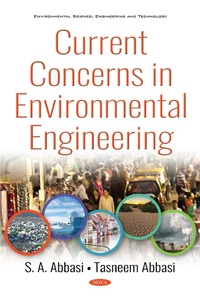
Current Concerns in Environmental Engineering
Published on 26. November 2018
328 pages
978-1-5361-3921-1 (ISBN)
Description

Current Concerns in Environmental Engineering is a treatment of 15 topics of great contemporary relevance by bestselling author S. A. Abbasi. Each topic is covered from its basics to its global application in a highly concise and compact yet exceedingly clear and lucid style. The coverage has a wide sweep, reflective of the great diversity and complexity of challenges presently faced by the Earth's environment. Some of the biggest existence-threatening questions are also addressed in this book - for example: Is renewable energy as safe for the world as is believed? Can technology make the present paradigm of development sustainable? Will a shift to renewables halt global warming? Is fossil fuel decarburization really workable?Current Concerns in Environmental Engineering would enhance the comprehension of undergraduate and graduate students while giving them a worldview that formal textbooks generally fail to do. The book will be exceedingly useful to teachers and researchers due to the fresh insights it can give and the innovative thinking it can stimulate. The book is profusely illustrated with dramatic as well as aesthetically pleasing visuals. Besides capturing the interest of the reader the visuals also enhance the reader's comprehension and appreciation of the text.
More details
Other editions
Additional editions
S. A. Abbasi | Tasneem Abbai
Current Concerns in Environmental Engineering
Book
09/2018
Nova Science Publishers Inc
€362.47
Shipment within 15-20 days
Content
- Intro
- Contents
- Foreword
- Preface
- About the Authors
- Acknowledgments
- Part I: Global Warming and Its Mitigation
- Chapter 1
- Pollution and Global Warming Due to the Use of Fossil Fuels: The Extent of the Problem
- Abstract
- 1. Introduction: The Fossil Fuels
- 2. Global Warming and Ocean Acidification
- 2.1. Global Warming
- 2.2. Ocean Acidification
- 2.2.1. How Have CO2 Emissions Caused Ocean Acidification?
- 3. Renewable Energy Sources: The Great 'Green' Hope
- References
- Chapter 2
- Global Warming Control by Decarbonization and Its Environmental Impacts
- Abstract
- 1. Introduction
- 2. Broad Approaches to Decarbonization
- 3. CO2Capture and Sequestration from Fossil Fuels
- 3.1. In-Plant Carbon Dioxide Capture and Sequestration (ICCS): Pre-Combustion and Post-Combustion Capture of CO2 in Power Plants
- 3.2. Storage/Disposal of Captured CO2
- 3.3. Other Avenues of CO2 Sequestration
- 3.4. CO2 Sequestration Coupled with Hydrogen Production
- 3.5. Decarbonization with Solid Carbon Capture
- 3.6. Decarbonization by Replacing Fossil Fuels with Non-Carbon Sources of Energy
- 4. Why Is Technology Not Going to Provide a Safe Solution?
- Summary
- References
- Part II: Urbanization and Its Impact
- Chapter 3
- Contribution of Paddy Fields to Methane Emissions and the Strategies to Control It: The Indian Scenario
- Abstract
- 1. Introduction: Methane and Paddy Fields
- 2. Research on GHG Emissions from Paddy Fields in India
- 3. Factors Which Have Been Found to Influence GHG Emissions
- Summary
- References
- Chapter 4
- Cellular Automata and Its Application in Urban Systems Simulation
- Abstract
- 1. Urbanization: A Primer
- 1.1. The Nature of Urban Growth
- 2. Modelling of Urban Growth
- 3. Cellular Automata
- 3.1. What Is Cellular Automata?
- 3.2. Applications of Cellular Automata
- 4. Cellular Automata and Urban Modeling
- 5. Use of Cellular Automata in Forecasting the Impact of Likely Accidents in Chemical Process Industries
- 5.1. The Background
- 5.2. The Approach Based on Cellular Automata
- 5.3. An Illustrative Case Study
- 5.4. The Distinguishing Feature of CA-Based Impact Forecasting
- 6. Cellular Automata Integrated with Geographic Information System (GIS)
- References
- Chapter 5
- The Digital Deluge - Has It Made Learning Easier or Better?
- Abstract
- 1. Ways in Which the Digital Deluge Has Facilitated Learning
- 1.1. Access to Online Books
- 1.2. Access to Other Forms of Information
- 1.3. Access to Online Forums and Groups Having Similar Interests
- 1.4. Assistance for Students Doing Post-Graduate Research
- 2. But Has the Digital Deluge Made Learning Better?
- 2.1. Can Concepts Be 'Taught' Online?
- 2.2. The Veracity of the Information Available Online
- 2.3. Assignments - The Problem of Ctrl A, Ctrl C, Ctrl V
- 2.4. Inability to Retain and Recall
- 2.5. The 'Laptop-Induced Brain Retardation Syndrome'
- 3. Addressing the Gaps - Potential Solutions
- 3.1. The Teacher Vets the Information Sources
- 3.2. Giving Open Ended Assignments
- 3.3. Changing the Pattern of Examination
- References
- Chapter 6
- Sustainable Food Production for the World's Multitudes and the Challenge of Food Taboos
- Abstract
- 1. Food Taboos: One Man's Peach....
- 2. Reasons Behind Food Taboos
- 3. Food Taboos vs Human Health
- 4. So, by and Large, Do Food Taboos Go Contrary to Sustainable Food Production and Protection of Human Health?
- Summary
- References
- Part III: Issues in Environmental Pollution Control
- Chapter 7
- Water Conflicts - Can Small Hydro Be a Solution?
- Abstract
- 1. Introduction
- 2. The Great Hope-Turned-Deep-Despair History of Large Hydro
- 3. The Big Hope from Small Hydro
- 3.1. Interference with River Flow
- 3.2. Storage
- 3.3. Siltation and Eutrophication
- 3.4. Emission of Greenhouse Gases
- 3.5. Risk of Draught
- References
- Chapter 8
- The Art of Sampling and Analysis
- 1. Why Do We Conduct Sampling and Analysis?
- 2. The Art of Sampling
- 2.1. The Importance of Sampling
- 2.2. What and When to Sample: How to Ensure 'Representativeness'?
- 2.2.1. An Example of the Intricacies Involved
- 2.2.2. Another Example of Intricacies Involved: How Water Quality of a Natural Water Body Changes from Morning to Evening and from Day to Night
- 2.3. How to Collect and Preserve the Sample(S)
- 2.3.1. Some General, Broad Considerations on Sample Collection
- 2.3.2. Sample Preservation
- 2.3.3. Sample Storage before Analysis
- 2.3.4. Gap between Collection and Analysis
- 2.4. Preservation Techniques
- 3. Choices of Instruments and Methods
- 3.1. The Matrix
- 3.2. The Range
- 4. Summary
- 5. So What Is the Mantra?
- References
- Chapter 9
- Water Quality Modelling: A Primer
- Abstract
- 1. Introduction
- 2. Types of Approaches to Water Quality Modeling
- 2.1. Coupled Systems
- 3. Sources and Sinks of Dissolved Oxygen
- 3.1. The Sources
- 3.1.1. Quantity of Incoming or Tributary Flow
- 3.1.2. Reaeration
- 3.1.3. Photosynthesis
- 3.2. The Sinks
- 3.2.1. Biochemical Oxygen Demand
- 3.2.2. Bottom Deposits and Runoff
- 3.2.3. Respiration
- 4. A Review of DO-BOD Models
- 5. Some Practical Problems in Field Estimation of Model Parameters
- 5.1. First Order Decay Constant for BOD
- 5.2. Re-Aeration Rate Constant
- 5.3. Oxygen Uptake by Benthal Deposits
- 5.4. Net Photosynthetic Rate
- 6. Lacunae in the Conventional Approach
- 7. Qual2E and Qual2E-Uncas
- 7.1. Brief History of Qual Series of Models
- 7.2. Enhancements to Qual 2E
- References
- Chapter 10
- A Novel Low-Cost and Clean-Green Technology SHEFROL® for Sewage Treatment, Especially Suited to Villages and Peri-Urban Dwellings
- 1. The Importance, Novelty and Usefulness of This Innovation
- 2. The Distinguishing Features of SHEFROL®
- 3. Case Studies
- Chapter 11
- Greenbelts for Effective Control of Air Pollution: Concept and Design
- Abstract
- 1. Introduction
- 2. Air Pollutant Uptake by Vegetation
- 2.1. Removal of Particulate Pollutants (Khan and Abbasi, 2001 a)
- 2.2. Removal of Gaseous Pollutants
- 3. Approaches to Greenbelt Design
- 3.1. The Main Objectives of Greenbelt Design
- 4. Factors Which Influence the Greenbelt Design
- 5. The Work of the Authors in the Context of the State-of-the-Art
- 6. Case Study: Design of a Greenbelt for a Large Industrial Complex
- 6.1. Air Pollution in the Manali Industrial Complex
- 6.2. Meteorology and Atmospheric Stability
- 6.3. Plume Path
- 6.4. Greenbelt Geometry
- References
- Chapter 12
- The Real Origin of the E-Waste Problem and Its Truly 'Sustainable' Solution
- Abstract
- 1. Introduction
- 1.1. An Invaluable Lesson from History
- 2. The E-Waste Problem
- 3. The Reality of the Recycling Option
- 3.1. Limits of Recycling
- Conclusion
- References
- Chapter 13
- Bioremediation and Phytoremediation
- Abstract
- 1. Remediation and Bioremediation
- 1.1. Remediation
- 1.2. Bioremediation, Phytoremediation, and Phytomining
- 2. Phytoremediation
- 2.1. Phytoremediation: Definition
- 2.2. Vascular Plants as Pollution-Controlling Bioreactors
- 2.3. Types of Phytoremediation
- 2.4. Economics of Phytoremediation
- 3. Mechanism of Phytoremediation
- 3.1. Activities Occurring in Plant Roots: Adsorption
- 3.2. Plant Metabolism vs Metabolism
- 4. Advantages and Disadvantages of Phytoremediation
- References
- Chapter 14
- The Visible and the Invisible Pollution
- Abstract
- 1. Introduction
- 2. A Full Dustbin Is Like a Big Pond of Water!
- 3. Will Not Resource Recovery from Waste Help Us in Eliminating the Problem of Wastage and Pollution?
- 4. By Shifting from Fossil Fuels to 'Green' Energy Can't We Eliminate Global Warming and Pollution?
- References
- Part IV: Pollution and Its Control
- Chapter 15
- Will a Total Shift to Renewable Energy Sources Ensure Global Sustainability?
- Abstract
- 1. A Question of Existence
- 2. The Present World-View
- 2.1. World's Anxiety to Shift to Renewable Energy Sources
- 2.2. The 'Clean' and 'Green' Perception and How Prevalent It Is
- 2.3. By-and-Large Everyone Is Taking Environment-Friendliness of 'Renewables,' for Granted
- 2.4. Life Cycle Assessments
- 2.5. There Is Little Evidence for the Perceived 'Greenness' and 'Cleanness'
- 2.6. The Gist of the Global State of Knowledge
- 3. The Author's Work
- 4. Illustrative Examples of EIA of RES -I: Small Hydro
- 4.1 Large Hydro and Small Hydro
- 4.2. The Once Perceived Cleanness of LHPs
- 4.3. The Change of Image
- 4.4. How the Perception Changed
- 4.5. Are We Not Committing Similar Folly with Reference to Small Hydro?
- 5. Illustration Example of EIA of RES - II: Solar Energy
- 5.1. Interference in Land-Use, and Visual Impacts
- 5.2. Stress on Natural Resources
- 5.3. Generation of Pollutants and Risks of Catastrophic Fires/Leaks during Plant Operations
- 5.4. Pre-Commissioning and Post-Decommissioning Emissions of Greenhouse Gases and Other Pollutants
- 5.5. Occupational Health and Safety
- 5.6. The E-Waste Analogy
- 5.6.1. The Origin and the Rise of the E-Waste Tide
- 5.6.2. The E-Waste Problem
- 5.6.3. In Summary
- References
- Index
- Blank Page
- Blank Page
