

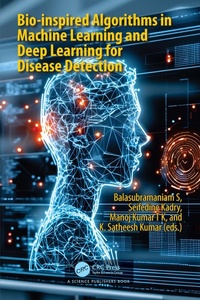
Bio-inspired Algorithms in Machine Learning and Deep Learning for Disease Detection
1st Edition
Published on 13. March 2025
262 pages
978-1-040-32944-3 (ISBN)
Description

Currently, computational intelligence approaches are utilised in various science and engineering applications to analyse information, make decisions, and achieve optimisation goals. Over the past few decades, various techniques and algorithms have been created in disciplines such as genetic algorithms, artificial neural networks, evolutionary algorithms, and fuzzy algorithms. In the coming years, intelligent optimisation algorithms are anticipated to become more efficient in addressing various issues in engineering, scientific, medical, space, and artificial satellite fields, particularly in early disease diagnosis. A metaheuristic in computer science is designed to discover optimisation algorithms capable of solving intricate issues. Metaheuristics are optimisation algorithms that mimic biological behaviours of animals or birds and are utilised to discover the best solution for a certain problem. A meta-heuristic is an advanced approach used by heuristics to tackle intricate optimisation problems. A metaheuristic in mathematical programming is a method that seeks a solution to an optimisation problem. Metaheuristics utilise a heuristic function to assist in the search process. Heuristic search can be categorised as blind search or informed search. Meta-heuristic optimisation algorithms are gaining popularity in various applications due to their simplicity, independence from data trends, ability to find optimal solutions, and versatility across different fields.
Recently, many nature-inspired computation algorithms have been utilised to diagnose people with different diseases. Nature-inspired methodologies are now widely utilised across several fields for tasks such as data analysis, decision-making, and optimisation. Techniques inspired by nature are categorised as either biology-based or natural phenomena-based. Bioinspired computing encompasses various topics in computer science, mathematics, and biology in recent years. Bio-inspired computer optimisation algorithms are a developing method that utilises concepts and inspiration from biological development to create new and resilient competitive strategies. Bio-inspired optimisation algorithms have gained recognition in machine learning and deep learning for solving complicated issues in science and engineering. Utilising BIAs learning methods with machine learning and deep learning shows great promise for accurately classifying medical conditions.
This book explores the historical development of bio-inspired algorithms and their application in machine learning and deep learning models for disease diagnosis, including COVID-19, heart diseases, cancer, diabetes and some other diseases. It discusses the advantages of using bio-inspired algorithms in disease diagnosis and concludes with research directions and future prospects in this field.
Recently, many nature-inspired computation algorithms have been utilised to diagnose people with different diseases. Nature-inspired methodologies are now widely utilised across several fields for tasks such as data analysis, decision-making, and optimisation. Techniques inspired by nature are categorised as either biology-based or natural phenomena-based. Bioinspired computing encompasses various topics in computer science, mathematics, and biology in recent years. Bio-inspired computer optimisation algorithms are a developing method that utilises concepts and inspiration from biological development to create new and resilient competitive strategies. Bio-inspired optimisation algorithms have gained recognition in machine learning and deep learning for solving complicated issues in science and engineering. Utilising BIAs learning methods with machine learning and deep learning shows great promise for accurately classifying medical conditions.
This book explores the historical development of bio-inspired algorithms and their application in machine learning and deep learning models for disease diagnosis, including COVID-19, heart diseases, cancer, diabetes and some other diseases. It discusses the advantages of using bio-inspired algorithms in disease diagnosis and concludes with research directions and future prospects in this field.
More details
Edition
1. Auflage
Language
English
Place of publication
London
United Kingdom
Publishing group
Taylor & Francis Ltd
Target group
College/higher education
Professional and scholarly
Illustrations
3 Line drawings, color; 45 Line drawings, black and white; 6 Halftones, black and white; 3 Illustrations, color; 51 Illustrations, black and white
File size
12,68 MB
ISBN-13
978-1-040-32944-3 (9781040329443)
Copyright in bibliographic data and cover images is held by Nielsen Book Services Limited or by the publishers or by their respective licensors: all rights reserved.
Schweitzer Classification
Other editions
Additional editions
Balasubramaniam S | Seifedine Kadry | Manoj Kumar TK
Bio-inspired Algorithms in Machine Learning and Deep Learning for Disease Detection
Book
approx. 07/2026
1st Edition
CRC Press
€66.00
Not yet published
Balasubramaniam S | Seifedine Kadry | Manoj Kumar TK
Bio-inspired Algorithms in Machine Learning and Deep Learning for Disease Detection
Book
03/2025
1st Edition
CRC Press
€227.30
Shipment within 10-20 days
Persons
Dr. Balasubramaniam S (IEEE Senior Member) is working as an Assistant Professor in School of Computer Science and Engineering, Kerala University of Digital Sciences, Innovation and Technology (Formerly IIITM-K), Digital University Kerala, Thiruvananthapuram, Kerala, India. He has totally around 15+ years of experience in teaching, research and industry. He has completed his Post Doctoral Research in Department of Applied Data Science, Noroff University College, Kristiansand, Norway. He holds a Ph.D degree in Computer Science and Engineering from Anna University, Chennai, India in 2015. He has published nearly 25+ research papers in reputed SCI/WoS/Scopus indexed Journals. He has also granted with 1 Australian patent and 2 Indian Patents and published 2 Indian patents. He has presented papers at conferences, contributed chapters to the edited books and editor in few books published by international publishers. His research and publication interests include machine learning and deep learning-based disease diagnosis, cloud computing security, Generative AI and Electric Vehicles.
Prof. Seifedine Kadry has a bachelor's degree in 1999 from Lebanese University, MS degree in 2002 from Reims University (France) and EPFL (Lausanne), PhD in 2007 from Blaise Pascal University (France), HDR degree in 2017 from Rouen University (France). At present his research focuses on Data Science, education using technology, system prognostics, stochastic systems, and applied mathematics. He is an ABET program evaluator for computing, and ABET program evaluator for Engineering Tech. he is a full professor of data science at Noroff University College, Norway and Department of Computer Science, Lebanese American University, Beirut, Lebanon.
Prof. Manoj Kumar T K, currently serving as Dean (Research) and Professor at Kerala University of Digital Sciences, Innovation and Technology, Thiruvananthapuram, Kerala, India. He is having 5 years of post-doctoral research experience in prestigious institutions like IIT-Madras and Pohang University of Science & Technology, Korea. With an impressive 17-year track record in post-graduate teaching, Dr Manoj has imparted knowledge across a diverse range of subjects including Data Analytics, Deep Learning, Computational Sciences, Predictive Analytics, Big data technologies and Cloud computing, Discrete mathematics, Ordinary differential Equations, Automata, Data Structure and Algorithm, Artificial Intelligence, and Quantum Chemistry. Their scholarly contributions extend to 80 publications in international journals of high impact, marking a significant impact in their respective fields. Previously, he has holding key administrative roles such as Chair of the School of Digital Sciences; Registrar, Digital University Kerala; Registrar, Indian Institute of Information Technology and Management - Kerala and Director of the International Centre for Free and Open-Source Systems, Kerala, India.
Prof. K. Satheesh Kumar presently holds the role of Visiting Professor at the Kerala University of Digital Sciences, Innovation, and Technology, Thiruvananthapuram Kerala, India. Previously, he served as Professor and Head of the Department of Futures Studies at the University of Kerala, Kerala, India. Dr. Kumar's academic journey began with a degree in mathematics, followed by doctoral research in suspension rheology and chaotic dynamics at the CSIR Lab in Thiruvananthapuram. He subsequently pursued post-doctoral research positions at Monash University, Australia, and POSTECH, South Korea. Dr. Kumar's research interests span suspension and polymer rheology, chaotic dynamics, nonlinear time series analysis, geophysics, complex network analysis, and wind energy modeling and forecasting.
Prof. Seifedine Kadry has a bachelor's degree in 1999 from Lebanese University, MS degree in 2002 from Reims University (France) and EPFL (Lausanne), PhD in 2007 from Blaise Pascal University (France), HDR degree in 2017 from Rouen University (France). At present his research focuses on Data Science, education using technology, system prognostics, stochastic systems, and applied mathematics. He is an ABET program evaluator for computing, and ABET program evaluator for Engineering Tech. he is a full professor of data science at Noroff University College, Norway and Department of Computer Science, Lebanese American University, Beirut, Lebanon.
Prof. Manoj Kumar T K, currently serving as Dean (Research) and Professor at Kerala University of Digital Sciences, Innovation and Technology, Thiruvananthapuram, Kerala, India. He is having 5 years of post-doctoral research experience in prestigious institutions like IIT-Madras and Pohang University of Science & Technology, Korea. With an impressive 17-year track record in post-graduate teaching, Dr Manoj has imparted knowledge across a diverse range of subjects including Data Analytics, Deep Learning, Computational Sciences, Predictive Analytics, Big data technologies and Cloud computing, Discrete mathematics, Ordinary differential Equations, Automata, Data Structure and Algorithm, Artificial Intelligence, and Quantum Chemistry. Their scholarly contributions extend to 80 publications in international journals of high impact, marking a significant impact in their respective fields. Previously, he has holding key administrative roles such as Chair of the School of Digital Sciences; Registrar, Digital University Kerala; Registrar, Indian Institute of Information Technology and Management - Kerala and Director of the International Centre for Free and Open-Source Systems, Kerala, India.
Prof. K. Satheesh Kumar presently holds the role of Visiting Professor at the Kerala University of Digital Sciences, Innovation, and Technology, Thiruvananthapuram Kerala, India. Previously, he served as Professor and Head of the Department of Futures Studies at the University of Kerala, Kerala, India. Dr. Kumar's academic journey began with a degree in mathematics, followed by doctoral research in suspension rheology and chaotic dynamics at the CSIR Lab in Thiruvananthapuram. He subsequently pursued post-doctoral research positions at Monash University, Australia, and POSTECH, South Korea. Dr. Kumar's research interests span suspension and polymer rheology, chaotic dynamics, nonlinear time series analysis, geophysics, complex network analysis, and wind energy modeling and forecasting.
Content
Preface. 1 Potential Benefits of BIAs-based ML/DL Models. 2 BIAs-based Deep Learning (DL) Models. 3 Evaluation of Bio-Inspired Algorithm-based Machine Learning and Deep Learning Models. 4 Disease Diagnosis: Traditional vs. Bio-Inspired Algorithm Approaches. 5 Algorithmic Heartbeat with Bio-Inspired Algorithms in Cardiac Health Monitoring. 6 Bio-Inspired Algorithms-based Machine Learning and Deep Learning Models for Covid-19 Diagnosis. 7 Bio-Inspired Intelligence in Early Cancer Detection: A Machine Learning Approach. 8 Bio-Inspired Algorithms in Machine Learning and Deep Learning for Diabetes Diagnosis. 9 A Multi-objective Optimized Bio-inspired Deep Learning framework for Autism Spectrum Disorder Diagnosis in Toddlers. 10 Bio-Inspired Algorithms using Machine Learning and Deep Learning for Social Phobia Treatment. 11 Bio-Inspired Algorithms-based Machine Learning models for Neural Disorders Prediction: A Focus on Depression Detection. 12 Research Directions and Challenges in Bio-Inspired Algorithms for Machine Learning and Deep Learning Models in Healthcare. Index.
