

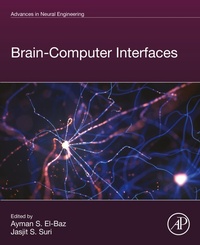
Brain-Computer Interfaces
Published on 5. November 2024
420 pages
978-0-323-95440-2 (ISBN)
Description

Advances in Neural Engineering: Brain-Computer Interfaces, Volume Two covers the broad spectrum of neural engineering subfields and applications. The set provides a comprehensive review of dominant feature extraction methods and classification algorithms in the brain-computer interfaces for motor imagery tasks. The book's authors discuss existing challenges in the domain of motor imagery brain-computer interface and suggest possible research directions. The field of neural engineering deals with many aspects of basic and clinical problems associated with neural dysfunction, including sensory and motor information, stimulation of the neuromuscular system to control muscle activation and movement, analysis and visualization of complex neural systems, and more.
- Presents Neural Engineering techniques applied to Signal Processing, including feature extraction methods and classification algorithms in BCI for motor imagery tasks
- Includes in-depth technical coverage of disruptive neurocircuitry, including neurocircuitry of stress integration, role of basal ganglia neurocircuitry in pathology of psychiatric disorders, and neurocircuitry of anxiety in obsessive-compulsive disorder
- Covers neural signal processing data analysis and neuroprosthetics applications, including EEG-based BCI paradigms, EEG signal processing in anesthesia, neural networks for intelligent signal processing, and a variety of neuroprosthetic applications
- Written by engineers to help engineers, computer scientists, researchers, and clinicians understand the technology and applications of signal processing
More details
Other editions
Additional editions
Book
11/2024
Academic Press
€192.50
Shipment within 15-20 days
Content
1. Advances in Human Activity Recognition: Harnessing Machine Learning And Deep Learning With Topological Data Analysis2. Design And Validation Of A Hybrid Programmable Platform For The Acquisition Of Exg Signals3. FBSE Based Automated Classification of Motor Imagery EEG Signals in Brain-Computer Interface4. Automated Detection Of Brain Disease Using Quantum Machine Learning5. A Study Of The Relationship Of Wavelet Transform Parameters And Their Impact On Eeg Classification Performance6. Bcis For Stroke Rehabilitation7. Decoding Imagined Speech For Eeg-Based Bci8. A Comparison Of Deep Learning Methods And Conventional Methods For Classification Of Ssvep Signals In Brain Computer Interface Framework9. Benchmarking Convolutional Neural Networks On Continuous Eeg Signals: The Case Of Motor Imagery-Based Bci10. Advancements in The Diagnosis Of Alzheimer'S Disease (Ad) Through Biomarker Detection11. Alcoholism Identification By Processing The Eeg Signals Using Oscillatory Modes Decomposition And Machine Learning12. Investigating the role of cortical rhythms in modulating kinematic synergies and exploring their potential for stroke rehabilitation13. Stimulus-Independent Non-Invasive Bci Based On Eeg Patterns Of Inner Speech14. A Review of Modern Brain Computer Interface Investigations And Limits15. Non-Invasive Brain-Computer Interfaces Using Fnirs, Eeg And Hybrid Fnirs/Eeg16. Eeg-Based Cognitive Fatigue Recognition Via Machine Learning and Analysis Of Multidomain Features17. Passive Brain-Computer Interfaces for Cognitive and Pathological Brain Physiological States Monitoring And Control18. Beyond Brainwaves: Recommendations for Integrating Robotics & Virtual Reality for Eeg-Driven Brain-Computer Interface19. A Sociotechnical Systems Perspective To Support Brain-Computer Interface Development20. Assessing Systemic Benefit and Risk in The Development Of Bci Neurotechnology21. Recent Development of Single Channel EEG-Based Automated Sleep Stage Classification: Review And Future Perspectives
