

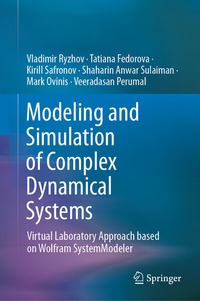
Modeling and Simulation of Complex Dynamical Systems
Description

This book highlights the practical aspects of computer modelling and simulation of complex dynamical systems for students. Mechanical systems are considered in the book as representative examples of dynamical systems. Wolfram SystemModeler, in combination with Learning Management System Sakai, is used as an instrument for studying features of various physical and technical phenomena and processes. Each of the presented virtual labs may be considered a stand-alone mini project to enable students to go through all the steps of mathematical modelling and computer simulation-from the problem statement to mathematical and physical analysis of the obtained result. The book is useful for teachers to organize the educational process, allowing gradual monitoring of the learning process and assessment of students' competencies. It also allows tutors to design individual educational trajectories for students to achieve educational properties. The subject of the book is an extension of activitystarted by the international team of authors within the InMotion project of the European programme ERASMUS+.
Reviews / Votes
"The authors went to great effort to produce beautiful figures, with color no less, to aid the reader. The tables are laid out logically, and the discussion for each model is, for the most part straightforward. I wish I could recommend the book . ." (David S. Mazel, MAA Reviews, August 22, 2022)More details
Other editions
Additional editions
Persons
Dr. Vladimir Ryzhov works at the SMTU since 1984 and is Head of Applied Math & Math Modeling Department, Director of «e-Learning, Science & Technology Center», Professor, and Doctor of Technical Sciences. His teaching background is engaged in developing innovative methods and models of training on subjects of the department with a special focus on e-learning courses. He developed methods of knowledge testing for research engineering disciplines. He has extensive experience in educational (academic and corporative) and research projects management. He trains Ph.D. students in fluid mechanics. He is Member of the Academic Degree Councils and has a large experience in Ph.D. thesis quality assessment. He is Author of more than 100 scientific publications. He was Coordinator of international projects (TEMPUS, ERASMUS programs).
Dr. Tatiana Fedorova
works at the SMTU since 1994, is Associate Professor of the Department of Applied Mathematics and Mathematical Modeling, and holds Ph.D. in theoretical physics. The area of her research experience lies in the field of many-body interactions in complex systems. She teaches a wide range of disciplines at graduate and postgraduate levels. She has a special interest in developing e-learning courses of theoretical orientation. She is involved in graduate and postgraduate student supervision in the fields of mathematical and computer modeling. She is Author of 25 articles. She has extensive experience in teamwork and international cooperation.
Kirill Safronov
works at the SMTU since 2015 and is Assistant Professor of Applied Mathematics and Mathematical Modeling Department. He has held the position of Assistant Professor. He is engaged in developing innovative methods and models of teaching on mathematical subjects. He has work experience in the primary field of the department (he works for Wärtsila Ltd as Modeling Engineer). He is Developer of syllabi of the practice-oriented computer modeling and simulation courses.
Dr. Shaharin Anwar Sulaiman
serves the Department of Mechanical Engineering at Universiti Teknologi PETRONAS. He holds a B.Sc., M.Sc., and Ph.D. in Mechanical Engineering from the USA and the UK. He was Mechanical & Electrical (M&E) Engineer in YTL Construction prior to joining the academics in 1998. His research interests include air conditioning, biomass energy, solar photovoltaic, combustion, and flow assurance.
Dr. Mark Ovinis
is Senior Lecturer at the Mechanical Engineering Department, Universiti Teknologi PETRONAS. His current research areas are in underwater vehicles and machine vision. He received his Ph.D. from Loughborough University, UK. He earned his Master's degree in Mechanical Engineering from Texas A&M University, USA, and a Bachelor's degree in Mechanical Engineering from Universiti Teknologi Malaysia. He is Graduate Member of the Board of Engineers Malaysia and the Institution of Engineers, Malaysia.
Dr. Veeradasan Perumal
received his Ph.D. in Nanoelectronics Engineering from Universiti Malaysia Perlis in 2016. He joined the Department of Mechanical Engineering at Universiti Teknologi PETRONAS as Lecturer. His current research interests are mainly on the synthesis and study of biopolymer and carbon-based nanomaterials for flexible supercapacitor and biosensor applications.
Content
Introduction.- 1. Virtual Labs.- 2. Guidelines for performing virtual labs in Wolfram SystemModeler.
