

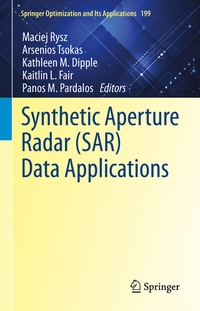
Synthetic Aperture Radar (SAR) Data Applications
Description

This carefully curated volume presents an in-depth, state-of-the-art discussion on many applications of Synthetic Aperture Radar (SAR). Integrating interdisciplinary sciences, the book features novel ideas, quantitative methods, and research results, promising to advance computational practices and technologies within the academic and industrial communities. SAR applications employ diverse and often complex computational methods rooted in machine learning, estimation, statistical learning, inversion models, and empirical models. Current and emerging applications of SAR data for earth observation, object detection and recognition, change detection, navigation, and interference mitigation are highlighted. Cutting edge methods, with particular emphasis on machine learning, are included. Contemporary deep learning models in object detection and recognition in SAR imagery with corresponding feature extraction and training schemes are considered. State-of-the-art neural network architectures in SAR-aided navigation are compared and discussed further. Advanced empirical and machine learning models in retrieving land and ocean information - wind, wave, soil conditions, among others, are also included.
More details
Other editions
Additional editions
Persons
Arsenios Tsokas currently works as an analyst for Citibank, N.A. He received his B.Sc. in Mathematics from the Aristotle University of Thessaloniki in 2014. He received his Ph.D. degree in Industrial & Systems Engineering from the University of Florida in 2021. He has a diverse background including data science, optimization, and machine learning. He has worked on various topics, such as data analysis with applications in medicine and network science with applications on network robustness.
Kathleen M Dipple is currently a research scientist with the US Air Force Research Lab (AFRL). A first-generation undergraduate student, she earned her bachelor's degree in Chemistry from Appalachian State University and received her Ph.D. from the Nanoscale Science program at the University of North Carolina at Charlotte. She completed her post-doctoral work holding a provisional patent in the Nature-Inspired Section at AFRL's Munitions Directorate through the National Research Council Associateship Program.
Kaitlin Fair is a Systems Development Engineer working on guidance, navigation, and control technologies at the Air Force Life Cycle Management Center. Dr. Fair served as a Research Engineer and Team Lead at the Air Force Research Lab for ten years prior to serving in her current role, during which she received the SMART Scholarship and completed her PhD in Electrical Engineering from the Georgia Institute of Technology in 2017. Her research interests include efficient signal processing and algorithm development on brain-inspired (neuromorphic) engineering architectures.
Panos M. Pardalos is a distinguished Professor Emeritus of Industrial and Systems Engineering at the University of Florida. Additionally, he is the Paul and Heidi Brown Preeminent Professor in Industrial & Systems Engineering. He is also an affiliated faculty member of the Computer and Information Science Department, the Hellenic Studies Center, and the Biomedical Engineering Program. He is also the Director of the Center for Applied Optimization. Dr. Pardalos is a world leading expert in global and combinatorial optimization. His recent research interests include network design problems,optimization in telecommunications, e-commerce, data mining, biomedical applications, and massive computing. He has co-authored and co-edited more than 30 books, as well as publishing more than 600 journal articles and conference proceedings. Prof. Pardalos is a Fellow of AAAS (American Association for the Advancement of Science), Fellow of American Institute for Medical and Biological Engineering (AIMBE), and EUROPT. He is a Distinguished International Professor by the Chinese Minister of Education; Honorary Professor of Anhui University of Sciences and Technology, China; Elizabeth Wood Dunlevie Honors Term Professor; Honorary Doctor, V.M. Glushkov Institute of Cybernetics of The National Academy of Sciences of Ukraine; Foreign Associate Member of Reial Academia de Doctors, Spain; and Advisory board member of the Centre for Optimisation and Its Applications, Cardiff University, UK. He is also the recipient of UF 2009 International Educator Award; Medal (in recognition of broad contributions in science and engineering) of the University of Catani, Italy; EURO Gold Medal (EGM); Honorary Doctor of Science Degree, Wilfrid Laurier University, Canada; Senior Fulbright Specialist Award; University of Florida Research Foundation Professorship; and IBM Achievement Award.
