

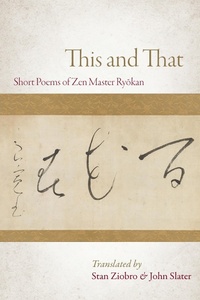
This and That
Description

Zen poems of everyday awakening.
A fresh translation of short poems by the Japanese Zen poet Ryokan that reads well as modern American poetry, accompanied by an introduction and commentaries on the poems from the translators. Most of the existing translations are stiff, or sentimental, or awkward as poems in English. This effort is comparable to Gary Snyder's Han-Shan poems, or Thomas Merton's Chuang-Tzu.
One of the greatest poets of the Edo period and certainly one of the most loved, Ryokan was a highly original and eccentric master artist and Zen practitioner. A solitary hermit who begged for food and lived among the poor, often in dire need himself, his offbeat poems are moments of everyday awakening, characterized, as was his personality, by both austerity and playfulness. This translation aims to retain Ryokan's charm without undue sentiment or saint-making, allowing for his rougher edges to appear.
More details
Other editions
Additional editions
Person
Ryokan (1758?1831) was a Japanese Soto Zen Buddhist monk who lived as a hermit. Even by those standards, he was known for unconventionality, shocking others, for example, by refusing to hurt bugs, and confronting burglars to willingly give them his clothes. But most of all Ryokan is remembered for his poetry, which presents the essence of Zen life.
John (aka Isaac) Slater has lived since 1999 as a Trappist monk at the Abbey of the Genesee in New York, where he's novice director. He's published collections of his own poems, a co-translation, The Tangled Braid: Ninety-Nine Poems by Hafiz of Shiraz, and Do Not Judge Anyone: Desert Wisdom for a Polarized World. He was recently a guest on the popular podcast, ?The Spiritual Life with Fr. James Martin, SJ.? Slater has been drawn to the work and figure of Ryokan for more than thirty years.
Stan Ziobro lives in Charleston, SC. After earning a certificate in Asian studies from Kansai University in Osaka, Japan, he graduated from the University of Rochester in philosophy and Japanese. His graduate degrees are in religious studies from Wake Forest University and The Divinity School at University of Chicago. He's worked as a professional translator of Japanese since 1998. Translations include those incorporated in James L. Ford's Jokei and Buddhist Devotion in Early Medieval Japan (Oxford University Press, 2006). He lives in Charleston, SC.
