

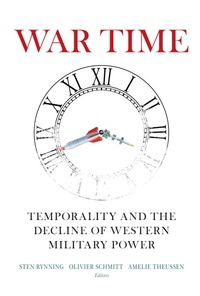
War Time
Temporality and the Decline of Western Military Power
1st Edition
Published on 2. March 2021
1 pages
978-0-8157-4338-5 (ISBN)
Description

Perceptions of time contributed to recent Western military failings
The ¿decline of the West¿ is once again a frequent topic of speculation. Often cited as one element of the alleged decline is the succession of prolonged and unsuccessful wars¿most notably those waged in recent decades by the United States. This book by three Danish military experts examines not only the validity of the speculation but also asks why the West, particularly its military effectiveness, might be perceived as in decline.
Temporality is the central concept linking a series of structural fractures that leave the West seemingly muscle-bound: overwhelmingly powerful in technology and military might but strategically fragile. This temporality, the authors say, is composed of three interrelated dimensions: trajectories, perceptions, and pace.
First, Western societies to tend view time as a linear trajectory, focusing mostly on recent and current events and leading to the framing of history as a story of rise and decline. The authors examine whether the inevitable fall already has happened, is underway, or is still in the future.
Perceptions of time also vary across cultures and periods, shaping socio-political activities, including warfare. The enemy, for example, can be perceived as belong to another time (being ¿backward¿ or ¿barbarian¿). And war can be seen either as cyclical or exceptional, helping frame the public's willingness to accept its violent and tragic consequences.
The pace of war is another factor shaping policies and actions. Western societies emphasize speed: the shorter the war the better, even if the long-term result is unsuccessful. Ironically, one of the Western world's least successful wars also has been America's longest, in Afghanistan.
This unique book is thus a critical assessment of the evolution and future of Western military power. It contributes much-needed insight into the potential for the West's political and institutional renewal.
The ¿decline of the West¿ is once again a frequent topic of speculation. Often cited as one element of the alleged decline is the succession of prolonged and unsuccessful wars¿most notably those waged in recent decades by the United States. This book by three Danish military experts examines not only the validity of the speculation but also asks why the West, particularly its military effectiveness, might be perceived as in decline.
Temporality is the central concept linking a series of structural fractures that leave the West seemingly muscle-bound: overwhelmingly powerful in technology and military might but strategically fragile. This temporality, the authors say, is composed of three interrelated dimensions: trajectories, perceptions, and pace.
First, Western societies to tend view time as a linear trajectory, focusing mostly on recent and current events and leading to the framing of history as a story of rise and decline. The authors examine whether the inevitable fall already has happened, is underway, or is still in the future.
Perceptions of time also vary across cultures and periods, shaping socio-political activities, including warfare. The enemy, for example, can be perceived as belong to another time (being ¿backward¿ or ¿barbarian¿). And war can be seen either as cyclical or exceptional, helping frame the public's willingness to accept its violent and tragic consequences.
The pace of war is another factor shaping policies and actions. Western societies emphasize speed: the shorter the war the better, even if the long-term result is unsuccessful. Ironically, one of the Western world's least successful wars also has been America's longest, in Afghanistan.
This unique book is thus a critical assessment of the evolution and future of Western military power. It contributes much-needed insight into the potential for the West's political and institutional renewal.
More details
Other editions
Additional editions
Sten Rynning | Olivier Schmitt | Amelie Theussen
War Time
Temporality and the Decline of Western Military Power
Book
03/2021
Brookings Institution
€63.00
Shipment within 10-20 days
Persons
Sten Rynning is professor of war studies at the University of Southern Denmark.Olivier Schmitt is professor with special responsibilities at the Center for War Studies, University of Southern Denmark, and currently director of research and studies at the French Institute for Higher National Defence Studies.Amelie Theussen is assistant professor at the Center for War Studies, University of Southern Denmark.
Content
Contents:
Foreword
Acknowledgments
Introduction
Part I: ¿Civic Militarism¿ and the Trajectory of Western Power: The Western Experience in Balancing Liberal and Military Virtues
1. The Modern State Rise and Decline of Civic Militarism
2. Making Time an Ally: Uncovering the Perils of Tactical Military Speed
3. Benefit or Burden? NATO-led Military Missions and Western Cohesion
4. The Future of the West: What If the United States Pulls Out of NATO?
Part II: Western Perceptions of Time and the International Normative Order: A Normative Order under Pressure
5. Civilian Casualties and Contemporary Coalition Operations: The Case of Afghanistan
6. Conflicting Norms of Intervention: When and How to Use Military Force?
7. In the Shadows: The Challenge of Russian and Chinese Gray Zone Conflict for the West
8. Competing Norms: What If China Takes Control of Djibouti to Protect Its People?
Part III: Military Operations and Temporality: Speed, Time, and Western Military Power
9. Fighting, Fast and Slow? Speed and Western Ways of War
10. War at Information Speed: Multi-Domain Warfighting Visions
11. The Limits of Technology: The Impact of Speed and Innovation on Western Military Primacy
12. Military Operations: What If Digital Technologies Fail on the Battlefield
Conclusion
Contributors
Index
Foreword
Acknowledgments
Introduction
Part I: ¿Civic Militarism¿ and the Trajectory of Western Power: The Western Experience in Balancing Liberal and Military Virtues
1. The Modern State Rise and Decline of Civic Militarism
2. Making Time an Ally: Uncovering the Perils of Tactical Military Speed
3. Benefit or Burden? NATO-led Military Missions and Western Cohesion
4. The Future of the West: What If the United States Pulls Out of NATO?
Part II: Western Perceptions of Time and the International Normative Order: A Normative Order under Pressure
5. Civilian Casualties and Contemporary Coalition Operations: The Case of Afghanistan
6. Conflicting Norms of Intervention: When and How to Use Military Force?
7. In the Shadows: The Challenge of Russian and Chinese Gray Zone Conflict for the West
8. Competing Norms: What If China Takes Control of Djibouti to Protect Its People?
Part III: Military Operations and Temporality: Speed, Time, and Western Military Power
9. Fighting, Fast and Slow? Speed and Western Ways of War
10. War at Information Speed: Multi-Domain Warfighting Visions
11. The Limits of Technology: The Impact of Speed and Innovation on Western Military Primacy
12. Military Operations: What If Digital Technologies Fail on the Battlefield
Conclusion
Contributors
Index
