

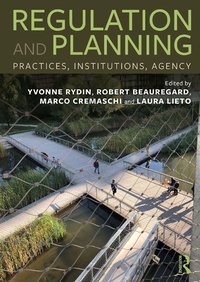
Regulation and Planning
Practices, Institutions, Agency
1st Edition
Published on 30. September 2021
234 pages
978-1-000-45062-0 (ISBN)
Description

In Regulation and Planning, planning scholars from the United Kingdom, France, Italy, Sweden, Canada, Australia, and the United States explore how planning regulations are negotiated amid layers of normative considerations. It treats regulation not simply as a set of legal guidelines to be compared against proposed actions, but as a social practice in which issues of governmental legitimacy, cultural understandings, materiality, and power are contested.
Each chapter addresses an actual instance of planning regulation including, among others, a dispute about a proposed Apple store in a public park in Stockholm, the procedures by which building codes are managed by planners in Napoli, the role that design plays in regulating the use of public space in a new Paris neighbourhood, and the influence of plans on the regulation of development in Malmoe and Cambridge. Collectively, the volume probes the institutions and practices that give meaning and consequence to planning regulations.
For planning students learning about what it means to plan, planning researchers striving to understand the influence of planners on urban development, and planning practitioners interested in reflecting on practices that occupy a great deal of their time, this is an indispensable book.
Each chapter addresses an actual instance of planning regulation including, among others, a dispute about a proposed Apple store in a public park in Stockholm, the procedures by which building codes are managed by planners in Napoli, the role that design plays in regulating the use of public space in a new Paris neighbourhood, and the influence of plans on the regulation of development in Malmoe and Cambridge. Collectively, the volume probes the institutions and practices that give meaning and consequence to planning regulations.
For planning students learning about what it means to plan, planning researchers striving to understand the influence of planners on urban development, and planning practitioners interested in reflecting on practices that occupy a great deal of their time, this is an indispensable book.
Reviews / Votes
It is important to understand the second layer of this reader. Rather than addressing the instrumental uses of Regulation and Planning, this exemplary collection of international experiences contextualizes these central concepts in a variety of social - material practices. The intelligence of planning and regulation arises in the overlapping social encounters of institution and agency in a plural environment.- Willem Salet, University of Amsterdam
The issue of regulation is at the very core of planning theory and practice. Unfortunately, this aspect is too often taken as if it were obvious and already well-known. Refuting these assumptions, this intriguing book critically revisits various forms and dimensions of regulation. Rules are not taken to be black-box tools, but are instead re-discussed in terms of processes creating them, social meaning and multiple impacts. In this way, the book provides a welcome challenge to policy-makers and planners to pay more attention to certain crucial and constitutive aspects of their endeavours.
- Stefano Moroni, Professor of Planning at Milan Polytechnic
More details
Edition
1. Auflage
Language
English
Place of publication
London
United Kingdom
Publishing group
Taylor & Francis Ltd
Target group
College/higher education
Product notice
Reflowable
Illustrations
2 Tables, black and white; 11 Halftones, black and white; 11 Illustrations, black and white
ISBN-13
978-1-000-45062-0 (9781000450620)
Copyright in bibliographic data and cover images is held by Nielsen Book Services Limited or by the publishers or by their respective licensors: all rights reserved.
Schweitzer Classification
Other editions
Additional editions
Yvonne Rydin | Robert Beauregard | Marco Cremaschi
Regulation and Planning
Practices, Institutions, Agency
Book
09/2021
1st Edition
Routledge
€60.20
Shipment within 15-20 days
Yvonne Rydin | Robert Beauregard | Marco Cremaschi
Regulation and Planning
Practices, Institutions, Agency
Book
09/2021
1st Edition
Routledge
€192.21
Shipment within 15-20 days
Regulation and Planning
Practices, Institutions, Agency
Book
09/2021
Routledge
Unfortunately, price unknown
Available (delivery time upon request)
Persons
Yvonne Rydin is Professor of Planning, Environment, and Public Policy at the Bartlett School of Planning, University College London. She works on a wide range of issues concerning sustainability and planning. Her most recent book is Theory for Planning Research (Palgrave Macmillan, 2021).
Robert A. Beauregard is Professor Emeritus at Columbia University (USA). He has written extensively on planning theory and urban theory. His most recent books are Advanced Introduction to Planning Theory (Edward Elgar, 2020), Cities in the Urban Age: A Dissent (University of Chicago Press, 2018), and Planning Matter: Acting with Things (University of Chicago Press, 2015).
Marco Cremaschi is Professor of Urban Planning at SciencesPo, Paris. His research insists on a comparative approach to large urban projects in cities, focusing on Rome, Buenos Aires, and Kolkata; the local development of weak economy regions; and the reception of refugees in European metropolitan areas. His last book is Culture and Policy-Making. Pluralism, Performativity, and Semiotic Capital (co-auth. with C. Fioretti, T. Mannarini, S. Salvatore: Springer, 2020).
Laura Lieto is a Professor of Urban Planning at Federico II University, Napoli (Italy). Laura is a planning theorist and an urban ethnographer. Her work focuses on urban informality, transnational urbanism, and planning regulation. Her most recent publications include "Star Architecture as Socio-material Assemblage" (2020) and "Planning for the Hybrid Gulf City" (2019).
Robert A. Beauregard is Professor Emeritus at Columbia University (USA). He has written extensively on planning theory and urban theory. His most recent books are Advanced Introduction to Planning Theory (Edward Elgar, 2020), Cities in the Urban Age: A Dissent (University of Chicago Press, 2018), and Planning Matter: Acting with Things (University of Chicago Press, 2015).
Marco Cremaschi is Professor of Urban Planning at SciencesPo, Paris. His research insists on a comparative approach to large urban projects in cities, focusing on Rome, Buenos Aires, and Kolkata; the local development of weak economy regions; and the reception of refugees in European metropolitan areas. His last book is Culture and Policy-Making. Pluralism, Performativity, and Semiotic Capital (co-auth. with C. Fioretti, T. Mannarini, S. Salvatore: Springer, 2020).
Laura Lieto is a Professor of Urban Planning at Federico II University, Napoli (Italy). Laura is a planning theorist and an urban ethnographer. Her work focuses on urban informality, transnational urbanism, and planning regulation. Her most recent publications include "Star Architecture as Socio-material Assemblage" (2020) and "Planning for the Hybrid Gulf City" (2019).
Content
Introduction. The Editors Part 1: VARIETIES OF REGULATION 1. The Documents of Re-Zoning: Planning Aspirations In New York City Robert A. Beauregard 2. Planning Deregulation, Material Impacts and Everyday Practices: The Case of Permitted Development in England Ben Clifford 3. Malleable Categorisation and the Regulatory Process: The Case of the Apple Flagship Store in Stockholm Hoai Anh Tran 4. Democratic Debate or Empty Ritual? The Planning Hearing for Edinburgh's New Concert Hall Neil Thomas Smith 5. Encounters with Materiality: Planning Regulation and Non-Participation in Australia Brad Jessup Part 2: PRACTICES OF REGULATION 6. Planners as Brokers and Translators: On Regulation and Discretionary Power Laura Lieto 7. Artefacts in Dialogue: Regulatory Planning and the Search for Legitimacy Yvonne Rydin 8. Creating Land Through the Regulatory Process. The Case of Brownfield Land in England. Sonia Freire Trigo 9. Stepping Up to Meet the Challenge of a Zero Carbon Built Environment Meg Holden 10. Regulation and Water Management in the Milan Urban Region: The Seveso Creek Basin Matteo Del Fabbro and Gloria Pessina Part 3: BEYOND REGULATION 11. Intermediary Organisations and the Liquid Regulation of Urban Planning in England Mike Raco, Frances Brill and Jessica Ferm 12. Citizen Monitoring of Environmental Regulation in England: The Post-Consent Stage Lucy Natarajan 13. Regulation by Design: The Case of Batignolles Park, Paris Marco Cremaschi 14. When "the sensor gives them a voice": Representing Users Through Data Antoine Courmont 15. Land Banking Regulation as Rhetorical Infrastructure: Planning as Translation in the Muncie Land Bank, Indiana John H. West Afterward: On Practices, Institutions, Agency The Editors
