

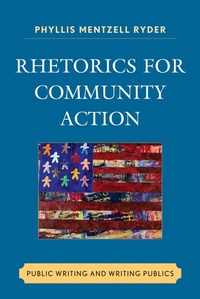
Rhetorics for Community Action
Public Writing and Writing Publics
1st Edition
Published on 10. July 2012
325 pages
978-0-7391-3768-0 (ISBN)
Description

Rhetorics for Community Action: Public Writing and Writing Publics, by Phyllis Mentzell Ryder, offers theory and pedagogy to introduce public writing as a complex political and creative action. To write public texts, we have to invent the public we wish to address. Such invention is a complex task, with many components to consider: exigency that brings people together; a sense of agency and capacity; a sense of how the world is and what it can become. All these components constantly compete against texts that put forward other public ideals-opposing ideas about who really has power and who really can create change. Teachers of public writing must adopt a generous response to those who venture into this arena.
Some scholars believe that to prepare students for public life, university classes should partner with grassroots community organizations, rather than nonprofits that serve food or tutor students. They worry that a service-related focus will create more passive citizens who do not rally and resist or grab the attention of government leaders or corporations. With carefully contextualized study of an after-school arts program, an area soup kitchen, and parks organizations, among others, Ryder shows that many so-called "service" organizations are not passive places at all, and she argues that the main challenge of public work is precisely that it has to take place among all of these compelling definitions of democracy.
Ryder proposes teaching public writing by partnering with multiple community nonprofits. She develops a framework to help students analyze how their community partners inspire people to action, and offers a course design that support them as they convey those public ideals in community texts.
But composing public texts is only part of the challenge. Traditional newspapers and magazines, through their business models and writing styles, reinforce a dominant role for citizens as thinking and reading, but not necessarily acting. This civic role is also professed
Some scholars believe that to prepare students for public life, university classes should partner with grassroots community organizations, rather than nonprofits that serve food or tutor students. They worry that a service-related focus will create more passive citizens who do not rally and resist or grab the attention of government leaders or corporations. With carefully contextualized study of an after-school arts program, an area soup kitchen, and parks organizations, among others, Ryder shows that many so-called "service" organizations are not passive places at all, and she argues that the main challenge of public work is precisely that it has to take place among all of these compelling definitions of democracy.
Ryder proposes teaching public writing by partnering with multiple community nonprofits. She develops a framework to help students analyze how their community partners inspire people to action, and offers a course design that support them as they convey those public ideals in community texts.
But composing public texts is only part of the challenge. Traditional newspapers and magazines, through their business models and writing styles, reinforce a dominant role for citizens as thinking and reading, but not necessarily acting. This civic role is also professed
More details
Series
Edition
1. Auflage
Language
English
Place of publication
New York
United States
Publishing group
Bloomsbury Publishing Plc
Target group
Professional and scholarly
ISBN-13
978-0-7391-3768-0 (9780739137680)
Copyright in bibliographic data and cover images is held by Nielsen Book Services Limited or by the publishers or by their respective licensors: all rights reserved.
Schweitzer Classification
Other editions
Additional editions
Book
12/2010
Lexington Books
€156.00
Shipment within 10-20 days
Person
Phyllis Mentzell Ryder is associate professor of writing at the George Washington University.
Content
Chapter 1 Dedication
Chapter 2 Acknowledgments
Chapter 3 Table of Contents
Chapter 4 List of Figures
Chapter 5 Chapter 1: Introduction
Chapter 6 Chapter 2: Publics Worth Studying
Chapter 7 Chapter 3: Public Writing with Community Organizations
Chapter 8 Chapter 4: The Public of Traditional Media: Circulating Deliberative Conversations
Chapter 9 Chapter 5: Counterpublics: Beyond Deliberative Conversation
Chapter 10 Chapter 6: Circulating Counterpublic Rhetoric
Chapter 11 Chapter 7: Publics 2.0: Public Formation through Social Networking
Chapter 12 Chapter 8: Teaching Public Writing in Academic Settings
Chapter 13 Appendix 1: Some Practical Guidelines
Chapter 14 Appendix 2: Sample Writing Assignments
Chapter 15 Appendix 3: Sample Community Partner Profiles
Chapter 16 References
Chapter 2 Acknowledgments
Chapter 3 Table of Contents
Chapter 4 List of Figures
Chapter 5 Chapter 1: Introduction
Chapter 6 Chapter 2: Publics Worth Studying
Chapter 7 Chapter 3: Public Writing with Community Organizations
Chapter 8 Chapter 4: The Public of Traditional Media: Circulating Deliberative Conversations
Chapter 9 Chapter 5: Counterpublics: Beyond Deliberative Conversation
Chapter 10 Chapter 6: Circulating Counterpublic Rhetoric
Chapter 11 Chapter 7: Publics 2.0: Public Formation through Social Networking
Chapter 12 Chapter 8: Teaching Public Writing in Academic Settings
Chapter 13 Appendix 1: Some Practical Guidelines
Chapter 14 Appendix 2: Sample Writing Assignments
Chapter 15 Appendix 3: Sample Community Partner Profiles
Chapter 16 References
