

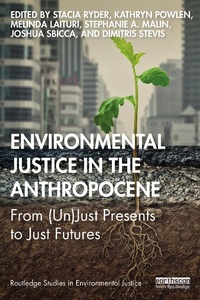
Environmental Justice in the Anthropocene
From (Un)Just Presents to Just Futures
1st Edition
Published on 9. June 2021
358 pages
978-1-000-39662-1 (ISBN)
Description

Through various international case studies presented by both practitioners and scholars, Environmental Justice in the Anthropocene explores how an environmental justice approach is necessary for reflections on inequality in the Anthropocene and for forging societal transitions toward a more just and sustainable future.
Environmental justice is a central component of sustainability politics during the Anthropocene - the current geological age in which human activity is the dominant influence on climate and the environment. Every aspect of sustainability politics requires a close analysis of equity implications, including problematizing the notion that humans as a collective are equally responsible for ushering in this new epoch. Environmental justice provides us with the tools to critically investigate the drivers and characteristics of this era and the debates over the inequitable outcomes of the Anthropocene for historically marginalized peoples. The contributors to this volume focus on a critical approach to power and issues of environmental injustice across time, space, and context, drawing from twelve national contexts: Austria, Bangladesh, Chile, China, India, Nicaragua, Hungary, Mexico, Brazil, Sweden, Tanzania, and the United States. Beyond highlighting injustices, the volume highlights forward-facing efforts at building just transitions, with a goal of identifying practical steps to connect theory and movement and envision an environmentally and ecologically just future.
This interdisciplinary work will be of great interest to students, scholars, and practitioners focused on conservation, environmental politics and governance, environmental and earth sciences, environmental sociology, environment and planning, environmental justice, and global sustainability and governance. It will also be of interest to social and environmental justice advocates and activists.
Environmental justice is a central component of sustainability politics during the Anthropocene - the current geological age in which human activity is the dominant influence on climate and the environment. Every aspect of sustainability politics requires a close analysis of equity implications, including problematizing the notion that humans as a collective are equally responsible for ushering in this new epoch. Environmental justice provides us with the tools to critically investigate the drivers and characteristics of this era and the debates over the inequitable outcomes of the Anthropocene for historically marginalized peoples. The contributors to this volume focus on a critical approach to power and issues of environmental injustice across time, space, and context, drawing from twelve national contexts: Austria, Bangladesh, Chile, China, India, Nicaragua, Hungary, Mexico, Brazil, Sweden, Tanzania, and the United States. Beyond highlighting injustices, the volume highlights forward-facing efforts at building just transitions, with a goal of identifying practical steps to connect theory and movement and envision an environmentally and ecologically just future.
This interdisciplinary work will be of great interest to students, scholars, and practitioners focused on conservation, environmental politics and governance, environmental and earth sciences, environmental sociology, environment and planning, environmental justice, and global sustainability and governance. It will also be of interest to social and environmental justice advocates and activists.
Reviews / Votes
"This impressive collection makes an important contribution to our understanding of environmental justice. With a refreshing and original focus on transitions and futures, it is highly recommended for anyone interested in how environmental inequalities are made and sustained, and how, crucially, we might imagine and achieve a more just future." - Neil Simcock, Liverpool John Moores University, UK."This is an impressive volume, with a distinctively critical and international perspective, drawing together fresh voices on the challenges and possibilities of just transitions across different sites and settings. Its multi-scalar, multi-species and intersectional scope puts it at the cutting edge of contemporary environmental justice scholarship." - Professor Gordon Walker, Lancaster Environment Centre, Lancaster University, UK.
"This impressive, interdisciplinary collection makes important contributions to the field of critical environmental justice studies in its broad examination of the social and ecological inequities intrinsic to the 'Anthropocene.' Grounded in a wide range of case studies from diverse national contexts, the chapters draw on foundational concepts of spatial and intergenerational justice to analyze the degree to which our go-to 'sustainability solutions' will in fact bring about the just transitions they promise. From the complexities of bioenergy justice initiatives in Yucatan, Mexico, to climate transition strategies in Tanzanian forest management policies, to the challenges and prospects of intersectional climate justice organizing in California, the authors provide original and forward-facing assessments of what is needed to move from '(un)just presents to just futures'." - Giovanna Di Chiro, Professor of Environmental Studies, Swarthmore College, USA.
More details
Series
Edition
1. Auflage
Language
English
Place of publication
London
United Kingdom
Publishing group
Taylor & Francis Ltd
Target group
College/higher education
Product notice
Reflowable
Illustrations
6 Tables, black and white; 9 Line drawings, black and white; 5 Halftones, black and white; 14 Illustrations, black and white
ISBN-13
978-1-000-39662-1 (9781000396621)
Copyright in bibliographic data and cover images is held by Nielsen Book Services Limited or by the publishers or by their respective licensors: all rights reserved.
Schweitzer Classification
Other editions
Additional editions
Stacia Ryder | Kathryn Powlen | Melinda Laituri
Environmental Justice in the Anthropocene
From (Un)Just Presents to Just Futures
Book
06/2021
1st Edition
Routledge
€207.20
Shipment within 15-20 days
Stacia Ryder | Kathryn Powlen | Melinda Laituri
Environmental Justice in the Anthropocene
From (Un)Just Presents to Just Futures
Book
06/2021
1st Edition
Routledge
€60.90
Shipment within 15-20 days
Persons
Stacia Ryder is a Post-Doctoral Research Fellow at the University of Exeter, UK.
Kathryn Powlen is a PhD candidate in Human Dimensions of Natural Resources, Colorado State University, USA.
Melinda Laituri is Professor Emeritus of Ecosystem Science and Sustainability at Colorado State University, USA.
Stephanie A. Malin is Associate Professor of Sociology at Colorado State University, USA.
Joshua Sbicca is Associate Professor of Sociology at Colorado State University, USA.
Dimitris Stevis is Professor of Politics at Colorado State University, USA.
Kathryn Powlen is a PhD candidate in Human Dimensions of Natural Resources, Colorado State University, USA.
Melinda Laituri is Professor Emeritus of Ecosystem Science and Sustainability at Colorado State University, USA.
Stephanie A. Malin is Associate Professor of Sociology at Colorado State University, USA.
Joshua Sbicca is Associate Professor of Sociology at Colorado State University, USA.
Dimitris Stevis is Professor of Politics at Colorado State University, USA.
Content
Foreword Preface: Environmental justice in the Anthropocene PART I Thinking on the Anthropocence Introduction: Just Anthropocene? Dimitris Stevis, Melinda Laituri, Stacia Ryder, Kathryn Powlen, Stephanie A. Malin, and Joshua Sbicca 1. Examining the Anthropocene: A contested term in capitalist times Stephanie A. Malin 2. The selective invisibility of oil and climate injustice in the Anthropocene and beyond Nino Antadze PART II Environmental justice as spatial justice Introduction: Contextualizing spatial justice Joshua Sbicca, Melinda Laituri, Stacia Ryder, and Kathryn Powlen 3. Environmental justice and autocracy in Eastern Europe: The case of Hungary Attila Antal 4. Navigating environmental justice in Chile: The case of Pascua Lama Sherrie Baver 5. Towards socio-ecological inclusion: Scaling up housing innovation in Vienna Michael Friesenecker and Roberta Cucca 6. From water insecurity to water injustice: How tourism produces environmental injustice along Nicaragua's "Emerald Coast" Sarah T. Romano and G. Thomas LaVanchy 7. Jatropha bioenergy in Yucatan, Mexico: An examination of energy justice Aparajita Banerjee 8. Keeping it local: The continued relevance of place-based studies for environmental justice research and praxis Michelle Larkins 9. Determinants of household electricity consumption in Mexico by income level Monica Santillan Vera, Lilia Garcia Manrique and Isabel Rodriguez Pena 10. Environmental justice and the Sabal Trail pipeline Julie A. Lester 11. Injustices in implementing donor-funded climate change resilience projects in Bangladesh: North-South dichotomy? Nowrin Tabassum PART III Just transitions Introduction: Pursuing just transitions: growing from seed to blossom Stacia Ryder, Kathryn Powlen, and Melinda Laituri 12. Just energy systems: Five questions and countless responses for regenerative energy ommunities Matthew J. Burke 13. Authoritarian environmentalism as just transition?: A critical environmental justice examination of state environmental intervention in northwestern China KuoRay Mao, Qian Zhang, and Nefratiri Weeks 14. Lessons from Tanzanian forest management: Justice in environmental and climate policy ransitions Jessica Omukuti 15. Is renewable power reaching the people and are people reaching the power?: Creating a Just Transition from the ground-up Caroline Farrell and Mad Stano 16. Contested suburban mobilities: Towards a sustainable urbanism of justice and difference Shimeng Zhou 17. Seeds, chemicals, and stuff: The agency of things in (un)just agriculture regimes Matt Comi 18. "To have a garden is against this system": The revolutionary subjectivity of convivial labor for home kitchen gardeners in San Jose, CA Gabriel Valle PART IV Just futures Introduction: Looking forward: Challenges and opportunities for a just future Kathryn Powlen, Stacia Ryder, and Melinda Laituri 19. Enhancing environmental and cultural justice outcomes under the National Environmental Policy Act and the National Historic Preservation Act Matthew J. Rowe and Judson B. Finley 20. One earth, one species history, and one future: Earth-Justice in the Anthropocene Saptaparni Pandit and Anindya Sekhar Purakayastha 21. A framework for intergenerational justice: Objections and principles Chaitanya Motupalli 22. Conditional freedom: A governance innovation for climate justice Rita Vasconcellos Oliveira 23. "Building the Bigger We" for climate justice Benjamin Max Goloff Conclusion: The quest for environmental justice Melinda Laituri, Stacia Ryder, Kathryn Powlen, Stephanie A. Malin, Joshua Sbicca, and Dimitris Stevis
