

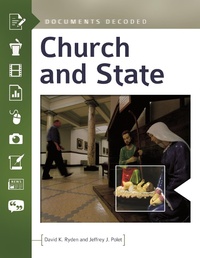
Church and State
Documents Decoded
Published on 1. December 2017
304 pages
979-8-216-06088-8 (ISBN)
Description

This thoroughly annotated document collection gives students and researchers an authoritative source for understanding the evolving political and legal relationship between church and state from colonial times to the present day.
The First Amendment to the Constitution of the United States declares that "Congress shall make no law respecting an establishment of religion, or prohibiting the free exercise thereof." The Establishment Clause, meanwhile, declares a position of neutrality not only between differing religions, but between religious and nonreligious beliefs. The terms of the Free Exercise Clause, however, provide special protections to religious belief and practice. Thus the provisions of the two clauses can clash. In fact, differing political and legal interpretations of these clauses have resulted in some of the most hard-fought and contentious philosophical battles in American history.
This book provides readers with convenient access to pertinent documents and court cases that enables a deeper understanding of the past and current balance between church and state and its political implications in the 21st century. The expert commentary that accompanies these key documents serves to elucidate how interpretation of the U.S. Constitution affects issues such as whether public funds or other public support should go to religious-based schools or hospitals; how to safeguard individuals' rights to religious expression while also considering how individuals should not be forced to participate in mandatory religious expressions in public institutions; and how the language regarding "separation of church and state" came about, when this phrase does not appear anywhere in the Constitution.
The First Amendment to the Constitution of the United States declares that "Congress shall make no law respecting an establishment of religion, or prohibiting the free exercise thereof." The Establishment Clause, meanwhile, declares a position of neutrality not only between differing religions, but between religious and nonreligious beliefs. The terms of the Free Exercise Clause, however, provide special protections to religious belief and practice. Thus the provisions of the two clauses can clash. In fact, differing political and legal interpretations of these clauses have resulted in some of the most hard-fought and contentious philosophical battles in American history.
This book provides readers with convenient access to pertinent documents and court cases that enables a deeper understanding of the past and current balance between church and state and its political implications in the 21st century. The expert commentary that accompanies these key documents serves to elucidate how interpretation of the U.S. Constitution affects issues such as whether public funds or other public support should go to religious-based schools or hospitals; how to safeguard individuals' rights to religious expression while also considering how individuals should not be forced to participate in mandatory religious expressions in public institutions; and how the language regarding "separation of church and state" came about, when this phrase does not appear anywhere in the Constitution.
More details
Series
Language
English
Place of publication
New York
United States
Publishing group
Bloomsbury Publishing Plc
Target group
Interest Age: From 7 to 17 years
File size
0,59 MB
ISBN-13
979-8-216-06088-8 (9798216060888)
Copyright in bibliographic data and cover images is held by Nielsen Book Services Limited or by the publishers or by their respective licensors: all rights reserved.
Schweitzer Classification
Other editions
Additional editions
Book
12/2017
ABC-CLIO
€101.20
Shipment within 3-4 weeks
Persons
David K. Ryden is professor of political science and department chair at Hope College.
Jeffrey J. Polet is professor of political science at Hope College, where he teaches political theory.
Jeffrey J. Polet is professor of political science at Hope College, where he teaches political theory.
Content
- Cover
- Title
- Copyright
- Contents
- Introduction
- Section I: Church and State in Colonial America
- Virginia Articles, Laws, and Orders (1610-1611)
- Introduction
- Mayflower Compact (November 11, 1620)
- Introduction
- Plymouth Oath of Allegiance and Fidelity (1625)
- Introduction
- John Winthrop's Sermon "A Model of Christian Charity" (1630)
- Introduction
- Letter from John Cotton to Lord Say and Seal (1636)
- Introduction
- Fundamental Orders of Connecticut (January 14, 1639)
- Introduction
- The Massachusetts Body of Liberties (December 1641)
- Introduction
- Roger Williams Explains "The Bloudy Tenent of Persecution, for Cause of Conscience" (1644)
- Introduction
- John Winthrop's Little Speech on Liberty (1645)
- Introduction
- A Platform of Church Discipline by John Cotton, Richard Mather, and Ralph Partridge (1649)
- Introduction
- Samuel Danforth's Brief Recognition of New England's Errand into the Wilderness (1670)
- Introduction
- Increase Mather's "The Day of Trouble Is Near" (December 11, 1673)
- Introduction
- Charter of Liberties and Frame of Government of the Province of Pennsylvania (May 5, 1682)
- Introduction
- Pennsylvania Act for Freedom of Conscience (December 7, 1682)
- Introduction
- George Whitefield on Britain's Mercies and Britain's Duties (August 24, 1746)
- Introduction
- Abraham Keteltas on "God Arising and Pleading His People's Cause" (1777)
- Introduction
- Jacob Cushing's "Divine Judgments Upon Tyrants" (April 20, 1778)
- Introduction
- Section II: Constitutional History of Church-State Relations
- Worcestriensis (1776)
- Introduction
- "To the Honorable the General Assembly of the Commonwealth of Virginia: A Memorial and Remonstrance" (1785)
- Introduction
- Elihu, American Mercury (February 18, 1788)
- Introduction
- George Washington's Letters to Religious Associations (1789, 1790)
- Introduction
- George Washington's Farewell Address (September 19, 1796)
- Introduction
- Section III: Civil Religion and Religious Expression in the Public Square
- Benjamin Franklin's Constitutional Convention Address on Prayer (June 28, 1787)
- Introduction
- Franklin D. Roosevelt Addresses the National Conference of Catholic Charities (October 4, 1933)
- Introduction
- George Docherty's "The New Birth of Freedom" (February 7, 1954)
- Introduction
- Dwight D. Eisenhower's Speech at the Islamic Center of Washington (June 28, 1957)
- Introduction
- John F. Kennedy Discusses His Religious Faith (September 12, 1960)
- Introduction
- John F. Kennedy's Inaugural Address (January 20, 1961)
- Introduction
- Prayer in Public Schools: Engel v. Vitale (June 25, 1962)
- Introduction
- Public Space, Religious Displays: County of Allegheny v. ACLU (July 3, 1989)
- Introduction
- Praying at Graduation: Lee v. Weisman (June 24, 1992)
- Introduction
- Displaying the Ten Commandments: Van Orden v. Perry (June 27, 2005)
- Introduction
- Petitioning God at Town Council: Town of Greece, New York v. Galloway (May 5, 2014)
- Introduction
- Section IV: Public Aid to Religious Institutions and Organizations
- Public Aid for Private School Transportation: Everson v. Board of Education (February 10, 1947)
- Introduction
- Public Funds for Parochial School Activities: Lemon v. Kurtzman (June 28, 1971)
- Introduction
- Teen Pregnancy Awareness and Religious Providers: Bowen v. Kendrick (June 29, 1988)
- Introduction
- Personal Responsibility and Work Opportunity Reconciliation Act (August 22, 1996)
- Introduction
- Funding Public Teachers in Religious Schools: Agostini v. Felton (June 23, 1997)
- Introduction
- Executive Order Establishing the White House Office of Faith-Based and Community Initiatives (January 29, 2001)
- Introduction
- Public Vouchers for Private Schools: Zelman v. Simmons-Harris (June 27, 2002)
- Introduction
- Excluding the Religious from State Scholarship Programs: Locke v. Davey (February 25, 2004)
- Introduction
- Religiously Based Prison Reentry Programs: Americans United v. Prison Fellowship (December 3, 2007)
- Introduction
- Americans United for Separation of Church and State's "The 'Faith-Based' Initiative" (n.d.)
- Introduction
- Section V: The Challenge of Religious Liberty
- Religious Proselytization and Local Regulation: Cantwell v. Connecticut (May 20, 1940)
- Introduction
- Labor Rights for Seventh Day Adventists: Sherbert v. Verner (June 17, 1963)
- Introduction
- Compulsory Education and the Amish: Wisconsin v. Yoder (May 15, 1972)
- Introduction
- Is Taking Peyote Protected Religious Practice? Employment Division v. Smith (April 17, 1990)
- Introduction
- Bill Clinton's Remarks on Signing the Religious Freedom Restoration Act (November 16, 1993)
- Introduction
- U.S. Supreme Court Ruling in City of Boerne v. Flores (June 25, 1997)
- Introduction
- Bishop William Lori Testifies Before Congress on Religious Liberty (October 26, 2011)
- Introduction
- Religious Liberty and the Contraceptive Mandate: Burwell v. Hobby Lobby Stores, Inc., et al. (June 30, 2014)
- Introduction
- Georgia Governor Nathan Deal Comments on Veto of State Religious Protection Law (March 28, 2016)
- Introduction
- Conclusion
- Establishment Clause
- Religious Liberty
- The Changing Court, the Changing Culture
- Timeline of Events
- Further Reading
- Section I. Church and State in Colonial and Revolutionary America
- Section II. Constitutional History of Church-State Relations
- Section III. Civil Religion and Religious Expression in the Public Square
- Section IV. Public Aid to Religious Institutions and Organizations
- Section V. The Challenge of Religious Liberty
- Index
- About the Authors
