

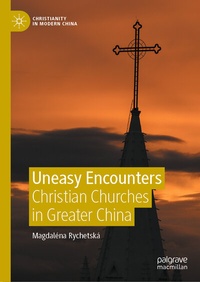
Uneasy Encounters
Description

The book examines the dynamic processes of the various social, political, and cultural negotiations that representatives of Christian groups engage in within authoritarian societies in Greater China, where Christianity is deemed a foreign religious system brought to China by colonial rulers. The book explores the political and social cooperation and negotiations of two particular Christian groups in their respective and distinct settings: the open sector of the Catholic Church in the communist People's Republic on mainland China from 1945 to the present day, and the Presbyterian church of Taiwan in the Republic of China in Taiwan during the period of martial law from 1949 to 1987. Rather than simply confirm the 'domination-resistance' model of church-state relations, the book focuses on the various approaches adopted by religious groups during the process of negotiation. In an authoritative Chinese environment, religious specialists face two related pressures: the demands of their authoritarian rulers and social pressure requiring them to assimilate to the local culture. The book uses two case studies to support a wider theory of economic approach to religion.
Reviews / Votes
"This book adopts the economic approach to religion to study the development of Christianity in China from the perspective of the relationship between Church and state. . This book is a catalyst for advancing the study of Christianity in China and will be much appreciated by both specialists and students of Chinese Christianity." (Wei Xiong, Religious Studies Review, Vol. 49 (1), March, 2023)"Uneasy Encounters, the author's first book, is a laudable effort at marshalling an extensive review of church publications and scholarly literature . . Rychetská is to be commended for bridging scholarly conversations that have not always been in dialogue with each other. In particular, Rychetská's review ofpublished church documents and government policy documents relating to the church will interest scholars and teachers seeking to illustrate particular aspects of church-state relations in either context." (Joshua Tan, Review of Religion and Chinese Society, February 20, 2023)
More details
Other editions
Additional editions
Person
Content
Introduction.- Part 1: Presbyterian Church in Taiwan during the martial law.- Chapter 1. A Historical Overview of the Presbyterian Mission in Taiwan.- Chapter 2. The Presbyterian Church in Taiwan under the Nationalist Rule during the Martial Law.- Chapter 3. Re-sinicization and the Struggle for Localisation.- Chapter 4. Church's struggle for Taiwanese National Identity.- Chapter 5. Church and the Human Rights.- Chapter 6. The Promotor of Democratisation.- Part 2: Chinese Catholic Patriotic Association in the People's Republic of China.- Chapter 7. A Historical Overview of the Catholic Mission in China.- Chapter 8. Catholic Church under the Communist Rule.- Chapter 9. Sino-Vatican Relations.- Chapter 10. Catholic Church in the Light of Policy and Legislation Documents on Religion.- Chapter 11. Sinicizing Christianity in the Contemporary People's Republic of China.- Chapter 12. Resistance or Cooperation? - Conclusion: Christian Churches in the Authoritarian Regimes.
