

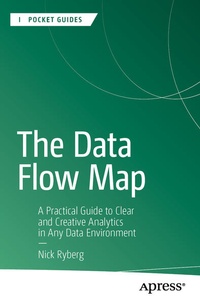
The Data Flow Map
Description

Unlock the secrets of practical data analysis with the Data Flow Map framework-a game-changing approach that transcends tools and platforms. This book isn't just another programming manual; it's a guide to thinking and communicating about data at a higher level. Whether you're working with spreadsheets, databases, or AI-driven models, you'll learn how to express your analytics in clear, common language that anyone can understand.
In today's data-rich world, clarity is the real challenge. Technical details often obscure insights that could drive real impact. The Data Flow Map framework simplifies complexity into three core motions: source, focus, and build. The first half of the book explores these concepts through illustrations and stories. The second half applies them to real-world datasets using tools like Excel, SQL, and Python, showing how the framework works across platforms and use cases.
A vital resource for analysts at any level, this book offers a practical, tool-agnostic approach to data analysis. With hands-on examples and a universal mental model, you'll gain the confidence to tackle any dataset, align your team, and deliver insights that matter. Whether you're a beginner or a seasoned pro, the Data Flow Map framework will transform how you approach data analytics.
What You Will Learn
- Grasp essential elements applicable to every data analysis workflow
- Adapt quickly to any dataset, tool, or platform
- Master analytic thinking at a higher level
- Use analytics patterns to better understand the world
- Break complex analysis into manageable, repeatable steps
- Iterate faster to uncover deeper insights and better solutions
- Communicate findings clearly for better decision-making
Who This Book Is For
Aspiring data professionals and experienced analysts, from beginners to seasoned data engineers, focused on data collection, analysis, and decision making
More details
Other editions
Additional editions
Person
Nick Ryberg has developed analytics across platforms, from Microsoft Excel and Access to more complex systems such as Postgres, Hadoop, and Spark SQL. Whether working on personal computers, Linux servers, mainframes, or even a Raspberry Pi, Nick thrives with a keyboard and a table or two of data.
As tools have improved, becoming more user-friendly and capable of handling larger datasets, Nick has observed that how we think and share our processes hasn't evolved much. At best, it's a messy whiteboard with bubbles and arrows; at worst, it's raw code left behind by a developer who departed years ago.
Throughout Nick's career, the focus has been on solving challenging analytic problems using these tools. The most complex problems encountered aren't related to sourcing, cleaning data, or mastering specific tools. Instead, the most difficult aspects involve thinking differently about solutions, sharing and brainstorming ideas, switching platforms, and documenting processes for future users.
Content
Chapter 1: Introduction.- Chapter 2: Framework Overview.- Chapter 3: Data Flow Map Deep Dive.- Chapter 4: Examples - Files.- Chapter 5: Examples - Databases.- Chapter 6: Examples - Python.- Chapter 7: Examples - APIs.- Chapter 8: Platforms.- Chapter 9: Pipelines.- Chapter 10: Analog Side of Analytics.- Appendix A: Sample Data Sourcing.
