

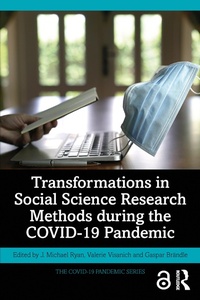
Transformations in Social Science Research Methods during the COVID-19 Pandemic
1st Edition
Published on 11. July 2024
236 pages
978-1-040-03821-5 (ISBN)
Description

This volume explores how researchers made innovative use of online technologies to innovate, define, and transform research methodologies in light of the varying impacts of the COVID-19 pandemic, especially those related to the ability to conduct qualitative research.
The onset of the COVID-19 pandemic resulted in a radical shift in the way that people all over the world were/have been able to live, work, study, and conduct their daily lives. Academics and other professionals who routinely engage in research were no exception. The sudden, continued, and uneven need for health mandates calling for physical distancing added a particular layer of complexity for those who used research methods that typically required face-to-face interactions. Continued technological developments associated with the Internet had already given rise to ongoing debates on innovative methodological thinking and practices. The COVID-19 pandemic has further accentuated how indispensable the internet has become for the private and public lives of those with access to it, including for their employment, education, leisure, and social interactions. For those fortunate enough to have access to them, communication software such as Zoom and Google Meet have also become indispensable digital resources for researchers seeking to continue conducting research during lockdowns and quarantines, and beyond. More than ever, researchers are finding it useful, even necessary, to equip themselves with online research tools in order to be able to continue conducting their fieldwork.
Drawing on research and case studies from around the world, this volume serves as a guidebook for those interested in attuning their own research methods to a world still struggling to grapple with the impacts of the COVID-19 pandemic.
The onset of the COVID-19 pandemic resulted in a radical shift in the way that people all over the world were/have been able to live, work, study, and conduct their daily lives. Academics and other professionals who routinely engage in research were no exception. The sudden, continued, and uneven need for health mandates calling for physical distancing added a particular layer of complexity for those who used research methods that typically required face-to-face interactions. Continued technological developments associated with the Internet had already given rise to ongoing debates on innovative methodological thinking and practices. The COVID-19 pandemic has further accentuated how indispensable the internet has become for the private and public lives of those with access to it, including for their employment, education, leisure, and social interactions. For those fortunate enough to have access to them, communication software such as Zoom and Google Meet have also become indispensable digital resources for researchers seeking to continue conducting research during lockdowns and quarantines, and beyond. More than ever, researchers are finding it useful, even necessary, to equip themselves with online research tools in order to be able to continue conducting their fieldwork.
Drawing on research and case studies from around the world, this volume serves as a guidebook for those interested in attuning their own research methods to a world still struggling to grapple with the impacts of the COVID-19 pandemic.
Reviews / Votes
"What happens when one is coerced to do fieldwork out of one's living room? COVID-19 did not just foist total lockdowns, social distancing and strict measures of confinement. It also obliged a sober assessment about how we do research in the social sciences, while reshuffling research priorities, exacerbating social inequalities, and impacting on both researchers and researched in multiple and complex ways. Changes in research techniques and fieldwork were adopted and adapted within the new realities brought about by the pandemic. The increased resort to the digital has ushered in new ethical, security, validity and privacy challenges. Editors Ryan, Visanich & Brandle deploy three running themes - developing pandemic sensitivities, innovative pandemic methods and critical pandemic methodologies - to regale us with a clutch of critical reflections and practical examples of the accommodations and innovations in social science research that have been trialled during the coronavirus pandemic, and many of which are here to stay. It's a book that deserves a virtual toast."Godfrey Baldacchino, Professor of Sociology, University of Malta, Malta.
"The social transformations resulting from the pandemic have changed the way we live. This book brings together researchers who had to be creative in the face of the health crisis and who are now generous enough to share how they faced the challenges and what lessons they have learned. The book is a collection of diverse and complementary perspectives on what we learned during the pandemic and what we continue to explore after the most serious part of the global crisis has passed. Some aspects of the research have been rethought, refocused or even completely transformed. At the same time, the text engages in dialogue with the criticisms and applause generated by the transformations and does so with an open eye to all the positive things we have been able to incorporate. The resulting mosaic is stimulating, rigorous and challenging for the research community."
Jose A. Ruiz San Roman, Professor of Sociology, Complutense University of Madrid, Spain and President of Research Committee of Sociology of Communication, International Sociological Association
More details
Series
Edition
1. Auflage
Language
English
Place of publication
London
United Kingdom
Publishing group
Taylor & Francis Ltd
Target group
College/higher education
Professional and scholarly
Illustrations
9 Tables, black and white; 2 Line drawings, black and white; 15 Halftones, black and white; 17 Illustrations, black and white
File size
6,62 MB
ISBN-13
978-1-040-03821-5 (9781040038215)
Copyright in bibliographic data and cover images is held by Nielsen Book Services Limited or by the publishers or by their respective licensors: all rights reserved.
Schweitzer Classification
Other editions
Additional editions
J. Michael Ryan | Valerie Visanich | Gaspar Braendle
Transformations in Social Science Research Methods during the COVID-19 Pandemic
Book
07/2024
1st Edition
Routledge
€206.30
Shipment within 10-20 days
J. Michael Ryan | Valerie Visanich | Gaspar Braendle
Transformations in Social Science Research Methods during the COVID-19 Pandemic
Book
07/2024
1st Edition
Routledge
€61.60
Shipment within 10-20 days
Persons
J. Michael Ryan is an award-winning teacher who has held academic positions at top-ranked universities across five continents. He is currently Professor-Researcher at Pontificia Universidad Catolica del Peru, Peru and has previously held academic positions in Ecuador, Egypt, Kazakhstan, Portugal, and the USA. He is the founding editor of Routledge's The COVID-19 Pandemic series.
Valerie Visanich is a Senior Lecturer in Sociology at the University of Malta, Malta.
Gaspar Braendle is Professor of Sociology and Chair of the Sociology Department at the University of Murcia, Spain.
Valerie Visanich is a Senior Lecturer in Sociology at the University of Malta, Malta.
Gaspar Braendle is Professor of Sociology and Chair of the Sociology Department at the University of Murcia, Spain.
Content
1. Accommodating and adapting research during the COVID-19 pandemic Section I: Developing pandemic sensitivities 2. Developing social psychological theory and methods in response to the COVID-19 pandemic 3. Distance discourses: The focus group through digital platforms 4. Batman Gzirjan: Continually revisiting the artistic qualitative research approaches 5. Researching language and communication during the COVID-19 pandemic: A linguistic duo-ethnography Section II: Innovative pandemic methods 6. Disruptions and innovations in sports research during the COVID-19 pandemic 7. Equitable collaborations: Modelling innovative public health research during a pandemic 8. Interviews that heal: Situated resilience and the adaptation of qualitative interviewing during lockdowns Section III: Critical pandemic methodologies 9. Remote interviewing during a global pandemic: A methodological reflection on an ICT-mediated qualitative study implemented during COVID-19 confinement periods 10. The impact of COVID-19 on postgraduate classroom-based research: An African perspective 11. Reflections on methodological reconsiderations and ethical procedures of a postdoctoral researcher 12. Troubled waters, fisherman's gain: A critical reflection on carrying out multi-sited research in times of COVID-19
