

Odd Blocks
Selected and New Poems
Published on 27. July 2012
160 pages
978-1-84777-975-5 (ISBN)
Description

In Odd Blocks Kay Ryan, the acclaimed American poet, presents her work to European readers for the first time. The book includes twenty-one new poems, seven of them first published here. Ryan's flamboyant imagination sparks in spare and elegant verse. 'Edges,' she has said, 'are the most powerful parts of the poem. The more edges you have the more power you have.' These poems take by surprise, and increase in resonance.
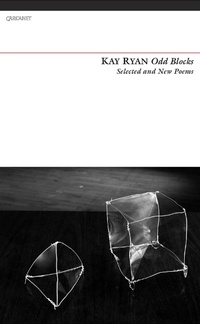
Cover photograph David Goldes Platonic Solids # 2, 2002. Reproduced by kind permission of the artist.
Cover photograph David Goldes Platonic Solids # 2, 2002. Reproduced by kind permission of the artist.
Reviews / Votes
The original article can be found here.'Monuments to randomness'.
America's poet laureate has a seductive authority.
Kay Ryan cuts a curious and contradictory figure. Her zippy, compact, user-friendly poetry has achieved wide popularity while remaining sceptical of the limelight:
One can't work
by lime light", she quips. "A bowlful
right at
one's elbow
produces no
more than
a baleful
glow.
Despite a large readership, leading to a successful term as poet laureate of the United States from 2008-10, Ryan has mostly rejected the professionalised life of the contemporary writer. Instead she has continued to teach 'remedial' classroom English (never creative writing) at a community college in San Jose, and lived quietly with her partner of 30-plus years, Carol Adair, until Adair's death in 2009. Such a steady, unassuming life, she insists, has enabled her to write. Her most recent accolades, a Pulitzer prize and a 'Genius' award from the MacArthur Foundation, worth $500,000, seems unlikely to change this stance.
Ryan's poems draw much of their appeal from such contradictions. They reliably deliver a jolt or a laugh or both; but further contemplation nearly always discovers more substance, and more resistance, than you bargained for. In her poem about limelight, for example, we might notice that 'baleful' comes from 'bale', an Old English word for evil, and that this gave rise to 'bale-fire', the name for a great blaze or a funeral pyre. Hence Ryan gives us 'baleful glow', which rather suggests that limelight is not produced by celebrating people but by destroying them. This makes perfect sense, of course, in connection with 'lime' itself, a substance notoriously helpful in dissolving human remains. Work like this can be underestimated. The description of a flamingo that opens Odd Blocks, Ryan's first UK publication, would seem to anticipate the cursory misreading: 'she's / too exact and sinuous / to convince an audience / she's serious. The natural elect, / they think, would be less pink', cleverly playing the putative audience off against the actual reader, who now feels determined to think in entirely the opposite way. It is typical of Ryan that the sexually politicised 'pink' (one thinks of the LGBTQ pink triangle, for example) chimes gently in the world of signs rather than commanding the poem.
Ryan's favourite verb is 'to be', her favourite sentence the dead-pan, disembodied assertion: 'There are thieves / in the mind'; or, 'Any morning / can turn molten / without warning'; or, 'We are always / really carrying / a ladder, but it's / invisible'. The conviction with which these statements are made gives them a seductive authority. Ryan has said in an interview: 'I like the sound of facts, but I don't care about them as facts. I like them as texture.' In this respect, and in the tight, narrow, spring-loaded forms of her poems, Ryan has learned a lot from Emily Dickinson. However, where Dickinson writes, 'I heard a Fly buzz-when I died-', Ryan would write: 'We hear flies buzz / when we die', preferring third and second person modes that include the reader. Her poems are, as she puts it, 'a mystery involving people, / but without the heat of people.' First person has too much of that heat: when she does use it, the result can seem slightly melted, as in 'Weak Forces', which considers
the sift left of resolve
sustained too long, the
strange internal shift
by which there's no knowing
if this is the road taken
or untaken.
Such scattergun rhyming is pure Ryan; the naked introspection not so much. Her allusion to Robert Frost's 'The Road Not Taken' is revealing: although Ryan shares with Frost a sympathy for hard lives, and for the lyric poem as a stay against confusion, she has tended not to narrate so heroically the moment of decision, perhaps because she finds it tricky to locate in the midst of that 'internal shift'. Odd Blocks, Ryan's title poem, contemplates a 'Swiss-village / calendar' that shows a huddle of buildings among 'glacier-scattered / thousand ton / monuments to / randomness', which the villagers now use to orientate themselves. The poem concludes:
Order is always
starting over.
And why not
also in the self,
the odd blocks,
all lost and left,
become first facts
toward which later
a little town
looks back?
The odd and the provisional are more important to Ryan than any discoverable grand design. Odd Blocks itself looks back to the early 'Vacation', which admired 'rocks arranged on the / basis of a plan, or plans, / inscrutable to modern man'. What this demands of the observer is what Ryan demands of herself: 'to stretch to be ignorant enough, / scoured to a clean vessel / as pure as the puzzle'. The way each poem resets to zero can be frustrating, and it makes for a few failed experiments; but it also means her poems take precious little for granted. Ryan has made this selection in a typically uncompromising fashion: usually something from every book would make the cut, but Odd Blocks snips off the first 10 years of her career. Dragon Acts to Dragon Ends was self-published in 1983, and is now impossible to buy. Her second book, Strangely Marked Metal, appeared in 1985. Odd Blocks begins with 'Flamingo Watching' (1994). It is a shame not to see the full development of Ryan's work; but, as with most of her poems, one enjoys the discipline of what is there in the light of what is not. 'I wanted to see what a fortunate life would produce.' So Kay Ryan has remarked of a poetic career which, after a slow start, has won her many garlands, including a laureateship and a Pulitzer Prize. Her deeply attractive work disproves the claim that happiness writes white. Specialising in short poems with short lines, her writing is not so much formal as formed. Sonnets, triolets, and villanelles are eschewed in favour of nameless poetic shapes which are as intricately worked as the innards of a prizewinning clock. Of course, short lines can achieve different things: one thinks of the mesmeric psychology of Laura Riding, the sonorous ceremony of Seamus Heaney, the elemental flexibility of A. R. Ammons. Here, they deliver the velvet punch of the proverbial. Take, for example, 'Failure':
Like slime
inside a
stagnant tank
its green
deepening
from lime
to emerald
a dank
but less
ephemeral
efflorescence
than success
is in general.
While it may be possible to argue with any particular proverb it is impossible to argue with the proverbial. Because they leave no flank exposed, nothing for a hostile reader to spike, such bursts of armour-plated wisdom are often favoured by careful, reticent writers. 'Failure', like many a Ryan poem, strikes us principally on two levels: firstly, with the force of something vitally true, something profound and heavy, secondly, with the force of its sonic play, as something unconquerably cheerful and light. It is this contrasting double-punch, I think, which makes them so successful. The short lines of 'Failure' allow the words 'green' and 'emerald' to marry in 'general', 'tank' and 'deepening' merge in 'dank', and the word 'slime' is (slimily) redistributed across the sounds of 'ephemeral/efflorescence'. This is an example of what Ryan calls 're-combinant rhyme', a method which she developed in the seventies and eighties at a time when straightforward rhyme seemed like old hat. This recuperation of rhyme, restoring it in a modern guise, is something shared with some of the better poets of recent years - witness Muldoon's extravagant use of pararhyme, R. F. Langley's deft internal chiming, and Robert Minhinnick's souped-up versions of cynghanedd.
Fortunate Ryan's life might have been, but the poetry has a definite toughness, a hard-bitten core, which puts one in mind of Robert Frost or Flannery O'Connor. Her early upbringing was spent, partly, in the unforgiving environs of the Mojave Desert. Her father was a Willie-Loman-style chaser of the American Dream who nurtured a set of get-rich schemes to disaster. His doomed efforts as a gold-miner perhaps account for Ryan's preoccupations not only with minerals but more generally with what lies beneath:
... Why does something
stacked in some secret bank or cabinet,
some miser's trove, far back, lambent,
and gloated over by its golem, make us
so solemnly convinced of the transaction
when Mandelstam says gold, even
in translation?
Yin to her father's yang, Ryan's mother was a nervous introvert who struggled to cope when her husband died young. But she did have a playful side which Ryan, in a Paris Review interview fondly remembers:
She might take these scissors and set them over there on the floor so that when she noticed them again she would remember that she had to turn off the hose. She wouldhave a variety of displaced objects sitting around on the rug. I loved her doing that.
It's not too much, I think, to see this surrealistic re-ordering of the humdrum in her poetry's unexpected juxtapositions. One could easily imagine her 'Crustacean Island', for example, being painted by Max Ernst:
It would be an island blessed
with only cold-blooded residents
and no human angle.
It would echo with a thousand castanets
and no flamencos.
While British writing of the 1930s was notorious for its obsession with boundaries - they were nearly always a matter of anxiety and regret - Ryan, equally obsessed with edges, regards them with an amiable calm:
Edges are the most powerful parts of the poem. The more edges you have the more power you have. They make the poem more permeable, more exposed.
Her poems suggest that the world, and all the divisions we can carve in it, is as it is. We can make and imagine it otherwise - true - but we don't have to imagine it will turn out as we wish. In so far as the poems are anti-utopian, they might be misinterpreted as quietistic, or even reactionary (I doubt that she would have gone down particularly well either in the 1930s or the 1960s.) At the heart of Ryan's sensibility is something abstract and geometrical. She is apt to convert any subject-matter into a spectrum of behaviours, habits, events, picking out what she considers to be the best and worst whilst navigating her way from the emotional human middle:
A bestiary catalogs
best. The mediocres
both higher and lower
are suppressed in favor
of the singularly savage
or clever.
Intimately impersonal, much of the writing assumes the presence of a collective personality, a 'we', on whose behalf it is spoken. Even when her writing is unsettling - and it nearly always is - it depends on and points to a world of settled truth. Even as the poems swoop and soar beyond the middle range of experience, they remember to respect it - they acknowledge that 'we' know this and 'we' know that - and so they remain accessible and humane.
Her characteristic tone is even. The voice never sounds harassed or desperate. Emotion is deconstructed, here, in tranquillity. The poems never submit to the pressure of a deadline - the poetry, instead, is in the patience:
It's her politeness
one loathes: how she
isn't insistent, how
she won't impose, how
nothing's so urgent
it won't wait. Like
a meek guest you tolerate
she goes her way-the muse
you'd have leap at your throat,
you'd spring to obey.
Her poems leave a lot out - one reason why they strike the reader as 'universal'. Reference to specific time-events is rare - they might have been composed almost any time in the last century. Reference to specific people rarely extends beyond the odd artist of whom she approves (Monk, Satie.) Reference to specific locations is similarly limited but the tendency is to mention places which have a kind of universal iconicity: Stonehenge, Easter Island, the Galapagos - places, yes, but ones so freighted with meaning that they are almost honorary abstractions. The preference, as always, is for a body of shared knowledge. In this, at least, she is quite unlike Bishop who is more than willing to report back from unfamiliar terrain. There are many places where Ryan will not go.
Her debt to Marianne Moore is often remarked upon. Certainly, the influence of her precursor's tart, brisk voice is clear, not least in Ryan's poems about the animal kingdom. But, in truth, a whole range of influences can be discerned. As the lead singer of The Kaiser Chiefs once averred, bands are unoriginal usually because they have only absorbed two or three influences - only when a band absorbs hundreds of influences has it a chance to be original (I paraphrase from a remembered TV interview.) Something similar can be said of poets. Ryan manages to remind us of many poets (from a much longer list one might adduce Moore, Dickinson, Stevens, Szymborska, Ammons, Bishop, Frost, Larkin, Belloc, Lear) without seeming subordinate to any of them. To put it mildly, she is an important American poet. For readers on this side of the Atlantic, Odd Blocks is a fine introduction to her work.
(c) John Redmond, December 2011
The views expressed by contributors to the reviews section of Poetry Matters are not those of Tower Poetry, or of Christ Church, Oxford The best poetry makes its thinking seem the way of things. Odd Blocks by Kay Ryan (Carcanet, GBP12.95) has addictive reflections, cross-stitched with rhyme, on how 'Order is always. starting over'. Dark, sharp and equally crystalline is Rae Armantrouts's Money Shot (Wesleyan University Press, GBP19.95). Both were worthy Pulitzer winners. The winner of this year's Pullitzer Prize for peotry Kay Ryan released her latest collection, Odd Blocks, tomorrow while Ssha Dugdale's haunting, lyrical Red House, on theepresences in the margins of our lives, is released on August 31. Old Blocks: Selceted and New Poems, from US Laureate Kay Ryan, is more concerned with peculiarities and anomalies than with the evryday. Her poems discuss flamingos, mirage oases, glass slippers, desert reservoirs, lighthouse keepers and the difficulties of waterwheels with a characteristic playful acceptance. The book is a veritable menagerie of bright creatures, each described as tenderly as the last, from the buck who, brushing wet bark 'whispers a syllable / singular to deer' to the 'graceless' turtle who 'lives / below luck-level' and whose movements are slow 'like dragging / a packing case places'. Of the animals poems, 'Miners' Canaries' is the most fascinating because her subject stands for Ryan's obsession with the limits or edges of things:
Something is always
testing the edges
of the breathable...
A similar curiosity runs through 'So Different', where Ryan describes how trees find it a pleasure to be separated from their blossoms, 'to be stripped / of what's white and winsome' before remarking lightly:
so different
for humans, for whom
what is un-set matters
so oddly - as though
only what is lost held possibility.
The poems in Odd Blocks demand that we see afresh. Ryan's poems are full of questions - 'It's Always Darkest Just Before Dawn' immediately challenges its own title: 'but how dark / is darkest?'. In 'Paired Things', Ryan muses 'so many paired things seem odd':
Who, who had only seen wings,
could extrapolate the
skinny sticks of things
girds use foir land,
the backward way they bend,
the silly way they stand?
When Ryan turns her searching gaze towards abstracts like 'Relief', 'Hope', 'Councel' and 'Losses', the effect is just as striking. Her poems often makes a show of contradicitions ('Most losses add something - a new socket or silence...') or denials ('in 'Star Block' she insists 'there is no such thing as star block...') and seem to follow a strange, entirely compelling logic, reminiscent of the work of Selima Hill. Take 'Silence':
Silence is not snow.
It cannot grow
deeper. A thousand years
of it are thinner
than paper. So
we must have it
all wrong
when we feel trapped
like mastodons.
Like Hill, Ryan is alive to the fragility of the body, the mind, the world. It is important to make things new or strange so that we don't take them for granted. In 'A Hundred Bolts of Satin', she cautions us:
All you
have to lose
is one
connection
and the mind
uncouples
all the way back.
As she says in 'Chemisty', even words are 'subject to / the chemistry of death'. To question the world is to be alive in it. Ryan often seems to revel in playful, almost childish rhymes ('Masterworks of Mins' begins ridiculously: 'Ming, Ming, / such a lovely / thing') and her short lines seem exhuberant in their brevity, dancing down the page. Poems like 'Crib' and 'Best' celebrate her obsession with language. In the latter, we're told that 'A bestiary catalogs / bests' and the poem concludes wryly:
Best is not to be confused with good -
a different creature altogether,
and treated of in the goodiary -
a text alas lost now for centuries.
The same acute eye that allows Ryan to describe dew on a blade of grass perfectly ('as neatly as peas / in their green canoe') allows her to write about mental states diufficult to articulate in a way that anchors them to things of the world. But her work is democratic enough not to privaledge one form of observation and reflection over the other. In this way, though her poems rarely describe people directly, through them she seems to come closest to Moritz's ideal of restoring person and external world to some kind of unity.
More details
Language
English
Place of publication
London
United Kingdom
Publishing group
Carcanet Press Ltd
File size
0,42 MB
ISBN-13
978-1-84777-975-5 (9781847779755)
Copyright in bibliographic data and cover images is held by Nielsen Book Services Limited or by the publishers or by their respective licensors: all rights reserved.
Schweitzer Classification
Other editions
Additional editions
Book
08/2011
Carcanet Press Ltd
€36.04
Article exhausted; check different version
Person
Kay Ryan was born in California and has lived in Marin County, California, since 1971. She has received numerous awards for her poetry, including the Pulitzer Prize, the Ruth Lilly Poetry Prize, fellowships from both the Guggenheim Foundation and the National Endowment for the Arts, and the Ingram Merrill Award. She has been a Chancellor of the Academy of American Poets since 2006, and was the sixteenth United States Poet Laureate from 2008 to 2010. In 2011, Kay Ryan was awarded a $500,000 Fellowship by the MacArthur Foundation, in recognition of her exceptional poetry.
Content
Contents
from Flamingo Watching (1994)
Flamingo Watching
This Life
Emptiness
Vacation
No Rest for the Idle
Glass Slippers
When Fishing Fails
So Different
Half a Loaf
Spring
Impersonal
I Marveled at How Generally I Was Aided
Force
Miners' Canaries
The Hinge of Spring
Deer
Poetry Is a Kind of Money
Masterworks of Ming
Paired Things
Osprey
Turtle
from Elephant Rocks (1996)
Living with Stripes
Doubt
Mirage Oases
Chemistry
Dew
Crib
Bestiary
How Birds Sing
If the Moon Happened Once
New Clothes
Crustacean Island
Les Petites Confitures
Why Isn't It All More Marked
Learning
Age
Counsel
Silence
A Cat/A Future
Hope
Losses
The Cabinet of Curiosities
Her Politeness
Swept Up Whole
Any Morning
Relief
A Plain Ordinary Steel Needle Can Float on Pure Water
Distance
Wooden
Heat
from Say Uncle (2000)
Say Uncle
Star Block
Corners
A Hundred Bolts of Satin
The Excluded Animals
Mockingbird
Blandeur
Patience
That Will to Divest
Winter Fear
Grazing Horses
The Fourth Wise Man
Help
The Pieces that Fall to Earth
Don't Look Back
It's Always Darkest Just Before the Dawn
Herring
The Silence Islands
Cheshire
Yeses
Crown
Among English Verbs
Lime Light
Why We Must Struggle
Drops in the Bucket
The Job
Failure
Failure 2
Matrigupta
Water under the Bridge
from The Niagara River (2005)
The Niagara River
Home to Roost
Carrying a Ladder
Sharks' Teeth
Weak Forces
The Elephant in the Room
A Ball Rolls on a Point
The Best of It
Shipwreck
The Other Shoe
Atlas
He Lit a Fire with Icicles
Rats' Tails
Chop
Felix Crow
Desert Reservoirs
Expectations
Ideal Audience
Stardust
Things Shouldn't Be So Hard
The Past
Reverse Drama
Least Action
Chart
No Names
Thieves
Late Justice
Lighthouse Keeping
Tune
New Poems
Odd Blocks
The Edges of Time
Bait Goat
Train-Track Figure
Virga
Dogleg
Ledge
The Pharaohs
Pentimenti
Bitter Pill
Finish
Easter Island
Spiderweb
Still Life with Lemons, Oranges and a Rose
Monk Style
On the Nature of Understanding
The Main Difficulty of Water Wheels
Splitting Ice
Shoot the Moon
More of the Same
The First of Never
Index of Titles
from Flamingo Watching (1994)
Flamingo Watching
This Life
Emptiness
Vacation
No Rest for the Idle
Glass Slippers
When Fishing Fails
So Different
Half a Loaf
Spring
Impersonal
I Marveled at How Generally I Was Aided
Force
Miners' Canaries
The Hinge of Spring
Deer
Poetry Is a Kind of Money
Masterworks of Ming
Paired Things
Osprey
Turtle
from Elephant Rocks (1996)
Living with Stripes
Doubt
Mirage Oases
Chemistry
Dew
Crib
Bestiary
How Birds Sing
If the Moon Happened Once
New Clothes
Crustacean Island
Les Petites Confitures
Why Isn't It All More Marked
Learning
Age
Counsel
Silence
A Cat/A Future
Hope
Losses
The Cabinet of Curiosities
Her Politeness
Swept Up Whole
Any Morning
Relief
A Plain Ordinary Steel Needle Can Float on Pure Water
Distance
Wooden
Heat
from Say Uncle (2000)
Say Uncle
Star Block
Corners
A Hundred Bolts of Satin
The Excluded Animals
Mockingbird
Blandeur
Patience
That Will to Divest
Winter Fear
Grazing Horses
The Fourth Wise Man
Help
The Pieces that Fall to Earth
Don't Look Back
It's Always Darkest Just Before the Dawn
Herring
The Silence Islands
Cheshire
Yeses
Crown
Among English Verbs
Lime Light
Why We Must Struggle
Drops in the Bucket
The Job
Failure
Failure 2
Matrigupta
Water under the Bridge
from The Niagara River (2005)
The Niagara River
Home to Roost
Carrying a Ladder
Sharks' Teeth
Weak Forces
The Elephant in the Room
A Ball Rolls on a Point
The Best of It
Shipwreck
The Other Shoe
Atlas
He Lit a Fire with Icicles
Rats' Tails
Chop
Felix Crow
Desert Reservoirs
Expectations
Ideal Audience
Stardust
Things Shouldn't Be So Hard
The Past
Reverse Drama
Least Action
Chart
No Names
Thieves
Late Justice
Lighthouse Keeping
Tune
New Poems
Odd Blocks
The Edges of Time
Bait Goat
Train-Track Figure
Virga
Dogleg
Ledge
The Pharaohs
Pentimenti
Bitter Pill
Finish
Easter Island
Spiderweb
Still Life with Lemons, Oranges and a Rose
Monk Style
On the Nature of Understanding
The Main Difficulty of Water Wheels
Splitting Ice
Shoot the Moon
More of the Same
The First of Never
Index of Titles
