

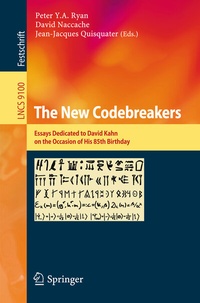
The New Codebreakers
Description

This Festschrift volume is published in honor of David Kahn and is the outcome of a Fest held in Luxembourg in 2010 on the occasion of David Kahn's 80th birthday. The title of this books leans on the title of a serious history of cryptology named "The Codebreakers", written by David Kahn and published in 1967.
This book contains 35 talks dealing with cryptography as a whole. They are organized in topical section named: history; technology - past, present, future; efficient cryptographic implementations; treachery and perfidy; information security; cryptanalysis; side-channel attacks; randomness embedded system security; public-key cryptography; and models and protocols.
More details
Other editions
Additional editions
Content
History.- Mary of Guise's enciphered letters.- About Professionalisation in the Intelligence Community: the French Cryptologists (ca 1870-ca 1945).- Myths and legends.- The One-Time Pad and the Index of Coincidence.- Technology - Past, Present, Future.- The Fall of a Tiny Star.- Post-Quantum Cryptography: State of the Art.- What is the future of cryptography?.- Efficient Cryptographic Implementations.- Bitsliced High-Performance AES-ECB on GPUs.- Buying AES Design Resistance with Speed and Energy.- Double-Speed Barrett Moduli.- Treachery and Perfidy.- Failure is Also an Option.- How to (Carefully) Breach a Service Contract?.- Information Security.- SpoofKiller: You can teach people how to pay, but not how to pay attention.- Cyber-Physical Systems Security.- Practical Techniques Building on Encryption for Protecting and Managing Data in the Cloud.- Cryptanalysis.- Cryptography as an Attack Technology: Proving the RSA/Factoring Kleptographic Attack.- Dual EC: A Standardized BackDoor.- An Improved Differential Attack on Full GOST.- Cryptographic Hash Functions and Expander Graphs: The End of the Story?.- Side-Channel Attacks.- Polynomial Evaluation and Side Channel Analysis.- Photonic Power Firewalls.- A Heuristic Approach to Assist Side Channel Analysis of the Data Encryption Standard.- Improving the Big Mac attack on Elliptic Curve Cryptography.- Randomness.- Randomness testing: result interpretation and speed.- A fully-digital Chaos-based Random Bit Generator.- Embedded System Security.- Secure Application Execution in Mobile Devices.- Hardware-enforced Protection against Buffer Overflow using Masked Program Counter.- Public-Key Cryptography.- Hierarchical Identities from Group Signatures and Pseudonymous Signatures.- Secure ElGamal-type Cryptosystems Without Message Encoding.- Safe-Errors on SPA Protected implementations with the Atomicity Technique.- Models and Protocols.- Clever Arbiters versus Malicious Adversaries: On the Gap between Known-Input Security and Chosen-Input Security.- Security Analysis of the Modular Enhanced Symmetric Role Authentication (mERA) Protocol.- Crypto Santa.
