

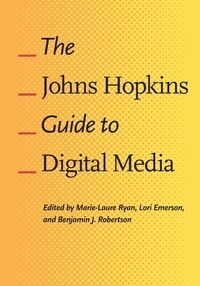
The Johns Hopkins Guide to Digital Media
Published on 10. June 2014
552 pages
978-1-4214-1225-2 (ISBN)
Description

The first systematic, comprehensive reference covering the ideas, genres, and concepts behind digital media.
The study of what is collectively labeled "New Media"-the cultural and artistic practices made possible by digital technology-has become one of the most vibrant areas of scholarly activity and is rapidly turning into an established academic field, with many universities now offering it as a major. The Johns Hopkins Guide to Digital Media is the first comprehensive reference work to which teachers, students, and the curious can quickly turn for reliable information on the key terms and concepts of the field.
The contributors present entries on nearly 150 ideas, genres, and theoretical concepts that have allowed digital media to produce some of the most innovative intellectual, artistic, and social practices of our time. The result is an easy-to-consult reference for digital media scholars or anyone wishing to become familiar with this fast-developing field.
The study of what is collectively labeled "New Media"-the cultural and artistic practices made possible by digital technology-has become one of the most vibrant areas of scholarly activity and is rapidly turning into an established academic field, with many universities now offering it as a major. The Johns Hopkins Guide to Digital Media is the first comprehensive reference work to which teachers, students, and the curious can quickly turn for reliable information on the key terms and concepts of the field.
The contributors present entries on nearly 150 ideas, genres, and theoretical concepts that have allowed digital media to produce some of the most innovative intellectual, artistic, and social practices of our time. The result is an easy-to-consult reference for digital media scholars or anyone wishing to become familiar with this fast-developing field.
More details
Language
English
Place of publication
Baltimore
United States
Target group
Professional and scholarly
Illustrations
2 s/w Abbildungen
2 Illustrations, black and white
File size
3,02 MB
ISBN-13
978-1-4214-1225-2 (9781421412252)
DOI
10.1353/book.29441
Copyright in bibliographic data and cover images is held by Nielsen Book Services Limited or by the publishers or by their respective licensors: all rights reserved.
Schweitzer Classification
Other editions
Additional editions
Marie-Laure Ryan | Lori Emerson | Benjamin J. Robertson
The Johns Hopkins Guide to Digital Media
Book
06/2014
Johns Hopkins University Press
€93.50
Shipment within 10-20 days
Marie-Laure Ryan | Lori Emerson | Benjamin J. Robertson
The Johns Hopkins Guide to Digital Media
Book
06/2014
Johns Hopkins University Press
€46.50
Shipment within 10-20 days
Persons
Marie-Laure Ryan is a member of the Department of English at the University of Colorado at Boulder, and author of Narrative as Virtual Reality 2: Revisiting Immersion and Interactivity in Literature and Electronic Media from Johns Hopkins University Press. Lori Emerson is an assistant professor in the Department of English at the University of Colorado at Boulder. Benjamin J. Robertson is an instructor of English at the University of Colorado at Boulder.
Content
- Cover
- Contents
- Preface
- Algorithm
- Alternate Reality Gaming
- Analog versus Digital
- Animated Poetry
- Animation/Kineticism
- Archive
- Artificial Intelligence
- Artificial Life
- Augmented Reality
- Authoring Systems
- Avatars
- Biopoetry
- Blogs
- Book to E-text
- Cave
- Cell Phone Novel
- Characteristics of Digital Media
- Chatterbots
- Cheats
- Code
- Code Aesthetics
- Cognitive Implications of New Media
- Collaborative Narrative
- Collective Intelligence
- Combinatory and Automatic Text Generation
- Computational Linguistics
- Conceptual Writing
- Copyright
- Critical Editions in the Digital Age
- Critical Theory
- Crowdsourcing
- Cut Scenes
- Cyberfeminism
- Cybernetics
- Cyberpunk
- Cyberspace
- Cyborg and Posthuman
- Data
- Database
- Dialogue Systems
- Digital and Net Art
- Digital Fiction
- Digital Humanities
- Digital Installation Art
- Digital Poetry
- Early Digital Art and Writing (Pre-1990)
- Easter Eggs
- E-books
- Electronic Literature
- Electronic Literature Organization
- E-mail Novel
- Emergence
- Ethics in Digital Media
- Fan Fiction
- Film and Digital Media
- Flarf
- Flash/Director
- Free and Open-Source Software
- Game Genres
- Game History
- Game Theory
- Gameplay
- Games and Education
- Games as Art/Literature
- Games as Stories
- Gender and Media Use
- Gender Representation
- Glitch Aesthetics
- Graph Theory
- Graphic Realism
- Hacker
- History of Computers
- Hoaxes
- Holopoetry
- Hypertextuality
- Identity
- Immersion
- Independent and Art Games
- Interactive Cinema
- Interactive Documentary
- Interactive Drama
- Interactive Fiction
- Interactive Narrative
- Interactive Television
- Interactivity
- Interface
- Language Use in Online and Mobile Communication
- Life History
- Linking Strategies
- Location-Based Narrative
- Ludus and Paidia
- Machinima
- Markup Languages
- Mashup
- Materiality
- Media Ecology
- Mediality
- Mobile Games
- MUDs and MOOs
- Music
- Narrativity
- Networking
- N-gram
- Nonlinear Writing
- NPC (Nonplayer Character)
- Old Media / New Media
- Online Game Communities
- Online Worlds
- Ontology (in Games)
- Participatory Culture
- Performance
- Platform
- Plot Types and Interactivity
- Politics and New Media
- Preservation
- Procedural
- Quest Narrative
- Race and Ethnicity
- Randomness
- Reading Strategies
- Relations between Media
- Remediation
- Remix
- Role-Playing Games
- Sampling
- Search
- Searle's Chinese Room
- Self-Reflexivity in Electronic Art
- Semantic Web
- Simulation
- Social Network Sites (SNSs)
- Software Studies
- Sound
- Spatiality of Digital Media
- Story Generation
- Storyspace
- Subversion (Creative Destruction)
- Temporality of Digital Works
- Transmedial Fiction
- Turing Test
- Twitter, Tumblr, and Microblogging
- Video
- Viral Aesthetics
- Virtual Bodies
- Virtual Economies
- Virtual Reality
- Virtuality
- Walkthrough
- Web Comics
- Wiki Writing
- Windows
- Word-Image
- Worlds and Maps
- Writing under Constraint
- List of Contributors
