

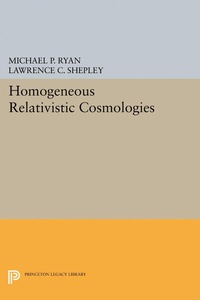
Homogeneous Relativistic Cosmologies
1st Edition
Published on 19. May 2015
338 pages
978-1-4008-6856-8 (ISBN)
Description

Addressing a variety of theoretical cosmological problems, and emphasizing a mathematical approach, this volume nicely complements Peebles' Physical Cosmology (Princeton Series in Physics, 1971).
Ryan and Shepley have concentrated on the structure of models of the universe. By using a modern terminology that emphasizes the operator nature of vectors and tensors, as opposed to their components in a particular coordinate system, the authors develop modern tensor analysis to the point where it can be applied to general relativistic cosmology. They then use it to describe homogeneous cosmologies in considerable detail. Both students and researchers are likely to find these techniques especially useful.
Among their subjects are: spaces with groups of motions; singularities; Taub-NUT-Misner space; Bianchitype models; Hamiltonian cosmology; and perturbations in anisotropic models. A brief section on observations is also included, as is a complete bibliography. A final section presents graded exercises that underscore the potential yet unrealized in this area of study.
Originally published in 1975.
The Princeton Legacy Library uses the latest print-on-demand technology to again make available previously out-of-print books from the distinguished backlist of Princeton University Press. These editions preserve the original texts of these important books while presenting them in durable paperback and hardcover editions. The goal of the Princeton Legacy Library is to vastly increase access to the rich scholarly heritage found in the thousands of books published by Princeton University Press since its founding in 1905.
Ryan and Shepley have concentrated on the structure of models of the universe. By using a modern terminology that emphasizes the operator nature of vectors and tensors, as opposed to their components in a particular coordinate system, the authors develop modern tensor analysis to the point where it can be applied to general relativistic cosmology. They then use it to describe homogeneous cosmologies in considerable detail. Both students and researchers are likely to find these techniques especially useful.
Among their subjects are: spaces with groups of motions; singularities; Taub-NUT-Misner space; Bianchitype models; Hamiltonian cosmology; and perturbations in anisotropic models. A brief section on observations is also included, as is a complete bibliography. A final section presents graded exercises that underscore the potential yet unrealized in this area of study.
Originally published in 1975.
The Princeton Legacy Library uses the latest print-on-demand technology to again make available previously out-of-print books from the distinguished backlist of Princeton University Press. These editions preserve the original texts of these important books while presenting them in durable paperback and hardcover editions. The goal of the Princeton Legacy Library is to vastly increase access to the rich scholarly heritage found in the thousands of books published by Princeton University Press since its founding in 1905.
More details
Other editions
Additional editions
Michael P. Ryan | Lawrence C. Shepley
Homogeneous Relativistic Cosmologies
Book
04/2016
Princeton University Press
€138.80
Article not available at the moment
Michael P. Ryan | Lawrence C. Shepley
Homogeneous Relativistic Cosmologies
Book
03/2015
Princeton University Press
€53.20
Shipment within 10-20 days

Michael P. Ryan | Lawrence C. Shepley
Homogeneous Relativistic Cosmologies
Book
02/1975
Princeton University Press
€55.71
Article exhausted; check different version
Michael P. Ryan | Lawrence C. Shepley
Homogeneous Relativistic Cosmologies
Book
02/1975
Princeton University Press
€21.03
Article exhausted; check different version
Persons
Michael P. Ryan & Lawrence C. Shepley
Content
Frontmatter, pg. i
Preface, pg. vii
Table of Contents, pg. ix
1. Cosmology: The Study of Universes, pg. 1
2. Geometry In the Language of Forms, pg. 11
3. Spacetime and Fluid Flow, pg. 40
4. Friedmann-Robertson-Walker Models: Begin with a Bang, pg. 57
5. Singularities in a Spacetime, pg. 74
6. Isometries of Space and Spacetime, pg. 96
7. Universes Homogeneous in Space and Time, pg. 118
8. T-Nut-M Space - Open to Closed to Open, pg. 132
9. The General Spatially Homogeneous Model in the Synchronous System, pg. 147
10. Singularities in Spatially Homogeneous Models, pg. 163
11. Hamiltonian Cosmology, pg. 182
12. Type I Models and Type IX Models - The Simplest and the Most Interesting, pg. 201
13. Numerical Techniques, pg. 221
14. Astrophysical Studies in Anisotropic Type I Models, pg. 237
15. Final Remarks: What Is, What Is Not, and What Should Be, pg. 260
Exercises and Problems, pg. 273
Bibliography, pg. 288
Index, pg. 316
Preface, pg. vii
Table of Contents, pg. ix
1. Cosmology: The Study of Universes, pg. 1
2. Geometry In the Language of Forms, pg. 11
3. Spacetime and Fluid Flow, pg. 40
4. Friedmann-Robertson-Walker Models: Begin with a Bang, pg. 57
5. Singularities in a Spacetime, pg. 74
6. Isometries of Space and Spacetime, pg. 96
7. Universes Homogeneous in Space and Time, pg. 118
8. T-Nut-M Space - Open to Closed to Open, pg. 132
9. The General Spatially Homogeneous Model in the Synchronous System, pg. 147
10. Singularities in Spatially Homogeneous Models, pg. 163
11. Hamiltonian Cosmology, pg. 182
12. Type I Models and Type IX Models - The Simplest and the Most Interesting, pg. 201
13. Numerical Techniques, pg. 221
14. Astrophysical Studies in Anisotropic Type I Models, pg. 237
15. Final Remarks: What Is, What Is Not, and What Should Be, pg. 260
Exercises and Problems, pg. 273
Bibliography, pg. 288
Index, pg. 316
