

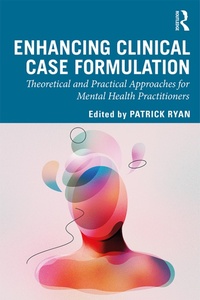
Enhancing Clinical Case Formulation
Theoretical and Practical Approaches for Mental Health Practitioners
1st Edition
Published on 5. December 2019
162 pages
978-0-429-94290-7 (ISBN)
Description

Clinical formulation lies at the heart of how mental health professionals understand psychological distress. It is the application of a framework that cohesively integrates scientific knowledge with the symptoms of distress. In essence, it is the creation of order to what is often experienced as disorder. The aim of this book is to bring awareness to the theoretical and practical opportunities for mental health professionals that exists by using atypical information when adapting typical formulation models.
Each chapter reflects some variation in how formulation is defined, conceptualised and practiced, by using information that regularly materializes from professional encounters but often is omitted from the formulation of a particular presenting problem. Chapters on diet and exercise, sleep, spirituality, sexuality and meaning-making highlight how approaches to formulation can be extended to provide additional opportunities for intervention for the client and practitioner.
A professional encounter orientated in the manner proposed will generate a type of formulation that will raise interesting and testable hypotheses that can assist in understanding 'stuck' points in therapy, difficulties within the therapeutic relationship, low motivation or inability to engage in particular approaches and will assist in devising person-specific mental health interventions. This book will appeal to clinical psychologists and psychotherapists in practice and training.
Each chapter reflects some variation in how formulation is defined, conceptualised and practiced, by using information that regularly materializes from professional encounters but often is omitted from the formulation of a particular presenting problem. Chapters on diet and exercise, sleep, spirituality, sexuality and meaning-making highlight how approaches to formulation can be extended to provide additional opportunities for intervention for the client and practitioner.
A professional encounter orientated in the manner proposed will generate a type of formulation that will raise interesting and testable hypotheses that can assist in understanding 'stuck' points in therapy, difficulties within the therapeutic relationship, low motivation or inability to engage in particular approaches and will assist in devising person-specific mental health interventions. This book will appeal to clinical psychologists and psychotherapists in practice and training.
Reviews / Votes
'This book is a gem. It is both thoughtful and practical. It challenges mental health professionals to use the formulation process to understand people, rather than just their problems. The central idea is to promote recovery by taking a wide-angle perspective on the complexities of clients' whole lives rather than zeroing in on their specific difficulties. There is a refreshing invitation to consider neuroscience, meaning-making, personality, sexuality, spirituality, nutrition, physical exercise, sleep and other variables in the formulation process. This book will be of interest to both mental health professionals in training and experienced clinicians.' - Alan Carr, PhD, Professor of Clinical Psychology, University College Dublin, Ireland'This book represents a much-welcomed addition to the literature on formulation in clinical practice. Unlike other texts, it promotes formulation as an attempt to consider the whole person in contrast to predominantly being concerned with problems and deficits. It is suggested that we need to start formulation by including a focus on clients' interests, strengths and competencies. This approach invites clinicians to work collaboratively alongside clients in a way which encourages generating positive, solution-oriented formulations. This also opens the door to formulation as a part of early intervention to generate hope and suggest resources that can be employed to the advantage of clients and clinicians.' - Rudi Dallos, Professor and Research Director, Clinical Psychology, University of Plymouth, UK
More details
Edition
1. Auflage
Language
English
Place of publication
London
United Kingdom
Publishing group
Taylor & Francis Ltd
Target group
College/higher education
Professional and scholarly
Illustrations
4 Tables, black and white; 3 Line drawings, black and white
ISBN-13
978-0-429-94290-7 (9780429942907)
Copyright in bibliographic data and cover images is held by Nielsen Book Services Limited or by the publishers or by their respective licensors: all rights reserved.
Schweitzer Classification
Other editions
Additional editions
Patrick Ryan
Enhancing Clinical Case Formulation
Theoretical and Practical Approaches for Mental Health Practitioners
Book
12/2019
1st Edition
Routledge
€44.70
Shipment within 10-20 days
Patrick Ryan
Enhancing Clinical Case Formulation
Theoretical and Practical Approaches for Mental Health Practitioners
Book
12/2019
1st Edition
Routledge
€195.70
Shipment within 10-20 days
Enhancing Clinical Case Formulation
Theoretical and Practical Approaches for Mental Health Practitioners
Book
12/2019
Routledge
Unfortunately, price unknown
Available (delivery time upon request)
Person
Patrick Ryan has worked as a clinical psychologist for 23 years. He is the Director of Clinical Psychology and Head of the Department of Psychology at the University of Limerick, Ireland. A clinical practitioner, he remains involved in clinical training, research, supervision and mental health consultancy.
Content
Contributors
Preface
Acknowledgements
1. Enhancing Formulation
Patrick Ryan and Aoife Kilroe
2. Meaning making in formulation
Patrick Ryan and Eva Usher
3. Integrating neuroscience in formulation
Rory Carolan, Fergal Connolly, and Patrick Ryan
4. Diet and nutrition
Mary Kelly and Patrick Ryan
5. Personality
Patrick Ryan and Eve Pender
6. Sleep
Kristina Cahill, Julie Lynch, and Patrick Ryan
7. Spirituality
Emma Breen, Julie Lynch, and Patrick Ryan
8. Sexuality
Patrick Ryan, Marie Kennedy, and Julie Lynch
9. Physical activity
Dermot McMahon and Patrick Ryan
Index
Preface
Acknowledgements
1. Enhancing Formulation
Patrick Ryan and Aoife Kilroe
2. Meaning making in formulation
Patrick Ryan and Eva Usher
3. Integrating neuroscience in formulation
Rory Carolan, Fergal Connolly, and Patrick Ryan
4. Diet and nutrition
Mary Kelly and Patrick Ryan
5. Personality
Patrick Ryan and Eve Pender
6. Sleep
Kristina Cahill, Julie Lynch, and Patrick Ryan
7. Spirituality
Emma Breen, Julie Lynch, and Patrick Ryan
8. Sexuality
Patrick Ryan, Marie Kennedy, and Julie Lynch
9. Physical activity
Dermot McMahon and Patrick Ryan
Index
