

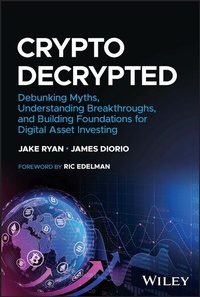
Crypto Decrypted
Description

Between the booms, crashes, jargon, and flashy memes, blockchain technology and digital assets have not been easy for ordinary investors to understand. Hopeful investors in blockchain, digital assets, and crypto everywhere have a lengthy list of questions--and the list keeps getting longer and more nuanced. But who do they turn to for answers?
In Crypto Decrypted, Tradecraft Capital's Jake Ryan and James Diorio decrypt a new world that is hidden in plain view, accessible currently to folks "in the know." This book is for anyone who finds themselves lost in the blockchain babble, exploring and explaining not only how to participate, but the often overlooked reasons why this new technology is relevant to every human being.
Ryan and Diorio dive in deeply, debunking common myths, clarifying major breakthroughs that are often disregarded, and providing easy-to-understand answers for both crypto newbies and blockchain enthusiasts, so they can move beyond the short-term to explore what great opportunities lie ahead for blockchain technologies while providing approaches to investing more safely and soundly so that you too can profit from this technological revolution.
You will learn:
* The basics of blockchain technology, which will allow you to better navigate this new world.
* The truth that debunks the six most common myths about crypto and blockchain.
* What the Byzantine Generals' Problem is, why it is important, and how it will impact your future.
* Why blockchain technology is so important and how it is relevant to you--yes, you!
* The ways in which blockchain innovation will transform our financial systems, our economy, and society itself.
* How to participate in lower risk approaches in investing in digital assets to diversify your retirement portfolio.
* Why the Information Age is over and that we've already begun a new long-wave economic cycle, the Age of Autonomy® , what the Autonomous Economy will look like in the coming years, and how it will impact us.
Just as the internet revolutionized our world decades ago, blockchain technology will impact every person and businesses on the planet- for the better - in the decades to come.
More details
Other editions
Additional editions
Persons
JAMES DIORIO is the Chief Executive Officer of Tradecraft Capital. He is a serial entrepreneur, speaker, and executive with a foundation in computer science and a history of guiding ventures to realize their full potential. He is the author of the Crypto: Decrypted¯® monthly blog, which focuses on education, insights and providing clarity in this often-misunderstood space.
Content
Part ii - Introduction iii
Part iii - Note from the Authors v
PART ONE -- THE PRIMER 1
Chapter 1: What's the Big Deal About Blockchain? 1
Chapter 2: Bitcoin, the First Application of a Blockchain 24
Chapter 3: What Makes a Smart Contract Smart? 45
Chapter 4: What is DeFi? 60
Chapter 5: Metaverse, NFTs & Web 3.0 72
PART TWO -- DEBUNKING MYTHS 88
Chapter 6: Myth - Regulation Will Kill Crypto 90
Chapter 7: Myth -- Crypto Is a Bubble 97
Chapter 8: Myth - Crypto Is Bad for the Environment 117
Chapter 9: Myth - Crypto is a Fraud 126
Chapter 10: Myth -- Crypto Empowers Crime 140
PART THREE -- THE BREAKTHROUGH 150
Chapter 11: A Primer on Technological Innovation 150
Chapter 12: The Byzantine General's Problem 162
Chapter 13: Peer-to-Peer Models 172
Chapter 14: Trusting Trustless Transactions 186
Chapter 15: No Permission Required 191
Chapter 16: Digital Scarcity 200
Chapter 17: A New Decentralized, Autonomous Economy 209
Chapter 18: Liquid Venture 218
PART FOUR -- THE APPLICATION 226
Chapter 19: Signals v. Noise 227
Chapter 20: Interpreting Charts 244
Chapter 21: Crypto as Diversification in a Total Portfolio 260
Chapter 22: Savings, Borrowing, Income Strategies & Taxes 270
Chapter 23: Retirement 277
Chapter 24: Looking Ahead 283
What's Next? 298
1
What's the Big Deal About Blockchain?
Everyone is talking about crypto, the colloquial term for digital assets. Love it or hate it, it seems to be on everyone's lips. The fact is that crypto is now mainstream. From Main Street to Wall Street, your street to our street, everyone has an opinion. We would often go present to different groups, ranging from trade shows to investor summits, and even as little as three years ago people looked at us like we were aliens. Truly - aliens bringing some unfathomable concept and, clearly, not of this Earth. Things have changed quite a bit over the past few years.
Bitcoin is the most popular and well-known of the crypto assets built on a blockchain. Yet Bitcoin is only one of thousands of crypto networks, applications, and protocols empowered through blockchain technology. Stories of teens driving Lamborghinis, or businesspeople who invested, then lost, all of their bitcoin by throwing away their wallet accidentally or forgetting a password permeated throughout. Riches were made and riches were lost, and everyone seemed to know about this volatile new asset. During this process, crypto has become somewhat of a dirty word. There is so much baggage around it that it's hard to actually cut through the noise and, with all the hype about making money, we see that the fundamentals and foundations of this amazing technology are generally overlooked and misunderstood. So let's start by understanding that blockchain technology is a breakthrough.
Blockchain, recently made possible through decades of computer science and mathematical innovations, enables computers in different locations to access, verify, and share their data. By doing so, blockchain technology overcomes one of the biggest computer software challenges of all time: how to share information quickly and reliably among separate, unaffiliated entities without the involvement of a centralized gatekeeper. This is known as the Byzantine Generals Problem and is discussed thoroughly in Chapter 12.
The breakthrough in solving this problem cannot be overstated, as it allows peers to transact business without an overlord. That may seem rather ho-hum to you, but consider the simple act of handing your friend a 20-dollar bill. You don't need to go to a bank or get permission; you can just do it. Well, before blockchain the only way to digitally exchange something was to go through that central third party. Now, you can just do it directly - like handing your friend a 20-dollar bill. Four unique characteristics make blockchain revolutionary. Blockchain is:
- Decentralized: No central authority controls transactions occurring over the network.
- Immutable: Posted transactions are there forever and can never be deleted or changed by anyone.
- Transparent: Every transaction on the blockchain is public record and can be viewed by anyone on the network.
- Authenticated with cryptography: Blockchains use complex mathematical codes to store and transmit data to ensure the legitimacy of each transaction and participant, just like an old-school signature. Every participant in the cryptoverse, via their crypto wallet, has a unique digital signature that's impossible to forge.
These features of blockchain position this technology as the biggest technological disruptor since the Internet. Blockchain, however, unlike many technology breakthroughs, is actualized by and empowers those who use it. As Vitalik Buterin, co-founder of Ethereum, said, "Whereas most technologies tend to automate workers on the periphery doing menial tasks, blockchains automate away the center. Instead of putting the taxi driver out of a job, blockchain puts Uber out of a job and lets the taxi drivers work with the customer directly." This is what we mean by peer-to-peer. To start giving this context let's look at Bitcoin, which is a blockchain that is a worldwide peer-to-peer financial network. It's the network and interaction directly between two people that is really important, and, as noted in Figure 1.1, the Bitcoin blockchain has grown significantly since its inception in 2009.
Figure 1.1 Bar Chart of Bitcoin Blockchain Size
Source: Blockchain © Statista 2022.
A Blockchain Is a Specialized Database
Google began when two graduate students in computer science and mathematics at Stanford, Larry Page and Sergey Brin, prototyped their search engine called BackRub (seriously). Page and Brin weren't planning on launching one of history's most successful companies. Rather, as computer scientists and academics the two friends saw the World Wide Web as a system of citation. In the world of academia, credible research is valued by how the author's work responds to citation (or reference), and by how future projects and publications cite the author's article or book. Well, the web to Page and Brin was simply a vast catalog of articles and information, but, without a way to cite (reference) other works, it would not realize its true potential. To Page, "the entire Web was loosely based on the premise of citation - after all, what is a link but a citation?," John Battelle wrote in his landmark book The Search. If Page could "divine a method to count and qualify each backlink on the Web, as Page puts it, 'the Web would become a more valuable place.'"
This may be strange now, but Page, Brin, and other computer scientists at the time saw the Internet as a graph. Each computer was a node, a data point, and each link on a web page connected the nodes. The result: "a classic graph structure." Brin and Page envisioned a search engine as perfecting the academic citation model.
"Not only was the engine good, but Page and Brin realized it would scale as the Web scaled," Batelle wrote. "Because PageRank worked by analyzing links, the bigger the Web, the better the engine. That fact inspired the founders to name their new engine Google, after googol, the term for the numeral 1 followed by 100 zeroes. They released the first version of Google on the Stanford Web site in August 1996 - one year after they met."1
We tell this story to make a point about innovation breakthroughs. In our daily lives, as we go about doing our jobs and getting stuff done, Google can seem like a utility service that mysteriously materialized on our computers. Of course, if we take a moment and think about it, we can dredge up a few relevant facts about how search engines came into our lives. Maybe inventing the wheel was an exception, but most technological breakthroughs happen as discoveries rooted in well-established systems begin to take hold. Jared Diamond observed that technology has to be invented or adopted. We say it is almost always both. Blockchain technology, then, was first invented, then adopted.
Decentralized
It can be easier to start understanding blockchain as a new kind of database where data is stored on individual, independent computers that exist in locations all over the globe. This makes a blockchain network distributed, because it consists of many computers that are not all in one location. That's pretty easy to grasp.
Decentralization is a little different, however, because blockchains are also decentralized. The best way to think about decentralization is to think about your photos on your laptop. If you drop your laptop in the ocean, you've probably lost your snapshots of vacation on the Big Island sipping a frothy, fruity rum drink. You may retort "not so!" because you have a backup somewhere.
That's great; however, if that backup goes kaput, then, once again, your pictures of that mai tai in Hawaii are gone. A next step, of course, would be to have all your photos uploaded to "the cloud" - a central location - which then allows us to download to multiple devices. In this, we're getting closer, but we still have that pesky central location. If that location falls into a sinkhole, the means to synchronize across all devices fails. What if there were another structure that didn't rely on single points of failure? In this example, what if there were 100,000 computers that all had copies of your photos (for some of you, that's a scary thought, so let's just pretend it's only the photos you want people to see), and every time you take a new photo, every computer gets a copy. That is decentralized. No single point of failure, no point more important than any other. That is decentralization. Blockchains are decentralized because every computer can access all of the information on a blockchain, which makes them very robust. There is no central entity controlling any given blockchain interaction; it's all kept on track with ingenious cryptography and computer software.
Immutable
Almost every database technology in use today allows transactions to be altered or overwritten. This includes everything from bank balances to health records. In a blockchain, by contrast, once a transaction is written into a block it is there forever and can never be deleted or changed by anyone. Period. So, if Bob sends Sally one bitcoin (BTC), once that transaction is confirmed, Sally has one BTC. That transaction is irrefutable, written in stone, and can never be changed. It's written on the blockchain. The computers in the network validate it (agree), and everyone has access...
