

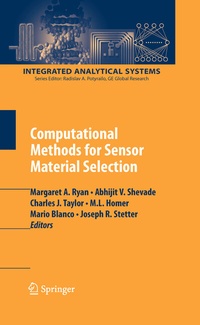
Computational Methods for Sensor Material Selection
1st Edition
Published on 6. October 2009
XV, 319 pages
978-0-387-73715-7 (ISBN)
Description

Chemical vapor sensing arrays have grown in popularity over the past two decades, finding applications for tasks such as process control, environmental monitoring, and medical diagnosis. This is the first in-depth analysis of the process of choosing materials and components for these "electronic noses", with special emphasis on computational methods. For a view of component selection with an experimental perspective, readers may refer to the complementary volume of Integrated Microanalytical Systems entitled "Combinatorial Methodologies for Sensor Materials."
Reviews / Votes
From the reviews:
"The book is written in a comprehensible manner. Each chapter contains descriptive examples. After a short introduction, the book gives very detailed information about scientific issues in each topic. Besides quantum mechanical principles, statistical approaches are covered as well. Therefore, all important topics for selecting sensing materials for chemical vapor sensing are covered. Owing to this excellent collection, the book is recommended for all scientists working on chemical vapor sensing." (Felix Kolarov, Analytical and Bioanalytical Chemistry, Vol. 397, May, 2010)More details
Other editions
Additional editions
Margaret A. Ryan | Abhijit V. Shevade | Charles J. Taylor
Computational Methods for Sensor Material Selection
Book
11/2014
Springer
€117.69
Shipment within 15-20 days
Margaret A. Ryan | Abhijit V. Shevade | Charles J. Taylor
Computational Methods for Sensor Material Selection
Book
10/2009
Springer
€160.49
Shipment within 7-9 days
Content
First Principles Methods For Materials Evaluation.- Introduction: Experimental Methods in Chemical Sensor and Sensor Array Evaluation and Development.- Electromechanical and Chemical Sensing at the Nanoscale: DFT and Transport Modeling.- Quantum Mechanics and First-Principles Molecular Dynamics Selection of Polymer Sensing Materials.- Prediction of Quartz Crystal Microbalance Gas Sensor Responses Using Grand Canonical Monte Carlo Method.- Computer-Aided Design of Organic Host Architectures for Selective Chemosensors.- First Principles Molecular Modeling of Sensing Material Selection for Hybrid Biomimetic Nanosensors.- Statistical And Multivariate Methods For Materials Evaluation.- Development of New Sensing Materials Using Combinatorial and High-Throughput Experimentation.- Chemical Sensor Array Response Modeling Using Quantitative Structure-Activity Relationships Technique.- Design and Information Content of Arrays of Sorption-Based Vapor Sensors Using Solubility Interactions and Linear Solvation Energy Relationships.- Designing Sensing Arrays.- A Statistical Approach to Materials Evaluation and Selection for Chemical Sensor Arrays.- Statistical Methods for Selecting the Components of a Sensing Array.- Hybrid Arrays for Chemical Sensing.- Future Directions.- Future Directions.
