

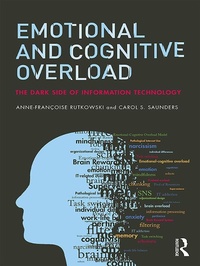
Emotional and Cognitive Overload
The Dark Side of Information Technology
1st Edition
Published on 3. October 2018
178 pages
978-1-351-68249-7 (ISBN)
Description

We live in a world of limitless information. With technology advancing at an astonishingly fast pace, we are challenged to adapt to robotics and automated systems that threaten to replace us. Both at home and at work, an endless range of devices and Information Technology (IT) systems place demands upon our attention that human beings have never experienced before, but are our brains capable of processing it all?
In this important new book, an in-depth view is taken of IT's under-studied dark side and its dire consequences on individuals, organizations, and society. With theoretical underpinnings from the fields of cognitive psychology, management, and information systems, the idea of brain overload is defined and explored, from its impact on our decision-making and memory to how we may cope with the resultant 'technostress'. Discussing the negative consequences of technology on work substitution, technologically induced work-family conflicts, and organizational design as well as the initiatives set up to combat these, the authors go on to propose measurement approaches for capturing the entangled aspects of IT-related overload. Concluding on an upbeat note, the book's final chapter explores emerging technologies that can illuminate our world when mindfully managed.
Designed to better equip humans for dealing with new technologies, supported by case studies, and also exploring the idea of 'IT addiction', the book concludes by asking how IT processes may aid rather than hinder our cognitive functioning. This is essential reading for anyone interested in how we function in the digital age.
In this important new book, an in-depth view is taken of IT's under-studied dark side and its dire consequences on individuals, organizations, and society. With theoretical underpinnings from the fields of cognitive psychology, management, and information systems, the idea of brain overload is defined and explored, from its impact on our decision-making and memory to how we may cope with the resultant 'technostress'. Discussing the negative consequences of technology on work substitution, technologically induced work-family conflicts, and organizational design as well as the initiatives set up to combat these, the authors go on to propose measurement approaches for capturing the entangled aspects of IT-related overload. Concluding on an upbeat note, the book's final chapter explores emerging technologies that can illuminate our world when mindfully managed.
Designed to better equip humans for dealing with new technologies, supported by case studies, and also exploring the idea of 'IT addiction', the book concludes by asking how IT processes may aid rather than hinder our cognitive functioning. This is essential reading for anyone interested in how we function in the digital age.
Reviews / Votes
"In this book, the authors take an in-depth view of Information Technology's (IT) understudied dark side and its dire consequences on individuals, organizations, and society. It covers: IT-related overload and IT-addiction; the brain and paradigms of the mind; individual differences in experiencing IT-related overload; measures of IT-related overload; and leveraging the positive side of IT. With theoretical underpinnings from the fields of cognitive psychology, management, and information systems, the idea of brain overload is defined and explored, from its impact on our decision-making and memory to how we may cope with the resultant 'technostress.'"- Journal of Consumer PolicyMore details
Edition
1. Auflage
Language
English
Place of publication
London
United Kingdom
Publishing group
Taylor & Francis Ltd
Target group
College/higher education
Illustrations
3 Tables, black and white; 5 Line drawings, black and white; 5 Illustrations, black and white
ISBN-13
978-1-351-68249-7 (9781351682497)
Copyright in bibliographic data and cover images is held by Nielsen Book Services Limited or by the publishers or by their respective licensors: all rights reserved.
Schweitzer Classification
Other editions
Additional editions
Anne-Francoise Rutkowski | Carol Saunders
Emotional and Cognitive Overload
The Dark Side of Information Technology
Book
09/2018
1st Edition
Routledge
€74.40
Shipment within 10-20 days

Anne-Francoise Rutkowski | Carol Saunders
Emotional and Cognitive Overload
The Dark Side of Information Technology
Book
09/2018
1st Edition
Routledge
€232.70
Shipment within 10-20 days
Persons
Anne-Francoise Rutkowski is Professor in Management of Information at Tilburg University. Her research interests include information overload, decision-making, emotion, and the materiality of algorithms. Her background is in psychology. Her research has been published in Decision Support Systems, IEEE Computer, IEEE Software, Journal of Surgical Endoscopy, and MIS Quarterly.
Carol S. Saunders has received the LEO Award from the Association of Information Systems (AIS) and the Lifetime Achievement Award from the Organizational Communication & Information Systems Division of the Academy of Management. She served or is serving on numerous editorial boards, including a three-year term as Editor-in-Chief of MIS Quarterly. Her articles appear in top-ranked management, information systems, computer science, and communication journals. She currently is the AIS Vice President of Publications.
Carol S. Saunders has received the LEO Award from the Association of Information Systems (AIS) and the Lifetime Achievement Award from the Organizational Communication & Information Systems Division of the Academy of Management. She served or is serving on numerous editorial boards, including a three-year term as Editor-in-Chief of MIS Quarterly. Her articles appear in top-ranked management, information systems, computer science, and communication journals. She currently is the AIS Vice President of Publications.
Content
Chapter 1. What is overload and why should we be interested?
Chapter 2. Brain overload: Memory, resources and time
Chapter 3. An example of IT-related overload
Chapter 4. Individual differences in experiencing IT-related overload
Chapter 5. IT-related overload in the workplace
Chapter 6. Measures of overload
Chapter 7. Leveraging the positive side of IT
Chapter 2. Brain overload: Memory, resources and time
Chapter 3. An example of IT-related overload
Chapter 4. Individual differences in experiencing IT-related overload
Chapter 5. IT-related overload in the workplace
Chapter 6. Measures of overload
Chapter 7. Leveraging the positive side of IT
