

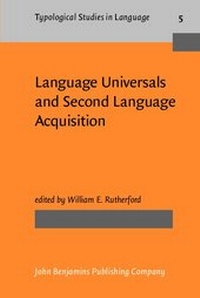
Language Universals and Second Language Acquisition
1st Edition
Published on 1. January 1984
IX, 264 pages
978-90-272-8640-6 (ISBN)
Description

This volume consists of papers presented at the Conference on Language Universals and Second Language Acquisition, University of Southern California, February 1982. Published with the papers are the remarks of the originally assigned discussants. The collection represents an important cross-fertilization between research in grammatical theory and in second language acquisition. Topics dealt with in a number of the papers include word order, markedness, core grammar, accessability hierarchies, and simplified registers. The range of universals discussed embraces phonology, syntax, semantics, and discourse. Universals are also considered with reference to ontology, psychological reality, and evaluation metrics.
More details
Other editions
Additional editions
William E. Rutherford
Language Universals and Second Language Acquisition
Book
01/1984
John Benjamins Publishing Co
€127.20
Shipment within 10-15 days
Content
- LANGUAGE UNIVERSALS AND SECOND LANGUAGE ACQUISITION
- Editorial page
- Title page
- Copyright page
- Table of contents
- PREFACE
- INTRODUCTION
- NOTES
- REFERENCES
- WHY LINGUISTS NEED LANGUAGE ACQUIRERS
- 1. Introduction
- 2. Relative Clause Formation
- 3. Ergative and Accusative Patterns
- 4. Conclusions
- NOTES
- REFERENCES
- COMMENTS ON THE PAPER BY COMRIE
- 1. Interaction
- 2. The importance of a wide data base
- 3. Ergativity
- SECOND LANGUAGE ACQUISITION AND THE ONTOLOGY OF LANGUAGE UNIVERSALS
- 1. Introduction
- 2. An overview of the nature of language universals and their potential influence on adult second language acquisition
- 3. Test cases
- 4. Discussion
- 5. Conclusion
- NOTES
- REFERENCES
- COMMENTS ON THE PAPER BY GASS AND ARD
- REPLY TO KUMPF'S COMMENTS
- 1. Nosography
- 2. Category selection
- 3. The status of universals
- 4. Data collection and instructional environment
- 5. Object of inquiry
- REFERENCES
- UNIVERSALS, TYPOLOGIES AND INTERLANGUAGE
- 1. Introduction and purpose
- 2. The hypothesis
- 3. The Test
- 3.1. Typologies
- 3.2. Data
- 3.3. Results
- 4. Discussion
- 5. Conclusion
- NOTES
- REFERENCES
- COMMENTS ON THE PAPER BY ECKMAN
- REFERENCE
- UNIVERSALS OF DISCOURSE STRUCTURE AND SECOND LANGUAGE ACQUISITION
- 1. Introduction
- 2. Topicality and topic continuity in discourse
- 3. Methodology and data-base
- 4. The Hawaii Korean-English transcript
- 4.1. Topic-marking devices
- 4.2. Numerical results
- 5. The Hawaii Philippine-English transcript
- 5.1. Topic-marking devices
- 5.2. Numerical results
- 6. The Spanish-English transcript
- 6.1. Methodological adjustments for conversation data
- 6.2. Topic-marking devices
- 6.3. Numerical results
- 7. Discussion
- 7.1. Comparison of coding-points on the topic-continuity scale
- 7.2. The gist of the topic-marking universals
- 7.3. Some concluding remarks on topics and comments
- 7.4. Variability and non-grammaticality in Pidginization
- NOTES
- REFERENCES
- APPENDIX I: Transcript page of the Korean-English text
- APPENDIX II: Transcript page of the Philippine-English text
- APPENDIX III: Transcript page of the Spanish-English text
- COMMENTS ON THE PAPER BY GIVÓN
- REFERENCES
- THE LANGUAGE BIOPROGRAM HYPOTHESIS AND SECOND LANGUAGE ACQUISITION
- 1. What are linguistic universals?
- 1.2. Universals and their neuro-biological infrastructure
- 2. The nature of the language bioprogram
- 3. Evidence for the bioprogram
- 3.1. Creoles
- 3.2. First language acquisition
- 3.3. Language origins
- 4. The bioprogram and the critical period
- 5. Primary versus secondary acquisition
- 6. Can the bioprogram influence secondary acquisition?
- NOTES
- REFERENCES
- COMMENTS ON THE PAPER BY BICKERTON
- A UNIVERSAL INPUT CONDITION
- 1. Introduction
- 2. Negative input: its nature and relevance
- 3. The availability of negative input
- 4. Learner response to negative input
- 5. Conclusion
- NOTES
- REFERENCES
- UNIFORMITY AND SOURCE-LANGUAGE VARIATION ACROSS DEVELOPMENTAL CONTINUA
- 1. Introduction
- 1.1. Uniformity and variation
- 1.2. Targeted and nativizing/optimalizing changes
- 2. Targeted change: negation
- 3. Evolutive change: subject deletion and fledgling SVO languages
- 4. Optimalization processes: the syntax and semantics of FOR
- 4.1. FOR with infinitival and sentential complements
- 4.2. FOR as a dative/genitive case preposition
- 4.3. Analogizing of the phrase structure
- 5. Conclusion
- NOTES
- REFERENCES
- COMMENTS ON THE PAPER BY ZOBL
- REFERENCES
- IN WHAT WAYS ARE LANGUAGE UNIVERSALS PSYCHOLOGICALLY REAL?
- 1. Introduction
- 2. The determination of the n-dimensional space.
- 3. In search of psychological correspondence.
- 4. Implications for second language acquisition research.
- 5. Conclusion.
- REFERENCES
- COMMENTS ON THE PAPER BY HAKUTA
- REFERENCES
- REPLY TO HATCH'S COMMENTS
- REPERTOIRE UNIVERSALS, MARKEDNESS, AND SECOND LANGUAGE ACQUISITION
- 1. Concepts
- 1.1. Repertoire universals.
- 1.2. Markedness.
- 1.3. Second language acquisition.
- 2. Examples.
- 2.1. Stops.
- 2.2. Negation.
- 2.3. Respect register.
- 3. Comment
- NOTE
- REFERENCES
- INDEX TO REFERENCES
- INDEX TO LANGUAGES
