

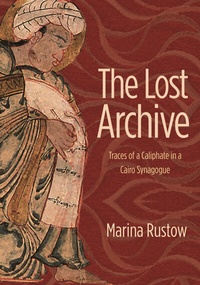
The Lost Archive
Traces of a Caliphate in a Cairo Synagogue
1st Edition
Published on 10. February 2020
624 pages
978-0-691-18952-9 (ISBN)
Description

A compelling look at the Fatimid caliphate's robust culture of documentation
The lost archive of the Fatimid caliphate (909-1171) survived in an unexpected place: the storage room, or geniza, of a synagogue in Cairo, recycled as scrap paper and deposited there by medieval Jews. Marina Rustow tells the story of this extraordinary find, inviting us to reconsider the longstanding but mistaken consensus that before 1500 the dynasties of the Islamic Middle East produced few documents, and preserved even fewer.
Beginning with government documents before the Fatimids and paper's westward spread across Asia, Rustow reveals a millennial tradition of state record keeping whose very continuities suggest the strength of Middle Eastern institutions, not their weakness. Tracing the complex routes by which Arabic documents made their way from Fatimid palace officials to Jewish scribes, the book provides a rare window onto a robust culture of documentation and archiving not only comparable to that of medieval Europe, but, in many cases, surpassing it. Above all, Rustow argues that the problem of archives in the medieval Middle East lies not with the region's administrative culture, but with our failure to understand preindustrial documentary ecology.
Illustrated with stunning examples from the Cairo Geniza, this compelling book advances our understanding of documents as physical artifacts, showing how the records of the Fatimid caliphate, once recovered, deciphered, and studied, can help change our thinking about the medieval Islamicate world and about premodern polities more broadly.
The lost archive of the Fatimid caliphate (909-1171) survived in an unexpected place: the storage room, or geniza, of a synagogue in Cairo, recycled as scrap paper and deposited there by medieval Jews. Marina Rustow tells the story of this extraordinary find, inviting us to reconsider the longstanding but mistaken consensus that before 1500 the dynasties of the Islamic Middle East produced few documents, and preserved even fewer.
Beginning with government documents before the Fatimids and paper's westward spread across Asia, Rustow reveals a millennial tradition of state record keeping whose very continuities suggest the strength of Middle Eastern institutions, not their weakness. Tracing the complex routes by which Arabic documents made their way from Fatimid palace officials to Jewish scribes, the book provides a rare window onto a robust culture of documentation and archiving not only comparable to that of medieval Europe, but, in many cases, surpassing it. Above all, Rustow argues that the problem of archives in the medieval Middle East lies not with the region's administrative culture, but with our failure to understand preindustrial documentary ecology.
Illustrated with stunning examples from the Cairo Geniza, this compelling book advances our understanding of documents as physical artifacts, showing how the records of the Fatimid caliphate, once recovered, deciphered, and studied, can help change our thinking about the medieval Islamicate world and about premodern polities more broadly.
More details
Language
English
Place of publication
Princeton, NJ
United States
Publishing group
De Gruyter
Target group
Professional and scholarly
Edition type
Digital original
Product notice
Reflowable
Illustrations
83 color + 17 b/w illus. 4 maps. 4c throughout
ISBN-13
978-0-691-18952-9 (9780691189529)
Schweitzer Classification
Other editions
Additional editions
Book
01/2020
Princeton University Press
€59.50
Shipment within 10-20 days
Person
Marina Rustow is the Khedouri A. Zilkha Professor of Jewish Civilization in the Near East and professor of Near Eastern studies and history at Princeton University. She is director of the Princeton Geniza Lab and a MacArthur fellow, and is the author of Heresy and the Politics of Community: The Jews of the Fatimid Caliphate.
Content
- Cover
- Title Page
- Copyright Page
- Contents
- Technical Note
- Introduction: Middle East History's Archive Problem
- I. Source Survival
- 1. The Geniza: Blind Spots and Cataclysms
- 2. The Storage Capacity of State Power
- 3. The Corpus: Its Shape and Coherence
- II. Chancery Practice
- 4. Paper: The Search for a Sustainable Support
- 5. Layout: Early Arabic Chancery Norms
- 6. Script: The Impact of the Abbasid East
- 7. Imperial Norms: The Abbasid Chancery
- 8. The Fatimid Petition-and-Response Procedure
- III. The Ecology of the Documents
- 9. Supply: A Proliferation of Decrees
- 10. Administrative Manuals and Nonmanuals
- 11. The Source: The Chancery
- 12. Copying, Storage, and Dissemination
- 13. The Probative Value of Documents: Archiving and Registraion
- Appendix to Chapter 13: Fatimid ?Ala?im and Registration Marks
- IV. The Problem of Archives
- 14. The Rotulus as an Instrument of Performance
- 15. The Ontological Status of the Decree
- 16. Archives, Documents, and the Persistence of "Despotism"
- Notes
- Acknowledgments
- Bibliography
- Subject Index
- Index of Manuscripts with Shelfmarks
- Photo Credits and Permissions
