

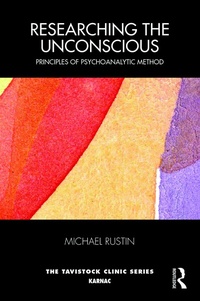
Researching the Unconscious
Principles of Psychoanalytic Method
1st Edition
Published on 12. February 2019
344 pages
978-0-429-67198-2 (ISBN)
Description

Researching the Unconscious provides an exposition of key issues in the philosophy and methods of the social sciences that are relevant to psychoanalysis, both as a clinical practice and as a human science.
These include the debates initiated by Thomas Kuhn's theory of scientific revolutions, the "actor-network theory" of Bruno Latour, the ideas of philosophical realism, distinctions between "meaningful" and "causal" explanation, and the relevance of complexity theory and "part-whole analysis" to psychoanalysis. The book goes on to discuss specific forms and methods of psychoanalytical research, including the role of case studies, of outcome research, and of "grounded theory" as a key methodological resource, of which it provides a detailed example. The book concludes by outlining principles and methods for psychoanalytic research in the wider contexts of infant observational studies, society, and culture.
Michael Rustin provides a unifying account of the methodological principles that underlie the generation of knowledge in psychoanalysis, in the light of recent developments in the philosophy and sociology of science. In doing so, it provides a coherent rationale for psychoanalytic investigation, which will be of value to those pursuing research in this field.
Researching the Unconscious is unusual in its being based both on a deep understanding of and respect for psychoanalytical clinical practice and on its author's wider knowledge of the philosophy and sociology of science. It is unique in its comprehensive approach to the principles of psychoanalytic research.
These include the debates initiated by Thomas Kuhn's theory of scientific revolutions, the "actor-network theory" of Bruno Latour, the ideas of philosophical realism, distinctions between "meaningful" and "causal" explanation, and the relevance of complexity theory and "part-whole analysis" to psychoanalysis. The book goes on to discuss specific forms and methods of psychoanalytical research, including the role of case studies, of outcome research, and of "grounded theory" as a key methodological resource, of which it provides a detailed example. The book concludes by outlining principles and methods for psychoanalytic research in the wider contexts of infant observational studies, society, and culture.
Michael Rustin provides a unifying account of the methodological principles that underlie the generation of knowledge in psychoanalysis, in the light of recent developments in the philosophy and sociology of science. In doing so, it provides a coherent rationale for psychoanalytic investigation, which will be of value to those pursuing research in this field.
Researching the Unconscious is unusual in its being based both on a deep understanding of and respect for psychoanalytical clinical practice and on its author's wider knowledge of the philosophy and sociology of science. It is unique in its comprehensive approach to the principles of psychoanalytic research.
Reviews / Votes
'How can psychoanalysis be a research activity when its task is not a generalizing one, but a particularizing one, that is, to impart the nuance and convey complexity? Michael Rustin has some fascinating and learned answers to this question. He shows how psychoanalysis does generate knowledge and should respect its own methods of doing so. Read him and learn!'-Anne Alvarez, PhD, MACP, Consultant Child and Adolescent Psychotherapist.'Michael Rustin is an outstanding contributor to the development of psychoanalytic studies, and author of several works of seminal importance in British sociology. In this lucid and rational book, he distils his thinking from many years of teaching and scholarship to offer a persuasive defence of psychoanalysis as a rational and progressive social science of huge cultural significance. The book is crucial reading for everyone interested in the standing of psychoanalysis as a human science.'-Stephen Frosh, Department of Psychosocial Studies, Birkbeck, University of London, UK
'This is an impressive work. Rustin is uniquely equipped to show how methods of research consistent with psychoanalytic approaches can produce an objective body of knowledge. His book continues the remarkable tradition of Jaspers and Ricoeur. It provides a great deal of what researchers and mental health therapists will need to meet the challenges of the future'-David Taylor, psychoanalyst and Visiting Professor, UCL Psychoanalysis Unit, UK
More details
Series
Edition
1. Auflage
Language
English
Place of publication
London
United Kingdom
Publishing group
Taylor & Francis Ltd
Target group
College/higher education
Professional and scholarly
Illustrations
2 Tables, black and white; 1 Halftones, black and white; 1 Illustrations, black and white
File size
3,35 MB
ISBN-13
978-0-429-67198-2 (9780429671982)
Copyright in bibliographic data and cover images is held by Nielsen Book Services Limited or by the publishers or by their respective licensors: all rights reserved.
Schweitzer Classification
Other editions
Additional editions
Book
02/2019
1st Edition
Routledge
€166.60
Shipment within 10-20 days
Book
01/2018
Karnac Books
€54.90
Shipment within 15-20 days
Person
Michael Rustin is a Professor of Sociology at the University of East London, UK. He has been a significant contributor to psychoanalytic debates over many years and is the author and editor of many books, including The Good Society and the Inner World (1991), Reason and Unreason (2001), and, with Margaret Rustin, Mirror to Nature (2002) and Reading Klein (2017). He has played a major role in the development of postgraduate and doctoral research at the Tavistock Clinic. He is an Associate of the British Psychoanalytical Society.
Content
Series editors' preface; Acknowledgements; Preface; Chapter 1: Introduction; Chapter 2: Psychoanalysis as a scientific paradigm; Chapter 3: The consulting room as the psychoanalytic laboratory; Chapter 4: Philosophical realism and its relevance; Chapter 5: Meanings and causes in psychoanalytical explanation; Chapter 6: On classification; Chapter 7: Case-study methods in psychoanalysis; Chapter 8: Parts and wholes: different kinds of explanation; Chapter 9: Complexity theory and psychoanalysis; Chapter 10: Clinical facts; Chapter 11: Grounded theory in psychoanalysis and child psychotherapy; Chapter 12: Grounded theory in child psychotherapy: an example; Chapter 13: Outcome studies; Chapter 14: Observational research methods; Chapter 15: Socio-psychoanalytic research; Chapter 16: Psychoanalytic cultural methods; References
