
Watching over Yellowstone
Description
Alles über E-Books | Antworten auf Fragen rund um E-Books, Kopierschutz und Dateiformate finden Sie in unserem Info- & Hilfebereich.
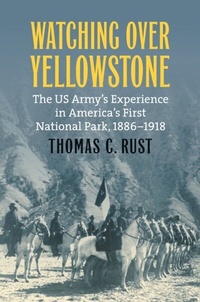
When, in 1883, Congress charged the US Army with managing Yellowstone National Park, soldiers encountered a new sort of hostility: work they were untrained for, in a daunting physical and social environment where they weren't particularly welcome. When they departed in 1918, America had a new sort of serviceman: the National Park Service Ranger. From the creation of Yellowstone National Park to the conclusion of the army's superintendence, Watching over Yellowstone tells the boots-on-the-ground story of the US troops charged with imposing order on man and nature in America's first national park.
Yellowstone National Park had been created only fourteen years before Captain Moses Harris arrived at Mammoth Hot Springs with his company, Troop M of the First United States Cavalry, in August of 1886. And in those years, the underfunded, poorly supervised park had been visited freely by over-eager tourists, vandals, and poachers. Thomas C. Rust describes the task confronting Congress, military superintendents, and the common soldiers as the ever-increasing number of tourists, commercial interests, and politics stained the unruly park. At a time when the army was already undergoing a great transformation, the common soldiers were now struggling with unusual duties in unfamiliar terrain, often in unaccustomed proximity to the social elite who dominated the tourist class-fertile if uncertain ground for both the failures and the successes that eventually shaped the National Park Service's ranger corps. What this meant for the average soldier emerges from the materials Rust consults: orders, circulars, inspection reports, court-martial cases, civilian accounts, and evidence from excavated soldier stations in the park. A nuanced social history from a rare ground-level perspective, his book captures an extraordinary moment in the story of America's military and its national parks.
All prices
More details
Other editions
Additional editions

Person
Content
Preface
Introduction: ?To Correct and Remedy the Existing State of Things?
1. ?The Work Is Not a Military Duty?: The Constabulary Soldier in Yellowstone Park
2. ?Peculiar, Perplexing and Severe Duties?: Life at Fort Yellowstone
3. ?Conditions . . . Resemble Those Existing 30-Odd Years Ago?: Life in the Park's Interior
4. An ?Undesirable Station?: Desertion, Social Class, and the Basis for the National Park Service Ranger
5. ?Petty Grievances?: Isolated Duty at the Soldier Outposts
Conclusion: ?Patriotism . . . and the Love of Nature?: The Close of the Military Era
Notes
Bibliography
Index

System requirements
File format: ePUB
Copy protection: Adobe-DRM (Digital Rights Management)
System requirements:
- Computer (Windows; MacOS X; Linux): Install the free reader Adobe Digital Editions prior to download (see eBook Help).
- Tablet/smartphone (Android; iOS): Install the free app Adobe Digital Editions or the app PocketBook before downloading (see eBook Help).
- E-reader: Bookeen, Kobo, Pocketbook, Sony, Tolino and many more (not Kindle).
The file format ePub works well for novels and non-fiction books – i.e., „flowing” text without complex layout. On an e-reader or smartphone, line and page breaks automatically adjust to fit the small displays.
This eBook uses Adobe-DRM, a „hard” copy protection. If the necessary requirements are not met, unfortunately you will not be able to open the eBook. You will therefore need to prepare your reading hardware before downloading.
Please note: We strongly recommend that you authorise using your personal Adobe ID after installation of any reading software.
For more information, see our ebook Help page.
File format: PDF
Copy-Protection: Adobe-DRM (Digital Rights Management)
System requirements:
- Computer (Windows; MacOS X; Linux): Install the free reader Adobe Digital Editions prior to download (see eBook Help).
- Tablet/smartphone (Android; iOS): Install the free app Adobe Digital Editions or the app PocketBook before downloading (see eBook Help).
- E-reader: Bookeen, Kobo, Pocketbook, Sony, Tolino and many more (only limited: Kindle).
The file format PDF always displays a book page identically on any hardware. This makes PDF suitable for complex layouts such as those used in textbooks and reference books (images, tables, columns, footnotes). Unfortunately, on the small screens of e-readers or smartphones, PDFs are rather annoying, requiring too much scrolling.
This eBook uses Adobe-DRM, a „hard” copy protection. If the necessary requirements are not met, unfortunately you will not be able to open the eBook. You will therefore need to prepare your reading hardware before downloading.
Please note: We strongly recommend that you authorise using your personal Adobe ID after installation of any reading software.
For more information, see our eBook Help page.
File format: ePUB
Copy protection: Watermark-DRM (Digital Rights Management)
System requirements:
- Computer (Windows; MacOS X; Linux): Use a reading software that can process the file format ePUB: e.g., Adobe Digital Editions or FBReader – both free (see eBook Help).
- Tablet/Smartphone (Android; iOS): Before downloading, install the free app Adobe Digital Editions (see eBook Help).
- E-reader: Bookeen, Kobo, Pocketbook, Sony, Tolino and many more (not Kindle).
The file format ePUB works well for novels and non-fiction books – i.e., „flowing” text without complex layout. On an e-reader or smartphone, line and page breaks automatically adjust to fit the small displays.
This eBook uses Watermark-DRM, a „soft” copy protection. This means that there are no technical restrictions to prevent illegal distribution. However, there is a personalised watermark embedded in the eBook that can be used to identify the purchaser of the eBook in the event of misuse and to provide evidence for legal purposes.
For more information, see our eBook Help page.
