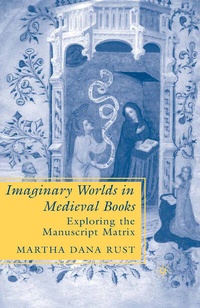
Imaginary Worlds in Medieval Books
Description

Reviews / Votes
"Rust's rich account underlines the central medieval-text principle; that just everything is an image of drawing or writing; and drawing and writing an image of anything at all. But Rust's own central interpretative ideas - middle letters, double literacy, manuscript matrix, codicology exert a calm control over her cornucopia of examples and ideas, with great ingenuity of both explanation and interpretation. What more one could ask for it would be hard to imagine." - John Powell Ward, Honorary Research Fellow, University of Wales, Swansea; Author of The Spell of the Song
'By demonstrating the complex dimensions of the medieval manuscript matrix, Rust elucidates a performative mode of reading text and image together and against one another that will transform the way we think about artistic practices in the Middle Ages. It is a major achievement.' - Stephen G. Nichols, James M. Beall Professor of French & Humanities Chair, Department of German & Romance Languages & Literatures Co-Director, Centre Louis Marin d'études pluridisciplinaires, Johns Hopkins University
"This fine book makes a considerable contribution to our growing interest, in medieval literary studies, in encountering texts in their original manuscript settings. Rust proposes the medieval manuscript especially the illustrated late-medieval devotional manuscript as a kind of tool, by interaction with which its user (often a layperson, very often a woman) could enter into the quite specificbut Imaginary Worlds of the title. Rust rightly suggests a link between such effects and Heidegger's notion of the 'locale,' or what she calls the 'manuscript matrix.' This is the sort of book that could only be written by someone who has had contact with many hundreds probably thousands of manuscripts, in a range of languages and levels of ambition." - Christopher Baswell, UCLA
More details
Other editions
Additional editions