

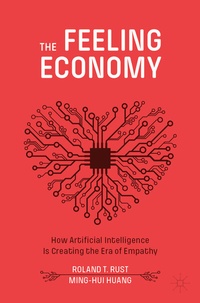
The Feeling Economy
Description

As machines are trained to "think," many tasks that previously required human intelligence are becoming automated through artificial intelligence. However, it is more difficult to automate emotional intelligence, and this is where the human worker's competitive advantage over machines currently lies. This book explores the impact of AI on everyday life, looking into workers' adaptation to these changes, the ways in which managers can change the nature of jobs in light of AI developments, and the potential for humans and AI to continue working together.
The book argues that AI is rapidly assuming a larger share of thinking tasks, leaving human intelligence to focus on feeling. The result is the "Feeling Economy," in which both employees and consumers emphasize feeling to an unprecedented extent, with thinking tasks largely delegated to AI. The book shows both theoretical and empirical evidence that this shift is well underway. Further, it explores the effect of the Feeling Economy on our everyday lives in the areas such as shopping, politics, and education. Specifically, it argues that in this new economy, through empathy and people skills, women may gain an unprecedented degree of power and influence. This book will appeal to readers across disciplines interested in understanding the impact of AI on business and our daily lives. It represents a bold, potentially controversial attempt to gauge the direction in which society is heading.Reviews / Votes
"The transition from goods-based economy to services-based economy and the intersection of these with the levels of intelligence are captured uniquely. Using numerous examples . . This book presents a realistic roadmap that illustrates the risks and opportunities accompanying AI growth for society. . The book provides a detailed analysis of the emergence of the Feeling Economy due to AI allowing both analytical and intuitive tasks." (Marko Rankovic, Bojan Kocic and Milena Ilic, Knjige i casopisi, rsp.hr, Issue 4, 2021)More details
Other editions
Additional editions
Persons
Roland T. Rust is Distinguished University Professor, David Bruce Smith Chair in Marketing at the Robert H. Smith School of Business, and Founder and Executive Director of the Center for Excellence in Service at the University of Maryland, USA.
Ming-Hui Huang
is Distinguished Professor of Information Management at National Taiwan University, Taiwan. Her research focuses on the intersection of technology and strategy, and its impact on service.
Content
1. Introduction.- 2. The Physical Economy.- 3. The Thinking Economy.- 4. The Feeling Economy.- 5. The Age of Emoji.- 6. Jobs That Feel.- 7. The Era of Women.- 8. Politics that Feel.- 9. How Education Must Change.- 10. AI for Consumers.- 11. Management in the Feeling Economy.- 12 Moral, Ethical and Governance Implications.- 13. Artificial Creativity.- 14. AI for Feeling.- 15. Beyond the Feeling Economy.- 16. Conclusions.
