

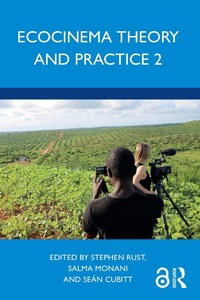
Ecocinema Theory and Practice 2
1st Edition
Published on 15. December 2022
268 pages
978-1-000-82704-0 (ISBN)
Description

This second volume builds on the initial groundwork laid by Ecocinema Theory and Practice by examining the ways in which ecocritical cinema studies have matured and proliferated over the last decade, opening whole new areas of study and research.
Featuring fourteen new essays organized into three sections around the themes of cinematic materialities, discourses, and communities, the volume explores a variety of topics within ecocinema studies from examining specific national and indigenous film contexts to discussing ecojustice, environmental production studies, film festivals, and political ecology. The breadth of the contributions exemplifies how ecocinema scholars worldwide have sought to overcome the historical legacy of binary thinking and intellectual norms and are working to champion new ecocritical, intersectional, decolonial, queer, feminist, Indigenous, vitalist, and other emergent theories and cinematic practices. The collection also demonstrates the unique ways that cinema studies scholarship is actively addressing environmental injustice and the climate crisis.
This book is an invaluable resource for students and scholars of ecocritical film and media studies, production studies, cultural studies, and environmental studies.
The Open Access version of this book, available at www.taylorfrancis.com, has been made available under a Creative Commons Attribution-Non Commercial-No Derivatives 4.0 license.
Featuring fourteen new essays organized into three sections around the themes of cinematic materialities, discourses, and communities, the volume explores a variety of topics within ecocinema studies from examining specific national and indigenous film contexts to discussing ecojustice, environmental production studies, film festivals, and political ecology. The breadth of the contributions exemplifies how ecocinema scholars worldwide have sought to overcome the historical legacy of binary thinking and intellectual norms and are working to champion new ecocritical, intersectional, decolonial, queer, feminist, Indigenous, vitalist, and other emergent theories and cinematic practices. The collection also demonstrates the unique ways that cinema studies scholarship is actively addressing environmental injustice and the climate crisis.
This book is an invaluable resource for students and scholars of ecocritical film and media studies, production studies, cultural studies, and environmental studies.
The Open Access version of this book, available at www.taylorfrancis.com, has been made available under a Creative Commons Attribution-Non Commercial-No Derivatives 4.0 license.
Reviews / Votes
"Expanding the focus of the groundbreaking first volume and bringing together a diverse group of contributors, Ecocinema Theory and Practice 2 explores new practices, materialities, and discourses in emerging ecocinema communities. It is an indispensable resource for students and scholars of environmental film and filmmaking."Alexa Weik von Mossner, Associate Professor of American Studies, University of Klagenfurt, Austria
"This wonderful sequel explores not only the toxicity of the petrofuelled ecocrisis but opens up to discuss broader changes in visual culture. The global - yet so skillfully situated - case studies offer much delight and insight to anyone interested in how moving images help to understand planetary change and justice."
Jussi Parikka, Professor in Digital Aesthetics and Culture, Aarhus University, Denmark and FAMU (Prague), Czech Republic
More details
Edition
1. Auflage
Language
English
Place of publication
London
United Kingdom
Publishing group
Taylor & Francis Ltd
Target group
College/higher education
Professional and scholarly
Product notice
Reflowable
Illustrations
22 Line drawings, black and white; 22 Illustrations, black and white
File size
5,29 MB
ISBN-13
978-1-000-82704-0 (9781000827040)
Copyright in bibliographic data and cover images is held by Nielsen Book Services Limited or by the publishers or by their respective licensors: all rights reserved.
Schweitzer Classification
Other editions
Additional editions
Stephen Rust | Salma Monani | Sean Cubitt
Ecocinema Theory and Practice 2
Book
12/2022
1st Edition
Routledge
€186.30
Shipment within 10-20 days
Stephen Rust | Salma Monani | Sean Cubitt
Ecocinema Theory and Practice 2
Book
12/2022
1st Edition
Routledge
€55.40
Shipment within 10-20 days
Persons
Stephen Rust is a Senior Instructor of English at the University of Oregon. He is co-editor of Ecocinema Theory and Practice (2013) and Ecomedia: Key Issues (2016) and an advisory board member of Media+Environment and the Journal of Environmental Media. He has published several articles in the field and is currently writing an ecocritical analysis of Merchant Ivory Productions.
Salma Monani is a Professor at Gettysburg College's Environmental Studies department. She has extensively published on explorations of Indigenous ecomedia, film, and environmental justice, and is co-editor of three ecocritical media anthologies. She is currently writing a monograph on Indigenous Ecocinema. As part of her college's Land Acknowledgment Committee, her scholarship also engages the practice of digital, public eco-humanities along with community research with Indigenous partners.
Sean Cubitt is a Professor of Screen Studies at the University of Melbourne. His publications include The Cinema Effect (2004), Finite Media: Environmental Implications of Digital Technologies (2016), and Anecdotal Evidence: Ecocritique from Hollywood to the Mass Image (2020). Co-editor of Ecomedia: Key Issues (2016), and series editor for Leonardo Books, he researches the history and philosophy of media, ecopolitical aesthetics, media arts and technologies, and media art history.
Salma Monani is a Professor at Gettysburg College's Environmental Studies department. She has extensively published on explorations of Indigenous ecomedia, film, and environmental justice, and is co-editor of three ecocritical media anthologies. She is currently writing a monograph on Indigenous Ecocinema. As part of her college's Land Acknowledgment Committee, her scholarship also engages the practice of digital, public eco-humanities along with community research with Indigenous partners.
Sean Cubitt is a Professor of Screen Studies at the University of Melbourne. His publications include The Cinema Effect (2004), Finite Media: Environmental Implications of Digital Technologies (2016), and Anecdotal Evidence: Ecocritique from Hollywood to the Mass Image (2020). Co-editor of Ecomedia: Key Issues (2016), and series editor for Leonardo Books, he researches the history and philosophy of media, ecopolitical aesthetics, media arts and technologies, and media art history.
Content
Part 1: Ecocinema Materialities 1. Unsustainable cinema: global supply chains 2. Greening Mexican cinema 3. Energy and exhaustion in a coal melodrama: Kaala Patthar (1979) 4. The sustainable audiovisual industry in Catalonia seen through the Green Shooting initiative Part 2: Ecocinema Discourses 5. Extraction and wild cinema in Africa 6. Polytemporality in the slow ecocinema of Lav Diaz: an installation in a trauma field 7. Exploring SF ecocinema: gender, infrastructure, and US/China dynamics in Interstellar and The Wandering Earth 8. Keaton's chimera, or the comic assemblage of mountains 9. The matrix of ecomedia: fan worlds as environments Part 3: Ecocinema Communities 10. Indigenous cosmologies and communities: the digital art of Johnathan Thunder and Missy Whiteman 11. Of toxic dust and sad places: ecochronicity and debility in Julio Hernandez Cordon's Polvo (Dust, 2012) 12. Indigenous post-apocalyptic filmmaking at Standing Rock 13. Blurry streams: the pandemic film festival 14. Seeing locally, expressing globally: participatory filmmaking and aesthetics Afterword: The sequel-effect
