

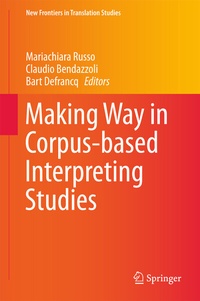
Making Way in Corpus-based Interpreting Studies
Description

Reviews / Votes
"The book has demonstrated that researchers have successfully made way in CIS, putting the fast-developing research field on a right track that may finally enable CIS researchers to discover the undiscoverable and to use corpus-based findings for practical ends. Undoubtedly, after Straniero Sergio and Falbo (2012), the current volume represents another authoritative reference on CIS, and is therefore a must read for interpreting students, trainers, researchers and other stakeholders interested in CIS." (Chao Han, FORUM International Journal of Interpretation, Vol. 18 (1), 2020)
"The volume presents a Compilation of state-of-the-art research in CIS over the past decade and is therefore an essential resource for both established researchers and postgraduate candidates. . the main purpose of this book is to showcase some of the larger existing corpora, and most authors rise to this task." (EllaWehrmeyer, Interpreting, Vol. 21 (1), 2019)
More details
Other editions
Additional editions
Persons
Claudio Bendazzoli is Assistant Professor of English Language and Translation at the Department of Economic and Social Studies, Mathematics and Statistics of the University of Turin (Italy). Between 2004 and 2011, he worked at the Department of Interpreting and Translation of the University of Bologna at Forlì, where he completed his PhD in Interpreting Studies. He developed the Directionality in Simultaneous Interpreting Corpus (DIRSI-C) and was part of the research group that created the European Parliament Interpreting Corpus (EPIC). His main research interests are corpus-based interpreting studies, theatre and interpreter training, ethnography of speaking, English as a Lingua Franca, and English medium instruction. He also works as a freelance conference interpreter and translator (Italian, English, Spanish).
Bart Defrancq is Associate Professor of interpreting and legal translation at Ghent University (Belgium). In 2002, he was granted his PhD in linguistics at Ghent University and became involved with corpus-based translation and interpreting studies when appointed at the Department of Translation, Interpreting and Communication at the same university. He is head of interpreter training both at the masters' and at the postgraduate levels since 2010 and the initiator of a corpus compilation project based on interpreting data (EPICG). He has published widely on corpus linguistics, translation and interpreting and is an editorial board member of Languages in Contrast and The Interpreters' Newsletter.
