

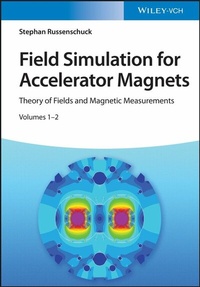
Field Simulation for Accelerator Magnets
Vol. 1: Theory of Fields and Magnetic Measurements / Vol. 2: Methods for Design and Optimization
1st Edition
Published on 15. April 2025
1136 pages
978-3-527-83957-5 (ISBN)
Description

"Field Simulation for Accelerator Magnets" is a comprehensive two-volume reference on the electromagnetic design and measurement of accelerator magnets. It covers the design and optimization of magnets with highly uniform fields, which are crucial for accelerating electrons or hadrons in particle accelerators used in various scientific fields.
The volumes provide essential mathematical foundations for project engineers and beam physicists, and are valuable for students of electrical engineering and physics. They offer detailed discussions on topics such as vector algebra, network theory, field computation, magnetic measurements, beam optics, and more. Additionally, they explore mathematical optimization techniques, multiphysics simulation, and model-based systems engineering.
Authored by a leading expert, these volumes are an excellent resource for learning mathematical methods and numerical techniques applicable in industry and science.
The volumes provide essential mathematical foundations for project engineers and beam physicists, and are valuable for students of electrical engineering and physics. They offer detailed discussions on topics such as vector algebra, network theory, field computation, magnetic measurements, beam optics, and more. Additionally, they explore mathematical optimization techniques, multiphysics simulation, and model-based systems engineering.
Authored by a leading expert, these volumes are an excellent resource for learning mathematical methods and numerical techniques applicable in industry and science.
More details
Other editions
Additional editions
Stephan Russenschuck
Field Simulation for Accelerator Magnets
Vol. 1: Theory of Fields and Magnetic Measurements / Vol. 2: Methods for Design and Optimization
Book
05/2025
1st Edition
Wiley-VCH
€399.00
Available immediately
Person
Stephan Russenschuck is a Principle Applied Physicist in the Accelerator Technology (TE) Department of the European Organization for Nuclear Research, CERN, Geneva, Switzerland. He is the leader of the magnetic measurement section in the TE department and the chairman of the technical and doctoral student committee (TSC). He received the Dipl.-Ing and Dr.-Ing. degrees in electrical engineering in 1986 and 1990 both from the Technical University Darmstadt. In 2000 he was recognized as a University Lecturer (Habilitation) for Theory of Electromagnetic Fields at the University of Vienna, Austria.
His research interests are mathematical optimization and numerical field computation techniques in support of magnet design, magnetic measurements, and accelerator operation. Stephan Russenschuck is the author of the numerical field computation program ROXIE and the author of the book "Field computation for accelerator magnets" published by Wiley-VCH.
His research interests are mathematical optimization and numerical field computation techniques in support of magnet design, magnetic measurements, and accelerator operation. Stephan Russenschuck is the author of the numerical field computation program ROXIE and the author of the book "Field computation for accelerator magnets" published by Wiley-VCH.
Content
Volume 1
Preface xv
Notation xix
1 Algebraic Structures and Vector Fields 1
2 Classical Vector Analysis 41
3 Maxwell?s Equations and Boundary-Value Problems in Magnetostatics 103
4 Fields and Potentials of Line Currents 153
5 Harmonic Fields 205
6 Complex Analysis Methods for Magnet Design 271
7 Faraday?s Law of Induction 305
8 Field Diffusion 319
9 Synchrotron Radiation 339
10 Theory of the Coil Magnetometer 357
11 Stretched-Wire Field Measurements 415
Appendix A Differential Forms 469
Appendix B The Vibration of the Taut String 485
Appendix C Uncertainty in Measurement and Approximation 497
Appendix D Orthogonal Array Testing 511
Appendix E SI Units 523
Volume 2
12 Magnets for Accelerators 525
13 Elementary Beam Optics and Field Requirements 573
14 Reference Frames and Magnet Polarities 603
15 Iron-Dominated Magnets 619
16 Coil-Dominated Magnets 653
17 Finite-Element Formulations 701
18 Discretization 721
19 Coupling of Boundary and Finite Elements 743
20 Superconductor Magnetization 781
21 Interstrand Coupling Currents 827
22 Quench Simulation 855
23 Differential Geometry Applied to Coil-Head Design 895
24 Mathematical Optimization Techniques 923
25 Model-Based Systems Engineering 983
Appendix F Material-Property Data for Field Simulation 1015
Appendix G The LHC Magnet Catalog 1035
Appendix H Ramping the LHC Dipoles 1061
Reference 1063
Glossary 1065
Index 1075
Preface xv
Notation xix
1 Algebraic Structures and Vector Fields 1
2 Classical Vector Analysis 41
3 Maxwell?s Equations and Boundary-Value Problems in Magnetostatics 103
4 Fields and Potentials of Line Currents 153
5 Harmonic Fields 205
6 Complex Analysis Methods for Magnet Design 271
7 Faraday?s Law of Induction 305
8 Field Diffusion 319
9 Synchrotron Radiation 339
10 Theory of the Coil Magnetometer 357
11 Stretched-Wire Field Measurements 415
Appendix A Differential Forms 469
Appendix B The Vibration of the Taut String 485
Appendix C Uncertainty in Measurement and Approximation 497
Appendix D Orthogonal Array Testing 511
Appendix E SI Units 523
Volume 2
12 Magnets for Accelerators 525
13 Elementary Beam Optics and Field Requirements 573
14 Reference Frames and Magnet Polarities 603
15 Iron-Dominated Magnets 619
16 Coil-Dominated Magnets 653
17 Finite-Element Formulations 701
18 Discretization 721
19 Coupling of Boundary and Finite Elements 743
20 Superconductor Magnetization 781
21 Interstrand Coupling Currents 827
22 Quench Simulation 855
23 Differential Geometry Applied to Coil-Head Design 895
24 Mathematical Optimization Techniques 923
25 Model-Based Systems Engineering 983
Appendix F Material-Property Data for Field Simulation 1015
Appendix G The LHC Magnet Catalog 1035
Appendix H Ramping the LHC Dipoles 1061
Reference 1063
Glossary 1065
Index 1075
