

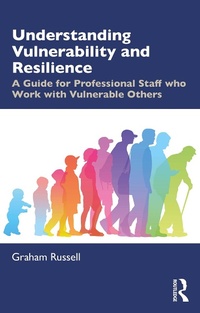
Understanding Vulnerability and Resilience
A Guide for Professional Staff who Work with Vulnerable Others
1st Edition
Published on 28. March 2023
232 pages
978-1-351-03553-8 (ISBN)
Description

This book offers an accessible and evidence-based approach for professional staff to improve their interactions with vulnerable people. Drawing upon contemporary research from a broad array of disciplines, including psychology, sociology, economics, biology and the neurosciences, it demonstrates how vulnerability and resilience are not fixed personality traits, as is commonly assumed, but rather fluid and dynamic states that result from inhibitory and developmental factors that reside within individuals and their external environments.
Each chapter focuses on factors that create vulnerability and those that promote resilience with reference to important subjects, such as child development, epigenetics, trauma, shame, addiction, poverty, emotional intelligence, personality, empathy, compassion and behaviour-change. Attention is given to the role of positive, early life experiences in creating an internal working model of the world that is based on trust, intimacy and hope and how the root causes of vulnerability often lie in the cyclical relationship that exists between child maltreatment, trauma and socially deprived environments that cumulatively act to keep people locked in states of inter-generational poverty. The author explores pressing and important workplace issues, such as occupational stress and burnout, and highlights the urgent need for compassionate systems of management that are functionally equipped to address human error, stress and trauma in complex professional arenas where staff are continually exposed to other peoples' suffering. The book also demonstrates how strategies and processes which coerce individuals and groups into changing their behaviour are generally counterproductive and it explains how resilient change is invariably supported by strategies that enhance trust, cooperation, personal control and self-efficacy.
This book will benefit professional staff, including health, emergency and social services, humanitarian workers, counsellors and therapists, as well as students who want to learn more about the conceptual frameworks that explain vulnerability and resilience.
Each chapter focuses on factors that create vulnerability and those that promote resilience with reference to important subjects, such as child development, epigenetics, trauma, shame, addiction, poverty, emotional intelligence, personality, empathy, compassion and behaviour-change. Attention is given to the role of positive, early life experiences in creating an internal working model of the world that is based on trust, intimacy and hope and how the root causes of vulnerability often lie in the cyclical relationship that exists between child maltreatment, trauma and socially deprived environments that cumulatively act to keep people locked in states of inter-generational poverty. The author explores pressing and important workplace issues, such as occupational stress and burnout, and highlights the urgent need for compassionate systems of management that are functionally equipped to address human error, stress and trauma in complex professional arenas where staff are continually exposed to other peoples' suffering. The book also demonstrates how strategies and processes which coerce individuals and groups into changing their behaviour are generally counterproductive and it explains how resilient change is invariably supported by strategies that enhance trust, cooperation, personal control and self-efficacy.
This book will benefit professional staff, including health, emergency and social services, humanitarian workers, counsellors and therapists, as well as students who want to learn more about the conceptual frameworks that explain vulnerability and resilience.
More details
Edition
1. Auflage
Language
English
Place of publication
London
United Kingdom
Publishing group
Taylor & Francis Ltd
Target group
Professional and scholarly
College/higher education
ISBN-13
978-1-351-03553-8 (9781351035538)
Copyright in bibliographic data and cover images is held by Nielsen Book Services Limited or by the publishers or by their respective licensors: all rights reserved.
Schweitzer Classification
Other editions
Additional editions
Graham Russell
Understanding Vulnerability and Resilience
A Guide for Professional Staff who Work with Vulnerable Others
Book
03/2023
1st Edition
Routledge
€186.90
Shipment within 10-20 days
Graham Russell
Understanding Vulnerability and Resilience
A Guide for Professional Staff who Work with Vulnerable Others
Book
03/2023
1st Edition
Routledge
€43.80
Shipment within 10-20 days
Person
Graham Russell is a Chartered Psychologist, Fellow of the Higher Education Academy and Associate Fellow of the British Psychological Society. He spent two enjoyable decades teaching psychology to a wide range of health professionals, during which time he published the successful textbook Psychology for Nurses and Other Health Professionals. Graham has also been active in mental health research with a particular focus on the impact of social anxiety on students in higher education.
Content
Acknowledgements
About the author
Preface
Part One: Vulnerability
1. Defining Vulnerability
2. How vulnerability is created and maintained
3. Vulnerability and childhood
4. The psychological impact of vulnerability
Part Two: Resilience
5. Defining Resilience
6. The family environment and resilience
7. Intelligence, Emotion and Compassion
8. When Compassion Fails
9. Resilience and Poverty
10. Behaviour change and Resilience
Epilogue
Bibliography Resilience
Bibliography Vulnerability
Index
About the author
Preface
Part One: Vulnerability
1. Defining Vulnerability
2. How vulnerability is created and maintained
3. Vulnerability and childhood
4. The psychological impact of vulnerability
Part Two: Resilience
5. Defining Resilience
6. The family environment and resilience
7. Intelligence, Emotion and Compassion
8. When Compassion Fails
9. Resilience and Poverty
10. Behaviour change and Resilience
Epilogue
Bibliography Resilience
Bibliography Vulnerability
Index
