

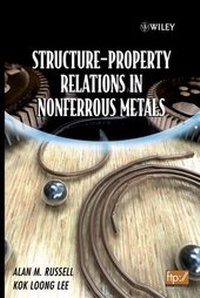
Structure-Property Relations in Nonferrous Metals
Description

Reviews / Votes
"...it contains a wealth of information on a wide variety of metalsfor which it is relatively difficult to locate information."(Materials and Manufacturing Process, January 2007) "...a text that is informative and useful for the practicingengineer, as well as interesting and instructional for the studentof metallurgy." (Journal of Metals Online, January 24,2006) "...well-written, illustrated, and presented...would be helpfulto junior/senior-level undergraduates, graduate students, faculty,and practicing metallurgists. An excellent acquisition for academicor industrial libraries." (CHOICE, November 2005)More details
Other editions
Additional editions
Persons
Content
PART ONE.
1. Crystal and Electronic Structure of Meals.
1.1 Introduction.
1.2 Crystal Structures of the Metallic Elements.
1.3 Exceptions to the Rule of the Metallic Bond.
1.4 Effects of High Pressure on Crystal Structure.
1.5 Effect of Electronic Structure on Crystal Structure.
1.6 Periodic Trends in Material Properties.
2. Defects and their Effects on Materials Properties.
2.1 Introduction.
2.2 Point Defects.
2.3 Line Defects (Dislocations).
2.4 Planar Defects.
2.5 Volume Defects.
3. Strengthening Mechanisms.
3.1 Introduction.
3.2 Grain Boundary Strengthening.
3.3 Strain Hardening.
3.4 Solid-Solution Hardening.
3.5 Precipitation Hardening (or Age Hardening).
4. Disclocations.
4.1 Introduction.
4.2 Forces on Dislocations.
4.3 Forces Between Dislocations.
4.4 Multiplication of Dislocations.
4.5 Partial Dislocations.
4.6 Slip Systems in Various Crystals.
4.7 Strain Hardening of Single Crystals.
4.8 Thermally Activated Dislocation Motion.
4.9 Interactions of Solute Atoms with Dislocations.
4.10 Dislocation Pile-ups.
5. Fracture and Fatigue.
5.1 Introduction.
5.2 Fundamentals of Fracture.
5.3 Metal Fatigue.
6. Strain Rate Effects and Creep.
6.1 Introduction.
6.2 Yield Point Phenomenon and Strain Aging.
6.3 Ultrarapid Strain Phenomena.
6.4 Creep.
6.5 Deformation Mechanism Maps.
6.6 Superplasticity.
7. Deviations from Classic Crystallinity.
7.1 Introduction.
7.2 Nanocrystalline Metals.
7.3 Amorphous Metals.
7.4 Quasicrystalline Metals.
7.5 Radiation Damage in Metals.
8. Processing Methods.
8.1 Introduction.
8.2 Casting.
8.3 Powder Metallurgy.
8.4 Forming and Shaping.
8.5 Material Removal.
8.6 Joining.
8.7 Surface Modification.
9. Composites.
9.1 Introduction.
9.2 Composite Materials.
9.3 Metal Matrix Composites.
9.4 Manufacturing MMCs.
9.5 Mechanical Properties and Strengthening Mechanisms in MMCs.
9.6 Internal Stresses.
9.7 Stress Relaxation.
9.8 High-Temperature Behavior of MMCs.
PART TWO.
10. Li, Na, K, Rb, Cs, and Fr.
10.1 Overview.
10.2 History, Properties, and Applications.
10.3 Sources.
10.4 Structure-Property Relations.
11. Be, Mg, Ca, Sr, Ba, and Ra.
11.1 Overview.
11.2 History and Properties.
11.3 Beryllium.
11.4 Magnesium.
11.5 Heavier Alkaline Metals.
12. Ti, Zr, and Hf.
12.1 Overview.
12.2 Titanium.
12.3 Zirconium.
12.4 Hafnium.
13. V, Nb, and Ta.
13.1 Overview.
13.2 History and Properties.
13.3 Vanadium.
13.4 Niobium.
13.5 Tantalum.
14. Cr, Mo, and W.
14.1 Overview.
14.2 Chromium.
14.3 Molybdenum.
14.4 Tungsten.
15. Mn, Tc, and Re.
15.1 Overview.
15.2 History and Properties.
15.3 Manganese.
15.4 Technetium.
15.5 Rhenium.
16. Co and Ni.
16.1 Overview.
16.2 Cobalt.
16.3 Nickel.
17. The Platinum Group Metals: Ru, Rh, Pd, Os, Ir, and Pt.
17.1 Overview.
17.2 History, Properties, and Applications.
17.3 Toxicity.
17.4 Sources.
17.5 Structure-Property Relations.
18. Cu, Ag, and Au.
18.1 Overview.
18.2 Copper.
18.3 Silver.
18.4 Gold.
19. Zn, Cd, and Hg.
19.1 Overview.
19.2 Zinc.
19.3 Cadmium.
19.4 Mercury.
20. Al, Ga, In, and Ti.
20.1 Overview.
20.2 Aluminum.
20.3 Gallium.
20.4 Indium.
20.5 Thallium.
21. Si, Ge, Sn, and Pb.
21.1 Overview.
21.2 Silicon.
21.3 Germanium.
21.4 Tin.
21.5 Lead.
22. As, Sb, Bi, and Po.
22.1 Overview.
22.2 Arsenic.
22.3 Antimony.
22.4 Bismuth.
22.5 Polonium.
23. Sc, Y, La, Ce, Pr, Nd, Pm, Sm, Eu, Gd, Tb, Dy, Ho, Er, Tm, Yb, and Lu.
23.1 Overview.
23.2 History.
23.3 Physical Properties.
23.4 Applications.
23.5 Sources.
23.6 Structure-Property Relations.
24. Ac, Th, Pa, U, Np, Pu, Am, Cm, Bk, Cf, Es, Fm, Md, No, and Lr.
24.1 Overview.
24.2 History and Properties.
24.3 Thorium.
24.4 Uranium.
24.5 Plutonium.
24.6 Less Common Actinide Metals.
25. Intermetallic Compounds: Their Promise and the Ductility Challenge.
25.1 Overview.
25.2 Bonding and General Properties.
25.3 Mechanical Properties.
25.4 Oxidation Resistance.
25.5 Nonstructural Uses of Intermetallics.
25.6 Stoichiometric Intermetallics.
25.7 Nonstoichiometric Intermetallics.
25.8 Intermetallics with Third-Element Additions.
25.9 Environmental Embrittlement.
Index.
