

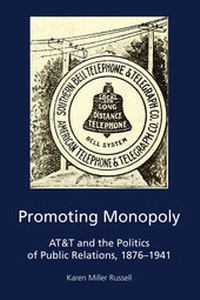
Promoting Monopoly
Description

Since the invention of the telephone in 1876, publicity has been central to the growth of the industry. In its earliest years the Bell company enjoyed a patent monopoly, but after Alexander Graham Bell's patents expired, it had to ?ght competitors, the public, and the U.S. government to maintain control of the telephone network. It used every means its executives could imagine, and that included constructing one of the earliest and most effective public relations programs of its time. This book analyzes the development of public relations at AT&T, starting with a previously forgotten publicist, William A. Hovey, and then including James D. Ellsworth and Arthur W. Page, who worked with other Bell executives to create a company where public relations permeated almost every aspect of work, leveraging employee programs, stock sales, and technological research for PR. Critics accused it of disseminating propaganda, but the desire to promote and protect the Bell monopoly propelled the creation of a corporate public relations program that also shaped the legal, political, media, and cultural landscape.
Reviews / Votes
"This is the book on AT&T's public relations that needed to be written. We knew AT&T was an early adopter of public relations. We knew the names of Vail, Ellsworth, Page, but little else. Karen Miller Russell fleshes out the story in a thoroughly researched and engagingly written book that provides a glimpse into the thinking of these and other men involved in promoting the idea that an AT&T monopoly was in the best interest of the American public."-Karla K. Gower, Director, Plank Center for Leadership in Public Relations, The University of AlabamaMore details
Other editions
Additional editions
Persons
Karen Miller Russell (Ph.D., University of Wisconsin-Madison) is Jim Kennedy Professor of New Media and Josiah Meigs Distinguished Teaching Professor at the University of Georgia. She is the author of The Voice of Business: Hill & Knowlton and Postwar Public Relations.
Content
List of Illustrations - Preface - Acknowledgements - "A Necessary Adjunct to Nearly All Commercial Enterprises": The Rise of Corporate Publicity in the United States - "To Undertake Something in the Missionary Line": William A. Hovey and Corporate Publicity at American Bell, 1876-1903 - "A Largely Random Basis": AT&T, Competition, and the Publicity Bureau, 1903-1907 - "One Policy, One System, Universal Service": Educating the Public, 1908-1913 - "We Are Really Governed by Publicity": Institutionalizing Public Relations, 1913-1926 - "To Serve Well We Must Earn Well": AT&T's Financial Policy and the Great Depression, 1927-1934 - "All Business in a Democratic Country . Exists by Public Approval": The FCC Investigation, 1935-1941 - Conclusion "The Number One Public Relations Post in Industry": AT&T in U.S. Public Relations History - Index.
