

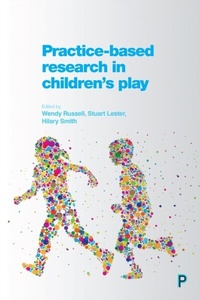
Practice-Based Research in Children's Play
1st Edition
Published on 8. March 2017
288 pages
978-1-4473-3005-9 (ISBN)
Description

This unique collection of 12 research projects carried out by experienced practitioners in the play sector in the UK and USA puts forward a range of perspectives on children's play and adults' relationships with it.
Drawing on a diverse range of research methodologies, the studies consider adults' memories of play; the co-production of spaces where children can play (in adventure playgrounds, out of school clubs, children's zoos, children's museums and public space); therapeutic approaches to playwork; playwork and wellbeing; supporting the play of severely disabled children and young people; play and contemporary art practice; and children's use of technology in a playground.
Offering a fresh look beyond the dominant singular voice of developmental psychology, this book is essential reading for anyone studying or working with children at play.
Drawing on a diverse range of research methodologies, the studies consider adults' memories of play; the co-production of spaces where children can play (in adventure playgrounds, out of school clubs, children's zoos, children's museums and public space); therapeutic approaches to playwork; playwork and wellbeing; supporting the play of severely disabled children and young people; play and contemporary art practice; and children's use of technology in a playground.
Offering a fresh look beyond the dominant singular voice of developmental psychology, this book is essential reading for anyone studying or working with children at play.
More details
Other editions
Additional editions
Book
03/2018
1st Edition
Policy Press
€43.40
Shipment within 15-20 days
Book
03/2017
1st Edition
Policy Press
€106.80
Shipment within 15-20 days
Wendy Russell | Stuart Lester | Hilary Smith
Practice-Based Research in Children's Play
E-Book
03/2017
1st Edition
Policy Press
€48.99
Available for download
Persons
Editor
University of Gloucester
Dr Wendy Russell is Senior Lecturer in Play and Playwork at the University of Gloucestershire, UK. Her research focuses on supporting children's right to play, particularly in terms of politics of space, policy and ethics.
Dr Wendy Russell is Senior Lecturer in Play and Playwork at the University of Gloucestershire, UK. Her research focuses on supporting children's right to play, particularly in terms of politics of space, policy and ethics.
University of Gloucester
Dr Stuart Lester is Senior Lecturer in Play and Playwork at the University of Gloucestershire, UK. Key research interests include the nature and value of children's play, playful production of time/space through everyday encounters and the conditions under which children's (and adults) playfulness may thrive.
Dr Stuart Lester is Senior Lecturer in Play and Playwork at the University of Gloucestershire, UK. Key research interests include the nature and value of children's play, playful production of time/space through everyday encounters and the conditions under which children's (and adults) playfulness may thrive.
University of Gloucester
Hilary Smith is the Course Leader for the MA Professional Studies in Children's Play and a Senior Lecturer in the School of Liberal and Performing Arts at the University of Gloucestershire, UK. Her research interests are in the realm of children's play and links with physical literacy, health and wellbeing.
Hilary Smith is the Course Leader for the MA Professional Studies in Children's Play and a Senior Lecturer in the School of Liberal and Performing Arts at the University of Gloucestershire, UK. Her research interests are in the realm of children's play and links with physical literacy, health and wellbeing.
Contributions
University of Gloucestershire
University of Gloucestershire
Wrexham County Borough Council Safeguarding Support
The New Children's Museum, San Diego
Snug
Every Day a New Adventure
Content
Foreword ~ Berry Mayall;
Perspectives on play research: the practice-theory-research entanglement ~ Wendy Russell, Stuart Lester and Hilary Smith;
Part One: Then and now: historical perspectives;
Nostalgia and play ~ Paula Harris;
Debris and delight: children's play during the second world war ~ Becky Willans;
Adventure playgrounds and me: bringing the past into the auto-ethnographic present ~ Tom Williams;
Part Two: Here and there, this and that: spatial and creative perspectives;
Dancing with strangers: observing play in an English public square ~ Hattie Coppard;
Researching children's play and contemporary art ~ Megan Dickerson;
Play and value: determining the values of a nature play setting ~ Linda Kinney;
Your space or mine? Play in out of school clubs ~ Rebekah Jackson;
Co-creating spaces on an adventure playground: using participatory action research as an approach to continuing professional development ~ John Fitzpatrick and Bridget Handscomb;
Children, mobile phones and outdoor play ~ Chris Martin;
Part Three: Playfulness and wellbeing;
Understandings of play for children with profound and multiple learning disabilities (PMLD) ~ Stephen Smith;
Therapeutic playwork: exploring playworkers' perceptions of therapeutic playwork training and its usefulness in supporting children in afterschool clubs ~ Claire Hawkes;
Play, playwork and wellbeing ~ Nic Matthews, Hilary Smith, Denise Hill and Lindsey Kilgour;
Part Four: Closing thoughts;
What do we want research in children's research to do? ~ Wendy Russell, Stuart Lester and Hilary Smith
Perspectives on play research: the practice-theory-research entanglement ~ Wendy Russell, Stuart Lester and Hilary Smith;
Part One: Then and now: historical perspectives;
Nostalgia and play ~ Paula Harris;
Debris and delight: children's play during the second world war ~ Becky Willans;
Adventure playgrounds and me: bringing the past into the auto-ethnographic present ~ Tom Williams;
Part Two: Here and there, this and that: spatial and creative perspectives;
Dancing with strangers: observing play in an English public square ~ Hattie Coppard;
Researching children's play and contemporary art ~ Megan Dickerson;
Play and value: determining the values of a nature play setting ~ Linda Kinney;
Your space or mine? Play in out of school clubs ~ Rebekah Jackson;
Co-creating spaces on an adventure playground: using participatory action research as an approach to continuing professional development ~ John Fitzpatrick and Bridget Handscomb;
Children, mobile phones and outdoor play ~ Chris Martin;
Part Three: Playfulness and wellbeing;
Understandings of play for children with profound and multiple learning disabilities (PMLD) ~ Stephen Smith;
Therapeutic playwork: exploring playworkers' perceptions of therapeutic playwork training and its usefulness in supporting children in afterschool clubs ~ Claire Hawkes;
Play, playwork and wellbeing ~ Nic Matthews, Hilary Smith, Denise Hill and Lindsey Kilgour;
Part Four: Closing thoughts;
What do we want research in children's research to do? ~ Wendy Russell, Stuart Lester and Hilary Smith
